Last updated: August 20, 2026
Some links on this page are affiliate links. If you buy through them we may earn a commission at no extra cost to you. See our affiliate disclosure.
Search for a grab bar and the results look like variations on a theme: metal tubes of different lengths in a handful of finishes. Look closer and there are straight bars, angled bars, wave shaped bars, L shaped corner bars, flip up bars, bars with a shelf, bars with a toilet roll holder, and bars that double as a towel rail.
Each shape exists because it suits a particular movement better than a straight bar does. Knowing which is which turns a confusing catalogue into a short list, so this guide walks through every common type, what it is for, and where it is the wrong choice.
Quick Answer
What are the different types of grab bars?
- Straight bars, mounted horizontally, vertically, or diagonally, cover most needs and are the most flexible starting point.
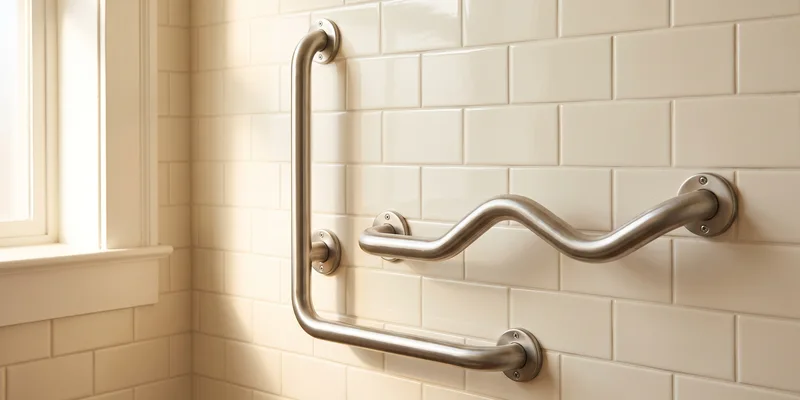
- Angled and wave shaped bars follow the arc of a hand rising during a sit to stand movement.
- Corner and L shaped bars cover two planes at once, which suits corner showers and tub corners.
- Flip up bars mount to a single wall and fold away, which solves a toilet with no side wall.
Bottom line: the shape follows the movement, so decide what the hand needs to do before comparing products.
Shape Follows the Movement
Every grab bar shape is an answer to a question about how a hand travels. A hand that stays in one place wants a short bar or a knob. A hand that slides along a wall wants a long horizontal one. A hand that rises and moves forward at the same time wants an angle.
Starting from the movement rather than the product avoids the most common shopping mistake, which is buying the shape that fits the wall and then discovering it fights the way the person actually moves. Our guide to where to place grab bars covers how to identify the movement first.
Orientation Is a Choice, Not a Property
A straight bar is not a horizontal bar. The same product mounts horizontally for steadying, vertically for pulling up while stepping over an edge, or diagonally as a compromise between the two. That flexibility is why straight bars remain the default even though specialised shapes exist.
The Common Shapes and What They Do
The list below covers what you will actually encounter when shopping, in rough order of how often each is used at home.
Straight Bars
The workhorse, available in a wide range of lengths and every common finish. Short lengths suit a single fixed handhold, long ones suit a wall the hand travels along. Because a longer bar spans more framing, it is often easier to land screws in two studs, which makes installation simpler as well.
Angled and Wave Bars
An angled bar rises across the wall at a fixed angle; a wave bar curves through the same path. Both follow the natural arc of a hand as the body stands up, which is why they turn up beside toilets and at shower entries where a horizontal bar would twist the wrist at the end of the movement.
Corner and L Shaped Bars
These cover a horizontal and a vertical run in one piece, which suits corner showers, neo angle enclosures, and the corner of a bathtub. They fix the relationship between the two runs, so check the projection dimensions against door swings and shower walls before ordering.
Flip Up and Fold Down Bars
Mounted to one wall and hinged so they swing up out of the way, these solve a toilet with no adjacent side wall. All the load lands on a single mounting plate, so the wall behind needs solid framing or proper blocking, and the stated weight rating is worth reading closely.
Bars With a Second Function
Combination bars pair a support with a toilet paper holder, a small shelf, a towel ring, or a soap dish. They appeal where wall space is scarce and where a household would rather the bathroom did not announce itself. Check that the load rating applies to the bar and that the accessory does not sit where a hand would land.
Tub Mounted and Freestanding Types
Clamp on tub rails grip the rim of a bathtub, tension mounted poles brace between floor and ceiling, and freestanding toilet frames stand on the floor. None of them fix to a wall, which makes them the practical answers for rentals and difficult walls. Our guide to no drill grab bars compares them.
Materials, Finishes, and Grip
Shape decides the job; material and surface decide whether the bar is pleasant to use in a wet room. Stainless steel is the default for its corrosion resistance, and the surface treatment is where the real difference in grip lies.
| Option | What it means in use |
|---|---|
| Satin or brushed stainless | Corrosion resistant, hides water spots, the standard wet area choice |
| Polished chrome | Looks bright, becomes slick under soapy water, shows every mark |
| Powder coated or painted | Color options, including high contrast; check the coating suits wet areas |
| Knurled or peened surface | Textured gripping section that holds up with wet hands |
| Nylon or vinyl coated | Warmer to the touch and often available in strong colors for visibility |
| Concealed flange | A cover conceals the screws for a cleaner look; the fixing underneath is what matters |
Color is worth a thought as well as texture. A bar that contrasts strongly with the wall behind it is easier to see, which matters more than styling in a steamy bathroom or a dimly lit one.
Sizing: Length, Diameter, and Clearance
Three dimensions decide whether a bar fits the hand and the wall. Length should cover the movement, diameter should be comfortable to wrap, and there needs to be enough space behind the bar for the fingers to pass.
The ADA Standards for Accessible Design apply to public and commercial facilities rather than homes, and they give useful reference numbers: a circular cross section of 1 and 1/4 to 2 inches, 1 and 1/2 inches of clearance between bar and wall, and the top of the gripping surface 33 to 36 inches above the floor. Our breakdown of ADA grab bar height covers those in detail.
Matching the Shape to the Person
Grip strength, hand size, reach, and whether someone pulls or pushes to rise all change which shape works best. If you are unsure what fits your situation, ask your doctor or an occupational therapist, who can watch the movement and often suggests a shape the family had not considered.
Which Shape Suits Which Spot
To bring it together, here is where each shape most often ends up in a home. Treat it as a starting point and correct against the movement you actually observe.
Vertical straight bars go at tub and shower entries. Long horizontal straight bars go on shower and tub walls. Angled or wave bars go beside toilets and at shower entries where the movement is diagonal. Corner bars go in corner enclosures. Flip up bars go beside toilets with no side wall. Clamp on rails go on tub rims, and tension poles go anywhere with no usable wall.
Frequently Asked Questions
What is the difference between a straight and an angled grab bar? A straight bar gives one consistent line to hold and mounts in any orientation; an angled bar follows the arc of a hand rising during a sit to stand movement, which many people find more comfortable at the end of that movement.
What is a wave grab bar? A bar with a curved profile that combines a horizontal section and a rising section in one piece, so the hand can steady and then rise without letting go.
When should I use a flip up grab bar? Beside a toilet with no adjacent side wall, or where a fixed bar would block a doorway or walking route. Because the load concentrates on one mounting plate, the wall behind it needs solid framing or blocking.
Are corner grab bars useful? In corner and neo angle showers and at tub corners, yes, since they cover two planes from one installation. Check the projection dimensions against any door swing before ordering.
Do grab bars with shelves work as well as plain ones? They can, since the strength comes from the bar, flange, and mounting. Check that the stated weight rating applies to the bar itself and that the shelf does not occupy the spot where a hand naturally lands.
What diameter should a grab bar be? Comfortable to wrap fully. The ADA standard for public facilities specifies a circular cross section between 1 and 1/4 and 2 inches, which is a sensible range to shop within at home.
Are colored grab bars a good idea? Often. A bar that contrasts with the wall is easier to see in steam or low light, and coated bars are also warmer to the touch than bare metal.
Which shape is best overall? There is no single best shape, only the one that matches the movement in that spot. Most homes end up mixing two or three, and our grab bar buying guide covers how to choose.
The Bottom Line
Grab bar shapes are answers to different movements: straight for steadying and traveling along a wall, angled or wave for rising, corner for two planes, flip up for a toilet without a side wall, and clamp or tension types where no wall works. Choose texture over shine in a wet room, keep the diameter comfortable to wrap, and see our buying guide and placement guide to put it together.