Last updated: August 20, 2026
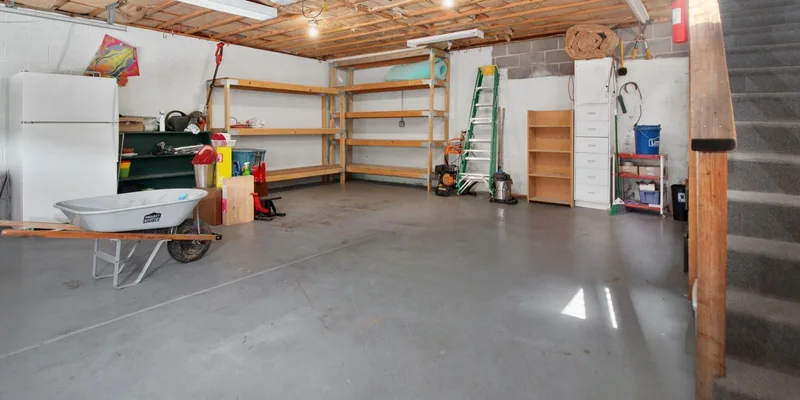
Garages and basements are the two rooms in an American house that were never really finished. The stairs into them are steeper than the ones upstairs, the handrail often stops halfway or was never installed at all, the light is a single bulb on a pull chain, and the floor is bare concrete with a step down into it that nobody remembers is there.
They also hold the freezer, the water heater, the laundry, the circuit breaker panel, and everything else that has to be reached occasionally. Writing them off is not practical, so the useful approach is to fix the stairs and the light first, then think about what needs to be stored down there at all.
This article contains affiliate links. If you buy through them, we may earn a commission at no extra cost to you. Learn more.
Quick Answer
What should you fix first in a garage or basement?
- The stairs: a continuous handrail that runs the full flight, ideally on both sides, plus grip on the treads if they are bare wood or painted concrete.
- The light: a switch at the top and the bottom of the stairs, so nobody starts down a dark flight to find a pull chain in the middle of the room.
- The step into the garage from the house, which is usually a single high step with nothing to hold, and the storage that has drifted above shoulder height.
Bottom line: these are stair and lighting rooms first. Get down and back up safely, then worry about the shelving.
Why These Two Rooms Behave Differently
Everywhere else in the house, the building code that governed the stairs was written with daily living in mind. Basement stairs, attic pull-downs, and the step from the house into an attached garage were often treated as utility access, which in practice means steeper flights, narrower treads, an open side with no rail, and lighting that was an afterthought.
Add cold concrete, dust, and the fact that people usually go down there carrying something, and it becomes clear why these rooms deserve their own walkthrough rather than a line on a general checklist.
The Stairs Are the Whole Problem
Start with the handrail. It should run the entire length of the flight, including the top and bottom steps, and it should be graspable, which a flat two-by-four nailed to the wall is not. Where the stairs have an open side, a rail on that side is usually the biggest single improvement available in the whole house.
Then look at the treads. Bare wood, painted wood, and smooth concrete all get slick, particularly when shoes come in wet from the garage. Adhesive non-slip strips or stair treads add grip without a rebuild, and a strip of contrasting color along the front edge of each step makes the edges visible, which matters more than most people expect in a dim stairwell.
Where the Handrail Stops Short
A rail that ends before the last two steps is a common and easily missed problem, because those last steps are exactly where somebody lets go and reaches for the floor. Extending an existing rail is straightforward carpentry. Our guides to indoor stair handrail options and making stairs safer without remodeling cover the approaches, and ADA stair and step dimensions gives the reference figures, noting that those standards apply to public buildings rather than houses.
Light Before the First Step
The rule is simple: the light for a stairway should be switchable from the top and from the bottom. A pull chain hanging in the middle of a basement is a design that requires walking down a dark flight to reach it, which is the exact thing to avoid.
If rewiring a three-way switch is not on the table, a motion-activated fixture at the head of the stairs, or a battery-powered light with a motion sensor mounted at the top and bottom, closes the gap without an electrician. Our guide to motion sensor lights and emergency lighting for power outages cover both the routine and the outage case, which matters because basements go completely dark when the power drops.

The Step From the House Into the Garage
Attached garages almost always have a single step down from the house door, often a tall one, sometimes with a threshold on top of it. There is rarely anything to hold, the door itself swings in the way, and people go through it carrying groceries.
Three things help. A grab handle mounted beside the door gives something to hold at the moment of stepping down. A half step or a small platform breaks a tall rise into two shorter ones. And a threshold ramp handles the lip itself where the height difference is small. Our guides to half steps for entry, entry door grab handles, and threshold ramps cover which suits which situation.
Garage and Basement Checkpoints
| Checkpoint | What to look for | Common fix |
|---|---|---|
| Handrail | Full length, both sides, graspable | Extend it or add a second rail |
| Treads | Slick surface, invisible edges | Non-slip treads, contrast edging |
| Stair lighting | Switch at top and at bottom | Motion light at each end |
| Garage step | Tall single rise, nothing to hold | Half step and a grab handle |
| Floor | Oil, damp, dust on concrete | Clean it, add a grippy mat |
| Storage height | Anything above shoulder height | Move it down or move it out |
| Step ladders | Being used for routine items | Relocate the items instead |
| Freezer and breaker | How often they are reached | Relocate what is used weekly |
| Clutter | Boxes narrowing the walkway | Clear one path all the way through |
Storage, Ladders, and the Overhead Habit
Garages accumulate storage upward. Once the useful shelves are full, things go on top of the cabinets, into the rafters, and onto hooks that need a step ladder. That habit is easy to keep and awkward to unwind, but it is worth unwinding, because a step ladder on a concrete floor is a different proposition at seventy-five than it was at fifty.
The practical version is not a total reorganization. It is picking out the ten things that are actually reached during a normal year, moving those to between hip and shoulder height, and leaving the rest wherever it is until somebody younger is visiting.
Reaching Without Climbing
A long-handled reacher covers a surprising amount of what used to need a step, particularly light items on a shelf just out of range. It does not replace a ladder for anything heavy, and nothing should be lifted overhead from a ladder in the first place. Our reacher grabber guide covers what these tools can and cannot do.
What This Page Deliberately Does Not Cover
Two things. First, whether these stairs should still be used at all is a question about the person, not the building, and it belongs with a doctor or an occupational therapist rather than with a checklist. If you are unsure what fits your situation, ask one of them, and ask before rather than after a change in how somebody moves.
Second, we do not recommend stairlifts here. Selection, fitting, and installation depend on the specific staircase and are handled by installers rather than by a product page, so the useful version of this article stops at handrails, treads, and light. For the broader picture, see our home modifications guide and the entryway and stairs checklist.
Frequently Asked Questions
Should basement stairs have handrails on both sides? Two rails give a hand on either side and a choice of which one to use going up and coming down, which is why they are commonly recommended for stairs used daily. At minimum, the existing rail should run the full flight rather than stopping short of the top or bottom step.
How do I make concrete basement stairs less slippery? Adhesive non-slip treads or grip tape sized to the step are the usual answer, and they go on without any rebuilding. Clean and fully dry the surface first, and follow the manufacturer’s stated curing time before the stairs go back into normal use.
What is the best lighting for a basement stairway? A fixture controlled by a switch at both the top and the bottom of the flight. If wiring a three-way switch is not practical, motion-activated lights at each end achieve the same result without walking into the dark.
How can I make the step into the garage easier? A grab handle beside the door gives something to hold, and a half step or small platform splits a tall single rise into two shorter ones. Where the difference is only a lip rather than a step, a threshold ramp is usually enough.
Is it worth moving the freezer or the laundry out of the basement? If either is used weekly, it is worth pricing out. Removing a routine reason to use the stairs is more effective than any improvement to the stairs themselves, though it is obviously a bigger job.
What about the garage floor itself? Concrete stays slippery where oil has soaked in and where water tracks in from the car. Clean the oiled patches, keep a grippy mat at the door, and be aware that concrete dust makes a smooth floor slicker than it looks.
Do you recommend a stairlift for basement stairs? We do not cover stairlifts. They depend heavily on the specific staircase and are sold and fitted through installers, so a general recommendation would not be useful. Handrails, tread grip, and lighting are what this site covers.
The Bottom Line
Garages and basements are stair problems wearing a storage costume. Run the handrail the full length of the flight, add grip and edge contrast to the treads, get a light switch at both ends, and put a grab handle beside the step into the garage. After that, bring the ten things that actually get used down to between hip and shoulder height and leave the rest alone. Our entryway and stairs checklist covers the same ground for the front of the house.