Last updated: August 20, 2026
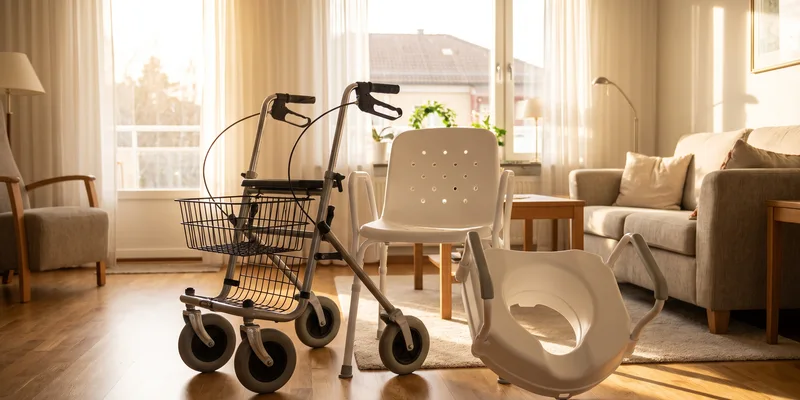
Grab bars, shower chairs, raised toilet seats, bed rails, rollators, ramps: the shopping list for making a home safer runs long, and somewhere in the middle of it most families ask whether any of it is handled by Medicare. The honest answer is that it depends on the item, on the plan, and on the individual situation, and that no website is in a position to tell you which.
This overview explains how the question is put together, which official sources give real answers, and what to ask so you spend your time on the right conversations. We have no role in any claim and nothing here is coverage advice.
This article contains affiliate links. If you buy through them, we may earn a commission at no extra cost to you. Learn more.
Quick Answer
How does Medicare treat home safety equipment?
- It varies by item, by plan, and by individual situation, so a single yes or no does not exist for the category.
- The official source is medicare.gov, plus the member documents of whichever plan the person actually holds.
- Free, independent counseling is available in every state through the State Health Insurance Assistance Program, listed on medicare.gov.
Bottom line: treat every item as its own question, and get the answer from the official source rather than from a retailer.
Why the Answer Differs by Item
Home safety products are not a single category in program terms. Some items are discussed as equipment, some are discussed as home modifications, and some are treated as ordinary household purchases. Those distinctions are made in the program’s own materials, and they do not follow the way a shopping list is organized.
That is why a general article, including this one, cannot map a shopping list onto coverage. Each item has to be asked about individually, and the answer for one household does not carry over to the next even when the products are identical.
Original Medicare Versus Private Plans
Someone can be enrolled in the original federal program, or in a plan administered by a private insurer, or hold supplemental coverage alongside either. These are governed by different documents, and rules that apply in one arrangement are not automatically the rules in another.
Before you look anything up, establish which of these the person actually has. It is printed on the card and in the annual member materials, and getting it right saves reading rules that do not apply to them.
Coverage Rules Are Updated
Program details change over time, which is the second reason to go to the source rather than to a summary. An article that was accurate when it was written can quietly stop being accurate, and there is nothing on the page to signal that. Medicare.gov reflects the current position.
Where to Get a Real Answer
| Source | What it can tell you |
|---|---|
| medicare.gov | The current official rules and the coverage lookup tool |
| The plan’s member services | What applies under that specific plan and what documentation is required |
| State SHIP counseling | Free, independent help with an individual case |
| The treating doctor | What can be documented and which forms they complete |
| The supplier | Whether they participate and how they handle paperwork |
| Area Agency on Aging | Local programs, lending closets, and referrals |
Note who is missing from that list: retailers, affiliate sites, and product pages. None of them are in a position to speak to a coverage question, ours included.
The Practical Sequence
Establish which plan the person holds, then take the items one at a time rather than as a list. For each, ask member services what applies and what documentation would be needed, and ask the doctor’s office what they are able to provide. Only then decide where to buy.
Doing it in that order matters because some paperwork has to exist before a purchase rather than after. Buying first and asking second is the sequence that most often leaves families stuck, and with heavy items like a lift chair or a bed rail, returns are difficult.
Keep a Simple Record
Write down the date of each call, who you spoke to, and what they said. When two sources give different answers, and they sometimes do, that record turns a frustrating repeat conversation into a short one. Families handling this on a parent’s behalf consistently say this is the thing they wish they had started sooner.
Other Routes Families Look At
Medicaid is administered by each state and its rules differ accordingly, so it has to be checked with your own state’s program. Veterans may have options through the VA. Some states and counties run home modification or safety programs of their own, and an Area Agency on Aging is usually the quickest way to find out what exists locally.
Local lending closets, often run by non-profits, churches, or community organizations, lend or resell used equipment such as rollators, shower chairs, and commodes. Availability is entirely local, and the same Area Agency on Aging can usually tell you whether one operates nearby.
Watch Out for Sellers Who Sound Certain
Some sellers advertise home safety products with confident claims about coverage. Certainty is a warning sign in a question that genuinely depends on individual circumstances. If a seller states plainly what will happen with your claim, ask them to put it in writing and verify it with the plan.
The same applies to unsolicited calls about home medical equipment. If someone contacts you offering equipment on behalf of a program, take their details and check independently through medicare.gov or the number on the card rather than acting on the call.
A Note on Getting Advice
Nothing here is coverage advice, and we are not an insurance adviser. For coverage, use medicare.gov, the plan itself, and your state’s free SHIP counseling. For which equipment actually suits someone at home, ask your doctor or an occupational therapist, who can assess how the person moves rather than working from a product list.
Frequently Asked Questions
Does Medicare handle home safety equipment? It varies by item, by plan, and by individual situation, so there is no single answer for the category. The official information is at medicare.gov and in the person’s plan documents.
Are grab bars and shower chairs treated the same way? Not necessarily. Different products sit in different categories in the program’s own materials, which is why each item has to be asked about separately.
Who gives an answer specific to my parent? The plan’s member services line, the treating doctor’s office, and your state’s free SHIP counseling service. Retail sites cannot.
What is SHIP? The State Health Insurance Assistance Program, a free counseling service available in every state, independent of any seller. Contact details are listed on medicare.gov.
Should I buy the equipment first? Ask first. Some documentation has to be in place before a purchase, and heavy items are difficult to return.
What about Medicaid or veterans’ benefits? Both have separate rules, and Medicaid is administered by each state individually. Contact those programs directly.
Are there cheaper routes to equipment? Local lending closets run by non-profits and community groups lend or resell used equipment in some areas. An Area Agency on Aging can tell you what operates near you.
A company called offering me equipment. Is that normal? Take their details and verify independently through medicare.gov or the number on the card before agreeing to anything.
The Bottom Line
Medicare and home safety equipment is not one question but a series of them, one per item, and the answers depend on the plan and the individual situation. Establish which plan the person holds, ask about each item separately through medicare.gov and member services, use the free SHIP counseling in your state, and keep a record of every call. For the equipment decisions themselves, our home modifications overview and aging in place checklist are the place to start.