Last updated: August 20, 2026
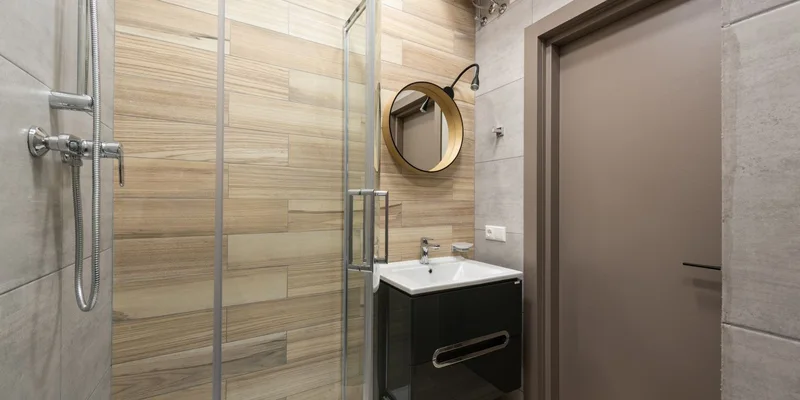
A lot of American bathrooms have a shower stall around 32 by 32 inches, and a standard shower chair with arms simply does not go in one. What usually happens next is that a chair gets bought anyway, wedged in at an angle, and then used with the door half open, which is worse than having no chair at all.
Small showers have their own set of answers: corner stools, narrow-footprint seats, wall mounted fold-down seats, and in some cases a rethink of the enclosure itself. This guide covers each option, how to measure properly, and what to give up when the floor area simply is not there.
This article contains affiliate links. If you buy through them, we may earn a commission at no extra cost to you. Learn more.
Quick Answer
What shower chair fits a small shower?
- A corner stool uses the triangle of floor a square seat wastes, and is usually the most seating you can fit into a compact stall.
- A wall mounted fold-down seat takes no floor area at all, but needs solid backing behind the wall surface.
- Measure the internal floor, not the outer stall dimensions, and measure the door opening separately, since that is often the real limit.
Bottom line: in a compact stall, the corner and the wall are the two places seating can go.
Measure the Inside, Not the Outside
Stall dimensions quoted by manufacturers are usually the outside footprint, and the usable interior is smaller once the frame, the door track, and any tiled curb are accounted for. Measure the internal floor at the widest and narrowest points, since neo-angle and quadrant stalls are not square inside.
Then measure the door opening on its own. Sliding doors give a narrower usable opening than the stall width suggests, and hinged doors that open inward take some of the floor with them. A chair that fits the stall but not the opening is still a chair that will not go in.
The Third Measurement People Forget
Note where the valve and shower head sit relative to the corner you plan to put the seat in. A seat that fits perfectly but leaves the controls out of reach means either standing to adjust the water or having someone else do it. A handheld shower head on a long hose usually solves this.
Corner Stools
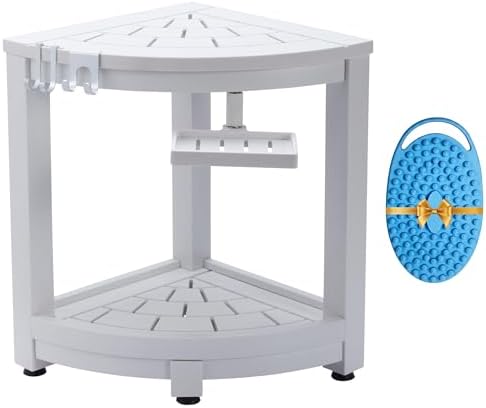
A corner stool has a triangular or shaped seat designed to sit into a corner, which uses floor space a rectangular chair leaves empty. It is generally the highest usable seat area you can get into a compact stall, and many models still offer adjustable legs and a small backrest along one edge.
What you give up is armrests and, on most models, a full backrest. For someone with steady sitting balance who mainly needs to stop standing, that is an acceptable trade. For someone who needs to push up on arms to stand, a grab bar in the right position has to do that job instead.
Wall Mounted Fold-Down Seats
Fold-down seats remove the floor problem entirely, because nothing stands on the floor when the seat is up. In a small stall that is a genuine advantage: the shower stays usable for everyone else, and there is no chair to carry in and out.
The constraint is the wall. A seat carrying an adult’s weight has to reach studs or purpose-installed blocking, and cannot be fixed into tile and backer board alone. If the wall build-up is unknown, that is a question for a contractor. Models with a fold-down support leg spread the load and are often easier to fit where backing is limited.

Narrow Freestanding Stools
Some ordinary shower stools are built on a deliberately compact footprint, with a smaller seat and legs that do not splay far. They fit where a full chair will not, need no installation, and can be lifted out when someone else wants the shower.
Look for a seat that is genuinely usable rather than just small, height-adjustable legs, and wide rubber tips. Stability comes largely from the leg stance, so a stool with legs that angle slightly outward tends to feel steadier than one with perfectly vertical legs on the same footprint.

The Options Compared
| Option | Floor space used | Main trade-off |
|---|---|---|
| Corner stool | Corner triangle only | Usually no arms, limited back |
| Wall mounted fold-down | None when folded up | Needs solid backing, fixed height |
| Narrow freestanding stool | Small rectangle | Smaller seat, carried in and out |
| Standard chair with arms | Full footprint | Often will not fit at all |
| Transfer bench | Spans a tub rim | Only applies to bathtubs, not stalls |
When the Shower Is the Problem
Sometimes no seat fits well, and the honest answer is that the enclosure itself is the limiting factor. In that situation the choices are a wall mounted seat installed during a wider bathroom change, or moving bathing to a different bathroom in the house if one exists.
Where a renovation is already being considered, this is the moment to plan seating and grab bar backing together, because both are far cheaper to do while the wall is open. Our guide to home modifications covers how these decisions tend to group together.
Making a Small Shower Work Around the Seat
Once a seat is in, the rest of the setup matters more than usual because there is no room to compensate. A handheld shower head with a long hose lets a seated user rinse without standing, and a slide bar keeps it within reach from the seat rather than from standing height.
A grab bar takes on extra importance in a stall without armrests, since it is the only fixed thing to push against. Position it with the seat in place, and see our guides on shower grab bars and placement for the specific positions.
Common Mistakes
- Measuring the stall from the outside. The usable interior is smaller once frame, track, and curb are counted.
- Forgetting the door opening. Sliding doors narrow the effective entry well below the stall width.
- Buying a chair with arms and hoping. A chair used at an angle with the door open is not a solution.
- Mounting a fold-down seat into tile alone. Fixings have to reach studs or added blocking.
- Placing the seat out of reach of the controls. Check the valve position before deciding on a corner.
- Skipping the grab bar. Without armrests, the bar is what makes standing up manageable.
When to Ask for Guidance
Compact bathrooms often need a compromise, and which compromise is acceptable depends on the person rather than the room. Occupational therapists commonly look at how someone moves through a bathroom and suggest the arrangement that fits both. If you are unsure what fits your situation, ask your doctor or an occupational therapist.
Frequently Asked Questions
What is the smallest shower chair available? Corner stools and narrow compact stools have the smallest footprints among freestanding options. A wall mounted fold-down seat takes no floor space at all when folded up.
Will a shower chair fit a 32 by 32 stall? A corner stool or a narrow stool usually will; a full chair with armrests usually will not. Measure the internal floor and the door opening and compare both against the listing.
Are corner shower stools stable? They are designed to sit into a corner with the legs spread across the available floor. Check for adjustable legs and wide rubber tips, and set all legs so the seat sits level on an uneven shower floor.
Can I fit a fold-down seat myself? Only if you can confirm the fixings reach studs or blocking. Tile and backer board alone will not hold a seat carrying an adult’s weight, so involve a contractor where the wall build-up is unknown.
Do I still need a grab bar with a corner stool? It becomes more important, not less, because corner stools rarely have armrests. A properly anchored bar gives the fixed handhold the stool does not provide.
What about a shower stall with a curb? A curb affects entry rather than seating. Keep the chair type decision separate and look at the entry step on its own, since a handhold at the entry is a different position from one beside the seat.
The Bottom Line
In a small shower the seating goes in the corner or on the wall, and the choice between them comes down to whether the wall has solid backing and whether a fixed height works. Measure the internal floor and the door opening before ordering anything, expect to give up armrests, and make the grab bar do that job instead. For the full comparison of seat types across all bathroom sizes, see our shower chair guide.