
Last updated: August 20, 2026
In a bathroom with a standard tub, the hard part is almost never the washing. It is the moment of lifting one leg over a rim while balancing on the other, on a wet floor, with nothing solid to hold. A transfer bench exists specifically for that moment, and it is a different product from a shower chair despite being sold alongside them.
This guide covers how a transfer bench works, how to check that one will fit your tub and bathroom, the sliding and swivel variations, and the water containment problem every bench creates. It also covers when a shower chair is the better answer instead.
This article contains affiliate links. If you buy through them, we may earn a commission at no extra cost to you. Learn more.
Quick Answer
What does a bathtub transfer bench do?
- It spans the tub rim, with two legs outside the tub and two inside, so the person sits down outside and slides across instead of stepping over.
- Fit depends on tub wall height, the internal tub width, and whether the bathroom has floor space beside the tub for the outer legs.
- Every bench breaks the shower curtain line, so plan a split curtain or a curtain that tucks inside before the first use.
Bottom line: a transfer bench removes the step over the rim, which a shower chair inside the tub does not.
How a Transfer Bench Works
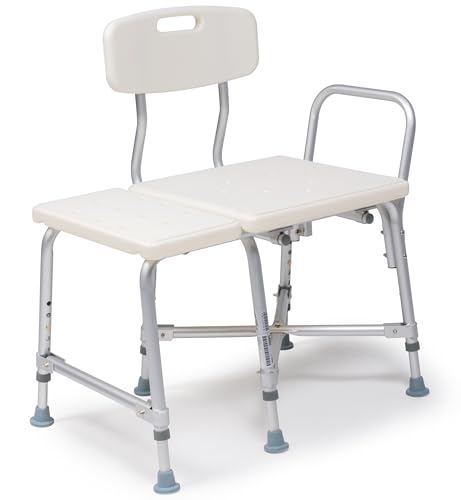
A transfer bench is a wide seat on four independently adjustable legs. Two legs stand on the bathroom floor beside the tub and two stand inside the tub, so the seat crosses the rim as a continuous surface. The person sits on the outer section, then moves along the seat until they are inside the tub area.
That sequence is the whole point. Sitting is done on stable ground, the leg lift over the rim happens while seated rather than while balancing, and both hands stay free to hold the bench or a grab bar. Many families use one for exactly this reason, and it is commonly suggested by occupational therapists when a tub is the only bathing option in the house.
Transfer Bench Versus Shower Chair
The two products solve different problems. A shower chair gives a place to sit once you are already inside the enclosure. A transfer bench addresses getting in and out. If stepping over the rim is manageable and only standing is the difficulty, a chair is simpler, cheaper on space, and easier to store.
Where both would work, the deciding factor is usually the tub. Walk-in showers take chairs; standard bathtubs with a rim around 15 to 20 inches high are where benches earn their place. Some households end up with both, using a chair in one bathroom and a bench in another.
| Situation | Transfer bench | Shower chair |
|---|---|---|
| Standard bathtub | Designed for it | Leaves the rim step unsolved |
| Walk-in shower | Not applicable | The right product |
| Stepping over is the problem | Yes | No |
| Standing is the problem | Yes | Yes |
| Floor space needed outside | Room for two legs and the seat | None |
| Curtain arrangement | Needs rethinking | Usually unchanged |
Measuring for Fit
Take four measurements. The height from the bathroom floor to the top of the tub rim, the internal height from the tub floor to the rim, the internal width of the tub, and the clear floor space beside the tub where the outer legs will stand. All four appear as constraints on product listings.
Then check the leg adjustment ranges. Because the inside legs sit lower than the outside ones, benches use independently adjustable legs with different ranges, and a tub that is unusually deep or shallow can fall outside a given model’s range. Sloped or contoured tub floors are worth noting too, since the inner legs need a stable place to stand.
Tubs With a Wide or Tiled Rim
Alcove tubs with a wide tiled deck, or tubs with a curved outer rim, change where the seat can bridge. Some benches include a backrest that clamps to the seat and can be positioned to clear an obstruction. Check the seat length against the total span you actually need to cover rather than the tub width alone.
Sliding and Swivel Benches
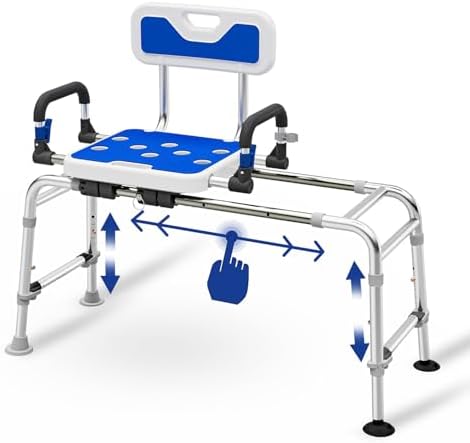
A standard bench requires the user to shuffle along a fixed seat. A sliding bench adds a seat that moves along a track, and a swivel bench adds a seat that rotates, so the person sits, turns, and slides rather than shuffling. Both reduce the effort of the move itself.
The trade-off is complexity and size. Sliding and swivel mechanisms add moving parts that need to lock reliably, and the frames are usually larger, which matters in a small bathroom. Test the lock on arrival and make locking a fixed step in the routine rather than an occasional check.

Heavier Duty and Wider Benches
Bariatric transfer benches use wider seats, thicker tubing, and additional bracing. Take the stated weight capacity from the listing for the exact model, and check the seat width against both the user and the clear floor space outside the tub, since a wider bench needs more room on the bathroom side.
The Shower Curtain Problem
A bench crosses the curtain line, which means water will find the bathroom floor unless the curtain arrangement changes. The usual solutions are a split curtain where one panel goes inside the tub and one outside, or a curtain with a cut and overlap at the bench position.
Handle this before the first shower rather than after. A wet bathroom floor is a hazard in its own right, and it also tends to be the reason a bench stops being used after the first week. A handheld shower head helps, because it keeps the spray aimed down rather than across.
What Else the Setup Needs
Two additions turn a bench from workable into comfortable. A handheld shower head on a long hose lets a seated user rinse without leaning or standing, and a grab bar or a clamp-on tub rail gives something solid to hold during the slide across.
Position the handhold with the bench in place, since the useful position with a bench differs from the useful position without one. Our guides on bathtub safety rails and handheld shower heads cover both, and using a transfer bench walks through the movement itself.
Common Mistakes
- Buying before measuring the rim height. Leg adjustment ranges are finite, and deep or shallow tubs fall outside some models.
- Forgetting the floor space outside. Two legs and part of the seat need room beside the tub.
- Ignoring the curtain. Plan the split curtain before the first shower rather than after mopping the floor.
- Using it in a tub with sliding glass doors. The door track usually blocks a bench; the doors have to come off first.
- Skipping the lock check on sliding models. A seat that moves during a transfer defeats the purpose.
- Assuming a weight capacity. Take the figure from the listing for the exact model.
When to Ask for Guidance
A transfer bench changes how someone moves, and the movement itself is worth having watched once by a professional. Occupational therapists commonly assess tub transfers and suggest both the equipment and the sequence that suits a particular person. If you are unsure what fits your situation, ask your doctor or an occupational therapist.
Frequently Asked Questions
Will a transfer bench fit my bathtub? It depends on the rim height, the internal depth, the internal width, and the floor space beside the tub. Take those four measurements and compare them against the leg adjustment ranges on the listing.
Can a transfer bench be used with sliding shower doors? Not usually. The door track sits where the bench needs to cross the rim, so the doors generally have to be removed and replaced with a curtain.
What is the difference between a transfer bench and a shower chair? A bench spans the tub rim so the person does not step over it. A chair sits inside the enclosure and helps only once you are already in.
How do you keep water off the bathroom floor? With a split curtain, one panel inside the tub and one outside, or a curtain cut to overlap at the bench. A handheld shower head aimed downward helps considerably.
Are sliding transfer benches better than fixed ones? They make the movement itself easier, at the cost of a larger frame and a locking mechanism to check. In a small bathroom the fixed version may simply fit better.
How much weight can a transfer bench hold? Capacities vary by model and are published on each listing. Use the figure for the exact bench you are buying, and consider a bariatric model where extra width is needed.
Does the bench need to be secured to the tub? Most benches rely on independently adjusted legs and rubber feet rather than clamping. Adjust every leg so the seat sits level and does not rock before anyone uses it.
Can one person set it up alone? Assembly is usually straightforward, but setting the leg heights is easier with two people, since one can hold the bench level while the other adjusts.
The Bottom Line
A transfer bench is the answer when the tub rim is the obstacle, and a shower chair is the answer when standing is. Measure rim height, internal depth and width, and the floor space beside the tub before ordering, then solve the curtain question before the first use. Add a handheld shower head and something solid to hold, and the routine becomes a seated one from start to finish. Our step by step guide covers the movement itself.