Last updated: August 20, 2026
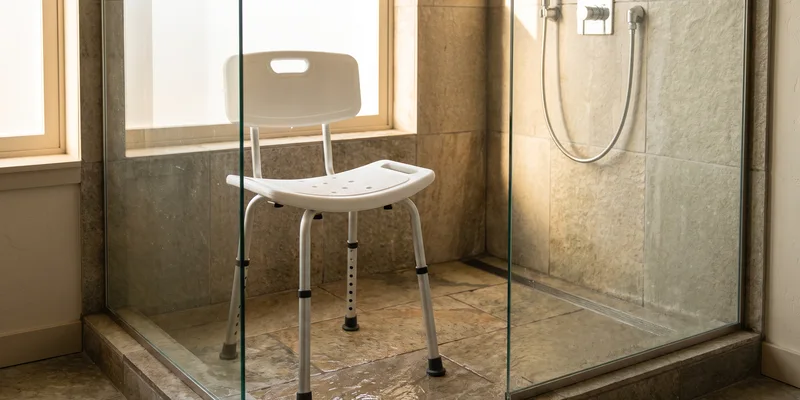
Almost every shower chair on the market is height adjustable, and almost every one of them arrives set to a height that suits nobody in particular. The legs telescope in one inch steps, a set of push button pins holds them, and the factory setting is simply wherever the pins happened to be when the chair was boxed.
Getting that setting right is the single cheapest improvement available on a shower chair, because it costs nothing and changes how hard standing up feels. This guide covers how the adjustment works, how to find the right height for a specific person, and what to check on a listing when the range itself is the deciding factor.
This article contains affiliate links. If you buy through them, we may earn a commission at no extra cost to you. Learn more.
Quick Answer
How should an adjustable height shower chair be set?
- Aim for feet flat on the shower floor with knees roughly level with the hips, or slightly lower than the hips, which keeps standing up manageable.
- Check the stated height range on the listing against the user, not against the average, and avoid ending up at the very top or very bottom of the range.
- All four legs go to the same setting, every pin has to click fully through its hole, and the setting is worth rechecking after the first few showers.
Bottom line: the adjustment is free, takes two minutes, and matters more than most of the features people compare instead.
How the Adjustment Works
Nearly all shower chairs use the same mechanism: an inner leg tube that slides inside an outer one, with a spring loaded button that pops through a row of holes. Press the button, slide the leg to the hole you want, and let the button spring out until it clicks and sits proud of the surface.
The range is usually somewhere between fifteen and twenty two inches from the floor to the seat top, in one inch steps, though it varies by model. What matters is not the extremes but where the person needs to sit, and whether that number falls comfortably inside the range rather than at its limit.
Why the Very Top and Bottom Settings Are Worth Avoiding
At the highest setting, the least amount of inner tube remains inside the outer leg, which is the least stable configuration a frame offers. At the lowest, the chair may sit so low that standing up becomes much harder. A model whose middle settings land where the user needs them is a better fit than one that only just reaches.

Finding the Right Height for a Person
Start away from the bathroom. Have the person sit on a dining chair with their feet flat on the floor and their back upright, then measure from the floor to the top of the seat surface. That number is the baseline, and it already reflects their leg length rather than a general rule.
In the shower, aim for that height or an inch above it. A seat slightly higher than a familiar chair makes standing up easier, because there is less distance for the legs to lift through. Go too high and the feet lose contact with the floor, which takes away the grip and stability that make sitting down feel safe.
Sloped Shower Floors
Shower trays and tiled floors slope toward the drain, which means two legs can end up lower than the other two even when all four are set identically. Place the chair where it will live, then check that it sits without rocking. If it does rock, moving it a few inches usually solves it more reliably than setting one leg differently.
Checking the Range on a Listing
| Spec to read | What it tells you | Common trap |
|---|---|---|
| Seat height range | Whether the user’s number fits | Only reaching it at the extreme |
| Step size | How finely you can tune it | Large steps skipping the ideal height |
| Measured to seat top | The number you actually compare | Some listings measure to the frame |
| Leg tip type | Grip and replaceability | Hard narrow tips on wet tile |
| Weight capacity | Stated limit for that model | Assuming it from a similar model |
Setting It Up Correctly
Work on all four legs before putting any weight on the chair. Set each one to the same hole, counting from the bottom, and confirm every push button has fully popped through so the pin sits proud rather than half caught. A pin that is not fully seated can slip under load.
Then press down on each corner of the seat in turn while the chair is empty and check that nothing collapses or wobbles. It takes about a minute and catches both an unseated pin and a chair placed on an awkward part of the floor.
Rechecking Over Time
Pins loosen, tips wear, and the person using the chair may change shoes or find that a slightly different height suits them better. Building a quick check into the cleaning routine catches all three. Our cleaning guide covers what to look at while the chair is out of the shower anyway.

When the Range Is the Deciding Factor
Two groups run into the limits of a standard range. Taller users, who often need the upper settings and end up at the top of the range on a standard chair, and shorter users, whose feet dangle at anything but the lowest setting. Both are better served by a model chosen specifically for the range rather than for its features.
Our guide for taller users covers the models with genuinely extended legs, and it is worth reading before assuming a standard chair will stretch far enough. The same principle applies with a bathtub, where the chair sits inside a tub floor that is already raised or curved.
Height Is Not the Whole Answer
A correctly set seat makes standing up easier, but it does not replace something to push against or hold on to. If the stand up is still difficult at the right height, armrests or a well placed grab bar are the next thing to add rather than another inch of leg. Our guides on chairs with arms and grab bar placement cover both.
If getting up has become unreliable rather than simply slower, that is worth raising with a professional rather than solving with equipment alone. If you are unsure what fits your situation, ask your doctor or an occupational therapist, who can look at the person and the bathroom together.

Frequently Asked Questions
What height should a shower chair be set to? Set it so the feet rest flat on the shower floor with knees roughly level with the hips or slightly lower. Measuring a familiar dining chair and matching it, or going an inch above, gets most people close on the first attempt.
How do you adjust the legs on a shower chair? Press the spring loaded button on each leg, slide the inner tube to the hole you want, and let the button click fully through. Set all four legs to the same hole and confirm each pin is fully seated before use.
Can shower chair legs be set at different heights? They should not be, other than where a manufacturer explicitly allows it for a sloped floor. Setting legs unevenly makes the frame less stable, and repositioning the chair usually solves rocking better.
What is the usual height range on a shower chair? Many models cover somewhere around fifteen to twenty two inches in one inch steps, but it differs by model. Read the stated range on the listing and check whether it is measured to the seat top or the frame.
Is the highest setting less stable? Less inner tube remains inside the outer leg at the top setting, so a chair whose middle settings suit the user is generally the better choice than one reaching its limit.
How often should the height setting be checked? Checking it as part of the regular clean is enough for most households. Look at the same time for worn tips and loose pins.
Does the seat height change what weight the chair holds? The stated capacity is a property of the model, not the setting, so read it from the listing. Our capacity explainer covers what the figure describes.
The Bottom Line
An adjustable height shower chair is only as good as the setting somebody chooses for it, and the factory setting is not that. Measure a familiar dining chair, aim for that height or an inch above, set all four legs to the same hole, and check that every pin has clicked fully home. Read the stated range before ordering so the user lands in the middle of it rather than at an extreme, and add arms or a grab bar if standing up is still hard at the right height. The wider format comparison lives in our shower chair guide.