Last updated: August 20, 2026
A bed ladder strap is one of the simplest things in the bedroom equipment aisle and one of the most misunderstood. It is a webbing strap with a series of rungs, anchored at the foot of the bed, that a person pulls along hand over hand to bring themselves up to sitting. When it suits someone, it is quietly excellent. When it does not, it is useless within a week.
The difference is almost entirely about arm and grip strength, and secondly about what the strap is anchored to. This guide covers who the aid actually suits, what to check on a listing, and where it falls short compared with a rail or a handle.
This article contains affiliate links. If you buy through them, we may earn a commission at no extra cost to you. Learn more.
Quick Answer
What is a bed ladder pull up strap and who is it for?
- It is a webbing strap with rungs, anchored at the foot of the bed, that lets someone pull themselves up to sitting hand over hand from lying down.
- It suits people who have usable arm and grip strength but find the sit up motion itself hard, and it does very little for someone who cannot grip firmly.
- The anchor point decides whether it works at all. The strap has to attach to a solid bed frame or leg, and manufacturers state which bed types their model fits.
Bottom line: check grip strength and check the bed frame, in that order, before ordering one.
What a Bed Ladder Strap Actually Is
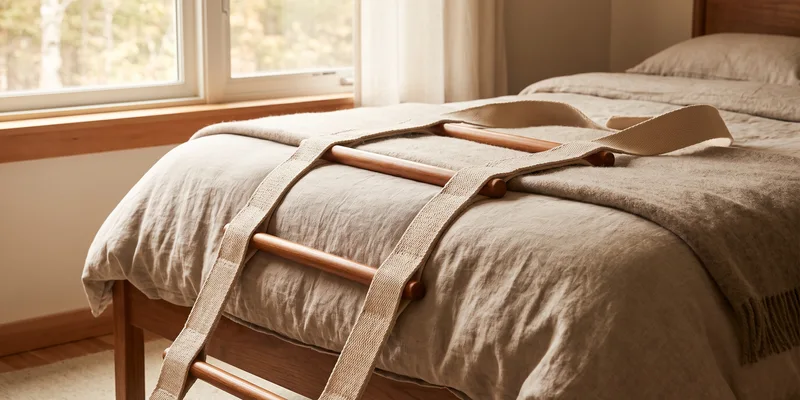
Picture a flat webbing ladder about the length of the bed. One end has an anchor strap that loops around the bed frame, a leg, or in some designs passes under the mattress. Along the rest sit rungs, either soft webbing loops or short rigid bars, spaced far enough apart to grab one at a time.
The user reaches for the nearest rung, pulls, reaches for the next, and works upward until they are sitting. It is the same motion as pulling yourself up a rope, done horizontally against gravity while lying on a mattress. Nothing about it is complicated, which is part of the appeal.
Names You Will See
The same product is sold as a bed ladder, a bed pull up strap, a rope ladder for bed, and a bed assist strap. There is no consistent naming, so search on the shape rather than the phrase, and read the photo to check whether the rungs are soft loops or rigid bars.

Who It Suits, and Who It Does Not
The strap suits someone who can grip firmly with both hands and pull with their arms, but who struggles with the abdominal effort of coming up from lying flat. That is a common combination, and for those people the ladder turns an exhausting move into a manageable one.
It does not suit someone whose hands are the weak link. If gripping a rung is itself a struggle, or if only one arm can be used reliably, a rigid handle beside the bed is usually the more workable tool. Our bed assist handle guide covers that alternative, and our comparison of a bed cane versus a bed rail covers the two rigid shapes.
Ask a Therapist Before You Assume
Grip strength, shoulder comfort, and trunk control are things an occupational therapist can assess in a few minutes and a product page cannot assess at all. If you are unsure what fits your situation, ask your doctor or an occupational therapist before ordering, especially if shoulders are already a sore point.
The Anchor Is the Real Constraint
Everything about a bed ladder depends on what the far end is attached to. A solid metal or wooden bed frame with accessible legs is the easy case. A platform bed with no exposed frame, an upholstered base, or a bed pushed tight against a wall makes anchoring awkward or impossible.
Manufacturers state which bed types their anchor design fits and how it should be attached, and that instruction is the one to follow rather than improvising a knot around something convenient. Check the anchor regularly too, since webbing straps loosen with repeated pulling and a strap that has crept a few inches changes where the first rung sits.
What to Read on the Listing
| Spec | Why it matters | What to look for |
|---|---|---|
| Overall length | Decides where the first rung falls | Match to bed length, adjustable straps are more forgiving |
| Rung type | How easy it is to grab | Rigid bars are easier to grip, soft loops store flatter |
| Rung spacing | How far each pull moves you | Closer rungs mean smaller, easier steps |
| Number of rungs | Range of the pull | More rungs suit taller users and longer beds |
| Anchor design | Whether it fits your bed at all | Frame strap, leg loop, or under mattress plate |
| Stated capacity | Manufacturer’s rating for that model | Read it from the listing, it varies by model |
| Washability | It lives on a bed | Removable and machine washable webbing where offered |
Rigid Rungs or Soft Loops
Rigid rungs, usually plastic or coated metal bars, are far easier to find and grab without looking, which matters at night. They also hold their shape when the strap is slack. The trade is bulk: they do not fold as flat and they can clatter against a bed frame.
Soft webbing loops are quieter, pack away easily, and are gentler if a hand catches one while moving in bed. They are harder to grab quickly because they lie flat against the strap. For most people the rigid version is the more practical choice, with soft loops making sense for travel or for a bed where the strap is stowed daily.

How It Compares With the Alternatives
A ladder strap is the simplest and least intrusive of the bedside aids. It adds no hardware, no under mattress plate on most designs, and nothing to walk into in the dark. That makes it attractive for a spare room or a temporary situation.
It is also the least versatile. A rail or a handle helps with rolling over, with sitting on the edge, and with standing up, while a ladder strap only helps with one thing: coming up to sitting. Households where standing is the difficult part are usually better served by a bed assist handle, and households where the whole start of the move is hard often end up looking at an adjustable bed instead, since raising the head section removes the sit up entirely.

A Word on Overhead Trapeze Bars
Trapeze bars, the overhead triangle handles seen on hospital beds, do a similar job from above. They involve a floor stand or a frame attachment and are normally set up as part of a professional equipment plan rather than bought on impulse, so they sit outside what a product listing can settle. Raise them with the therapist or supplier involved.
Common Mistakes
The first is buying one for someone whose hands are the limiting factor. It is a grip based aid, and no amount of padding changes that. The second is anchoring it to something that is not actually solid, such as a decorative headboard panel or a slatted base, rather than the frame the manufacturer specifies.
The third is leaving the strap slack across the bed where it can be rolled onto or caught in bedding. Most designs allow the strap to be shortened or clipped back when not in use, and using that feature keeps the bed tidy and the strap where it is expected to be.
A Note on Choosing Bedside Equipment
Which bedside aid suits a person depends on grip, shoulders, trunk strength, and the bed itself, and those change over time. If you are unsure what fits your situation, ask your doctor or an occupational therapist, who can watch the actual move before anything is ordered. Our overview of alternatives to bed rails lays out the full range of options in one place.
Frequently Asked Questions
What is a bed ladder strap used for? Pulling yourself up to sitting from lying down, hand over hand along a series of rungs anchored at the foot of the bed. It helps with the sit up motion specifically, not with standing.
Who should not use a bed ladder strap? Anyone whose grip is the limiting factor, or who cannot use both arms reliably, will get little from it. A rigid handle beside the bed is usually more workable in that case, and an occupational therapist can say which applies.
What does a bed ladder strap attach to? Usually the bed frame or a bed leg, with some designs using an under mattress plate. Manufacturers state which bed types their anchor fits, and platform beds without an exposed frame are the common problem case.
Are rigid rungs better than soft loops? Rigid rungs are easier to find and grab, especially at night, which is why most people prefer them. Soft loops are quieter and pack flatter, which suits travel or a bed where the strap is stowed daily.
What weight capacity do bed ladder straps have? Manufacturers state it per model and the figures vary. Take the number from the specific product listing rather than assuming a category standard.
Can a bed ladder strap be used with a bed rail? Often yes, since they occupy different parts of the bed and help with different stages. Check that the rail’s mounting plate and the strap’s anchor do not compete for the same spot.
Is it safe to leave the strap on the bed all the time? Most designs are meant to stay in place, but a slack strap lying loose across the mattress can get tangled in bedding. Shorten or clip it back when it is not in use, following the manufacturer’s instructions.
Do bed ladder straps work on adjustable beds? Only where the manufacturer says so, because the moving frame changes what the anchor is attached to. Check compatibility on the specific listing, and see our guide to adjustable beds for the alternative approach.
The Bottom Line
A bed ladder pull up strap is a narrow tool that does one job well: bringing someone up to sitting when arms work better than abdominals. Two questions decide whether to buy one. Can the person grip a rung firmly with both hands, and does the bed have a solid frame to anchor to? If either answer is no, look at a rigid handle instead. Our bed assist handle guide covers that route.