Last updated: August 20, 2026
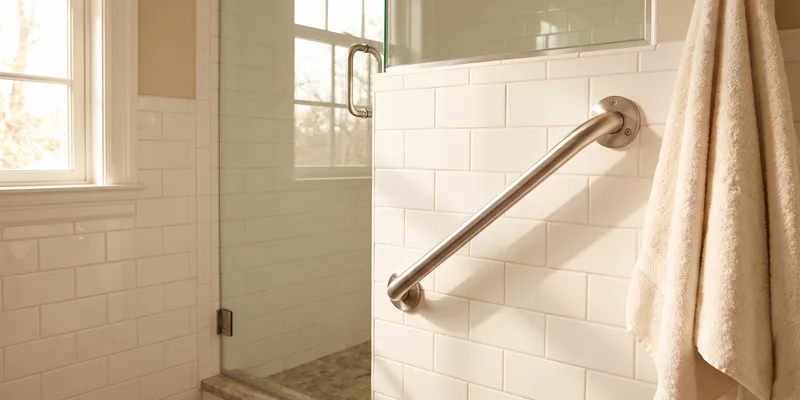
Look at how someone actually stands up out of a bathtub or off a shower seat and you will notice their hand does not stay at one height. It starts low, travels up and forward as the body rises, and ends somewhere near shoulder level. A horizontal bar gives one height. A vertical bar gives one line. An angled bar tries to follow the whole movement.
That is the entire argument for angled grab bars, and it is a real one. It also comes with a fixing complication that a horizontal bar does not have, and it sits outside the configuration the ADA standard describes. This guide covers when the diagonal earns its place and when a plain horizontal bar is the better call.
This article contains affiliate links. If you buy through them, we may earn a commission at no extra cost to you. Learn more.
Quick Answer
When does an angled grab bar make sense?
- An angled bar gives a range of grip heights along one length, which suits a movement where the hand rises, such as standing up from a shower seat or stepping over a tub rim.
- Mounting a bar diagonally rarely lines both end plates up with studs, so blocking or a stud-spanning mounting plate is usually part of the job.
- The ADA standard describes horizontal bars in accessible bathing and toilet facilities, so an angled bar is a home choice rather than a code-matching one.
Bottom line: angle the bar when the hand needs to travel, keep it horizontal when the hand stays at one height, and solve the fixing before you decide either way.
What an Angled Grab Bar Is
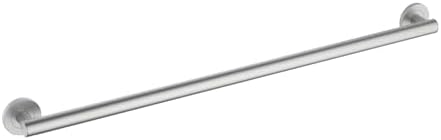
An angled grab bar is a straight bar mounted diagonally rather than level or plumb, typically somewhere between 30 and 45 degrees. Some are sold as dedicated angled products with shaped end flanges; more often a standard straight bar is simply installed on the diagonal, which is why the same model appears in listings both ways.
The point of the angle is that grip height varies continuously along the bar. Someone can take hold low, then slide the hand up the bar as they rise, without letting go and regrabbing. For a movement that combines standing and stepping, that continuity is the whole benefit.
Angled Is Not the Same as Curved
Curved and wave-shaped bars are a separate product. A curve changes the grip angle rather than the height along a straight line, and the shaped versions are often chosen as much for looks as for function. Our overview of grab bar types and shapes covers the full range side by side.
Angled Grab Bars by Situation
Standing Up From a Shower Seat
This is where the diagonal does its clearest work. The hand starts near seat height and finishes near shoulder height, and an angled bar on the wall in front of or beside the seat covers both without a second bar. It pairs naturally with a shower chair rather than replacing one.

Stepping Over a Bathtub Rim
Entering a tub means shifting weight onto one leg while the other swings over the rim, and the supporting hand climbs as the body straightens. An angled bar on the wall above the rim, or a curved bar shaped for tub entry, gives a hold through that whole sequence. Our guide to grab bars for the bathtub covers the placements around a tub in more detail.

Along a Stair Wall
Where a stairway has a wall but no rail on that side, a bar set to the pitch of the stairs follows the direction of travel rather than cutting across it. This is a job for a longer bar, and on stairs it is worth having the fixing done by someone who installs rails professionally, since the load angle is unforgiving.
When One Bar Has to Do Two Jobs
Combination bars, sometimes described as multi-position or wave bars, build a vertical section, a horizontal section, and an angled run into one piece. They suit a shower where a person sits on some days and stands on others, and they mean one set of fixings instead of two or three.

The Fixing Problem Nobody Mentions
Wall studs are vertical and evenly spaced, which is convenient for a horizontal bar and awkward for a diagonal one. Set a bar at 45 degrees and the two end flanges almost never land on studs at the same time, which is the single most common reason an angled installation stalls halfway through a Saturday.
There are two ways through it. Add blocking behind the wall, which means opening the surface and fitting timber between studs before closing it back up, or use a mounting plate designed to span studs and accept the bar anywhere along its length. Our guide to grab bar anchors and mounting hardware covers both routes.
Tile Makes It Harder Still
Drilling tile at a diagonal means the two holes are rarely in equivalent positions relative to grout lines, and a bit that wanders on a glazed surface is a chipped tile. Marking, center punching, and starting slow matters more here than on a level installation. The method is in our guide to grab bars for tile showers.
What the ADA Standard Says
The ADA standard describes horizontal grab bars in accessible toilet compartments and bathing facilities, mounted 33 to 36 inches above the floor, with specified lengths and positions on the side and rear walls. Angled bars are not part of that configuration.
That does not make an angled bar wrong in a private home, which the ADA standard does not govern. It does mean an angled bar is a decision made around one person’s movement rather than a way of matching a published specification, so if the goal is to follow the ADA layout, the horizontal arrangement is the one to copy. Our page on ADA grab bar height sets out those figures.
Comparing Bar Orientations
| Orientation | Best suited to | Watch out for |
|---|---|---|
| Horizontal | Steadying at one height, side support | Only one grip height available |
| Vertical | Pulling up, entering a tub or shower | Little help moving forward |
| Angled | Rising while stepping or leaning forward | End flanges rarely meet studs |
| Curved or wave | Varied grip angles in a small space | Fewer size and finish options |
| Combination | Mixed sitting and standing use | Bulk on a small shower wall |
Choosing the Angle and the Length
Set the angle from the movement, not from a drawing. Ask the person to make the movement slowly while resting a hand on the wall, mark where the hand starts and where it ends, and draw a line between the two marks. That line is the angle, and the distance between the marks is the minimum useful length.
Once you have the line, add margin at both ends so the hand is never at the very tip of the bar at either end of the movement. In practice that usually means 24 to 36 inches for a shower or tub position. Our guide on how to choose grab bar length works through the measuring in more detail.
One Angled Bar or Two Straight Ones
Two bars, one vertical at the entry and one horizontal at the seat, sometimes serve better than a single diagonal, especially when two people with different heights use the same shower. It is more fixings and more wall, but each bar sits exactly where its own job needs it.
Common Mistakes With Angled Bars
Choosing the angle for looks is the first. A 45 degree bar photographs well and is not automatically the angle a particular person’s hand travels through. The tape and pencil exercise above takes two minutes and settles it.
The second is mounting into whatever the drill happened to find. A diagonal bar with one flange in a stud and one in drywall anchors is not a supported installation, and the flange in the drywall is doing almost nothing. If both ends cannot reach solid backing, change the plan rather than the expectations.
A Note on Getting the Position Right
Where a support belongs, and at what angle, depends on how a specific person moves and which arm carries the work. If you are unsure what fits your situation, ask your doctor or an occupational therapist, who can watch the movement in the actual bathroom and mark the wall before anyone drills.
Frequently Asked Questions
Should a grab bar be horizontal or angled? Horizontal suits steadying at a fixed height; angled suits a movement where the hand rises, such as standing from a shower seat or stepping into a tub. The movement decides, and there is no single correct orientation for every position.
Does the ADA standard allow angled grab bars? The ADA standard describes horizontal bars at 33 to 36 inches above the floor in accessible facilities, and angled bars are not part of that configuration. Private homes are not governed by the ADA standard, so an angled bar remains a valid choice at home.
What angle should a diagonal grab bar be mounted at? Somewhere between 30 and 45 degrees is typical, but the useful answer is to mark where the hand starts and ends during the movement and set the bar along that line.
Why is an angled grab bar harder to install? Studs run vertically at regular spacing, so a bar set on a diagonal rarely lands both end flanges on framing. Blocking behind the wall or a stud-spanning mounting plate is usually needed.
What length should an angled grab bar be? Long enough to cover the full travel of the hand with margin at both ends, which for a shower or tub position typically means 24 to 36 inches.
Is a curved grab bar the same as an angled one? No. A curved or wave bar changes grip angle along its shape, while an angled bar is a straight bar mounted diagonally so grip height varies along its length.
Can an angled bar go on a stair wall? Yes, set to the pitch of the stairs, though stair walls carry load at an awkward angle and are often plaster or masonry rather than simple drywall. Professional installation is sensible there.
Do angled bars have a different weight capacity? The capacity comes from the model and its installation, not the orientation, and it should be read from the product listing. What changes with a diagonal mount is how easy it is to achieve the installation the manufacturer assumes.
The Bottom Line
Angled grab bars are worth it where a hand needs to travel through a range of heights, most obviously standing up from a shower seat or stepping over a tub rim. They are not worth the extra fixing work where the hand stays put, and they sit outside the horizontal arrangement the ADA standard describes. Mark the movement, measure the line, and solve the backing before you buy. Our main grab bar buying guide covers the alternatives.