Last updated: August 20, 2026
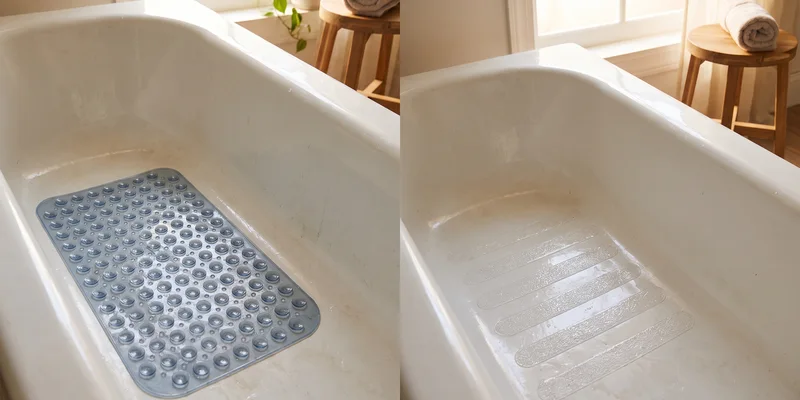
Two products claim the same square foot of wet tub floor, and they solve the problem in completely different ways. A bath mat is a sheet of rubber or vinyl that sits on the surface with suction cups holding it down. Adhesive treads are strips or shapes stuck permanently to the tub, textured on top and invisible from across the room.
Households usually pick one on price or appearance and then discover the trade the hard way: the mat that has to be lifted and dried every day, or the treads that will not come off the tub when it is time to sell the house. This comparison lays out what each one actually does well, and which situations point clearly to one or the other.
This article contains affiliate links. If you buy through them, we may earn a commission at no extra cost to you. Learn more.
Quick Answer
Should you use a bath mat or adhesive treads in the tub?
- Choose a suction bath mat when the tub is smooth, the surface is intact, and somebody is willing to lift and dry it regularly.
- Choose adhesive treads when the tub is textured, sculpted, or fiberglass, when a mat keeps sliding, or when nobody will maintain a mat day to day.
- Treads leave adhesive residue behind and are effectively permanent, so they suit an owned home more than a rental.
- Neither product replaces a grab bar, because grip underfoot and something to hold are two different needs.
Bottom line: mats give more coverage and need more upkeep, treads need almost none and cannot be undone easily.
What Sits Between You and the Tub
A bath mat covers a continuous area, usually most of the tub floor, with a textured rubber or PVC surface and dozens of small suction cups underneath. It grips by vacuum, which means it needs a smooth, clean, non-porous surface to grip against and a firm press to seat properly.
Adhesive treads take the opposite approach. Individual strips, circles, or a large sheet bond to the tub with a pressure-sensitive adhesive and stay put. There is nothing to lift, nothing to slide, and no water trapped between a mat and the tub, because the tread is bonded rather than floating.
Where Bath Mats Win
Coverage is the main advantage. A full-size mat gives a continuous textured surface across the whole standing area, so it does not matter exactly where somebody puts a foot down. Treads cover only the strips they occupy, and the tub between them stays exactly as slick as it was.
The second advantage is reversibility. A mat can be taken out for a bath, swapped for a different size, moved to another bathroom, or thrown away when it wears. Nothing about it changes the tub, which is what makes it the default choice in a rental or a home that might be sold. Our bath mat guide covers sizing and backing types in detail.

The Maintenance Bath Mats Demand
A mat left flat in a wet tub keeps the surface underneath permanently damp, and that is how both the mat and the tub end up discolored. Mats need lifting after use, rinsing, and hanging to dry, plus a proper clean every week or two. Households that will not do that consistently are better served by treads.
Where Adhesive Treads Win
Treads work on surfaces mats cannot grip. Textured or sculpted tub floors, older enamel with a slightly rough finish, and many fiberglass units simply do not give suction cups a seal, so the mat creeps under a foot rather than holding. On those surfaces treads are not the compromise option, they are the only one that stays put.
They also disappear visually. Clear treads on a white tub are barely noticeable from the doorway, which matters to households who dislike the look of bathroom equipment. And with nothing floating on the tub floor there is no mat edge to catch a toe on and nothing to lift for a bath.

The Trade: Getting Them Off Again
Adhesive treads are meant to stay. Removing them means peeling, heat, and adhesive remover, and even then a shadow often remains on the tub finish. Manufacturers publish removal guidance and it is worth reading before installing rather than after. In a rental, that removal difficulty is the reason to think twice.
Side by Side
| Point | Bath mat | Adhesive treads |
|---|---|---|
| Coverage | Continuous across the tub floor | Only where strips are placed |
| Surface needed | Smooth, clean, non-porous | Works on textured surfaces too |
| Reversible | Fully, leaves nothing behind | Difficult, residue is likely |
| Daily upkeep | Lift, rinse, hang to dry | Clean with the tub, nothing more |
| Appearance | Visible, often colored | Clear versions nearly invisible |
| Rental friendly | Yes | Usually not |
| Replacement | Buy another and drop it in | Remove old adhesive first |
Which Situation Points Which Way
A smooth enamel or acrylic tub in a home somebody owns, used by one or two people, with a household routine that includes hanging a mat to dry: that is bath mat territory, and the coverage advantage is worth having. Add a mat outside the tub as well, since the landing spot is where wet feet meet a hard floor.
A textured fiberglass tub-shower combination, a shared bathroom, or a household where nobody is going to lift and dry a mat every day points to treads. So does a tub where a mat has already been tried and keeps sliding, which is a clear sign the surface is not giving the suction cups anything to hold.
Using Both
There is no rule against combining them. Treads across the standing area with a mat on the bathroom floor outside is a common and sensible setup, because the two products are then solving two different problems in two different places rather than competing for the same square foot.

Common Mistakes With Both
Fitting either one to a dirty surface is the big one. Soap film defeats suction cups and stops adhesive bonding, so both products need a genuinely clean, dry tub before they go in. For treads that means following the surface preparation step in the instructions rather than skipping to the fun part.
The second mistake is expecting either product to do a grab bar’s job. Grip underfoot helps at the moment of standing; something solid to hold helps at the moment of sitting, standing back up, or stepping over the tub wall. Most bathrooms need both, and our guide to grab bar placement covers where the bar belongs.
Letting Either One Wear Out Quietly
Suction cups harden and stop sealing, and tread texture wears smooth in the spots that get stood on most. Both changes happen gradually enough to go unnoticed. Check the mat by pulling up a corner, check treads by running a hand across them wet, and replace either when the grip has clearly gone.
A Note on Getting the Right Setup
Traction underfoot is one piece of a bathroom that has to work as a whole, alongside a handhold, a place to sit, and the lighting to see what you are doing. If you are unsure what fits your situation, ask your doctor or an occupational therapist, who can look at how somebody actually gets in and out of the tub before anything is bought. For the full room, our bathroom safety checklist works through it zone by zone.
Frequently Asked Questions
Do bath mats work in a textured tub? Usually not well. Suction cups need a smooth, non-porous surface to seal against, and a sculpted or textured tub floor gives them nothing to grip. If a mat keeps creeping, that is the surface telling you to switch to adhesive treads.
Are adhesive treads permanent? Effectively yes. They can be removed with heat and adhesive remover, but the process is slow and often leaves a mark on the tub finish. Treat them as a long-term change rather than a temporary one.
Which is better for a rental bathroom? A bath mat, because it leaves the tub exactly as it was. Adhesive treads are difficult to remove cleanly, which is not a conversation most tenants want with a landlord. Our bathroom safety guide for renters covers the reversible options.
Can you use a bath mat and treads together? Yes, and pairing treads inside the tub with a mat on the floor outside is a common setup. What is less useful is layering a mat on top of treads, since the mat cannot grip a textured tread surface.
How often should a bath mat be replaced? When the suction cups no longer hold or the surface has gone smooth in the spots that get used most. Lifting a corner to test the grip every few weeks is enough to catch it.
Do treads make the tub harder to clean? Slightly. The texture holds soap residue, and the edges collect grime, so they want a scrub with a brush rather than a wipe. Keeping them clean also keeps their traction.
Are mats with drainage holes better? They let water pass through instead of pooling underneath, which helps the tub dry and reduces discoloration. They still need lifting and drying, just less urgently than a solid mat.
What about the floor outside the tub? That is where wet feet meet a hard floor, and it deserves as much attention as the tub itself. A mat with a proper grip backing, or a change to the flooring finish, covers that landing spot.
The Bottom Line
A bath mat gives continuous coverage and leaves nothing behind, at the cost of daily lifting and drying. Adhesive treads ask for almost no upkeep and work on surfaces a mat cannot grip, at the cost of being close to permanent. Let the tub surface and the household routine decide, not the price tag, and remember that neither one takes the place of something solid to hold. For flooring beyond the tub, our non slip flooring overview covers the rest of the room.