Last updated: August 20, 2026
Most people approach this backwards. They buy a product first, usually a mat or a suction handle, and then discover it did not address the part of the shower that was actually difficult. The useful order is the opposite: work out which moment in the routine has become hard, then choose the equipment that addresses that moment.
This guide walks through a shower routine in sequence, from walking into the bathroom to drying off, and covers what tends to help at each step. Nothing here is a project; most of it can be done over a weekend, and some of it costs almost nothing at all.
This article contains affiliate links. If you buy through them, we may earn a commission at no extra cost to you. Learn more.
Quick Answer
How do you make a shower safer for an elderly parent?
- Start with a place to sit, either a shower chair in a walk-in shower or a transfer bench across a bathtub rim.
- Add a properly anchored grab bar where the hands actually reach, plus a handheld shower head so a seated user can rinse without standing.
- Then deal with surfaces and lighting: a non-slip mat inside, a backed mat outside, and enough light to see the edges of things.
Bottom line: seat first, handhold second, surfaces third. If you are unsure what fits your situation, ask your doctor or an occupational therapist.
Start by Watching the Routine
Before buying anything, watch or talk through the whole sequence: walking to the bathroom, getting through the door, getting into the shower or over the tub rim, standing or sitting through the wash, rinsing, getting out, and drying. Ask which of those steps has changed in the last year.
The answers are often specific and surprising. Sometimes the shower itself is fine and the problem is the towel being out of reach; sometimes washing is fine and the step over the rim is the whole issue. Buying against the actual answer avoids a cupboard full of equipment nobody uses.
Step One: Somewhere to Sit
Sitting removes the balance demand from the longest part of the routine, and it is usually the change with the biggest effect. Which product depends entirely on the enclosure: a walk-in shower takes a chair or stool, a standard bathtub calls for a transfer bench that spans the rim so the leg lift happens while seated.
Choose a back and arms if sitting upright unsupported is tiring or if standing up again needs a push. Match the seat height so feet rest flat and knees sit roughly level with the hips, and take the stated weight capacity from the product listing rather than assuming.

The full comparison of seat types is in our shower chair guide, and the tub version in our transfer bench guide.
Step Two: Something Solid to Hold
A handhold matters at three separate moments: entering, sitting down, and standing up. Those are three different positions, which is why a single bar in a random place often turns out to be unhelpful. Plan the positions with the seat actually in place rather than from a diagram.
A properly anchored bar fixed into studs or blocking is the option that carries real load. Suction bars are a different product designed as a light balance aid on smooth surfaces, and manufacturers are explicit that they are not intended to take a person’s full weight, so it is worth reading that honestly before buying one.
If Drilling Is Not an Option
In a rented home, a clamp on tub rail gives a handhold at the rim without altering anything, and no-drill systems exist for some situations. Our guides on grab bars for renters and bathtub safety rails cover what is realistic without fixings, and where to place grab bars covers the positions.
Step Three: The Water Itself
Once someone is sitting, a fixed overhead shower head sprays past them. A handheld unit on a long hose fixes that, and a control on the handle lets the water be paused without reaching for the valve. Give the head a park position within reach of the seat rather than leaving the bracket at standing height.
Temperature deserves a mention because a seated person cannot step out of a stream that suddenly runs hot. If the home’s water temperature swings when another tap runs, that is a question for a licensed plumber rather than something to work around.

Step Four: Surfaces
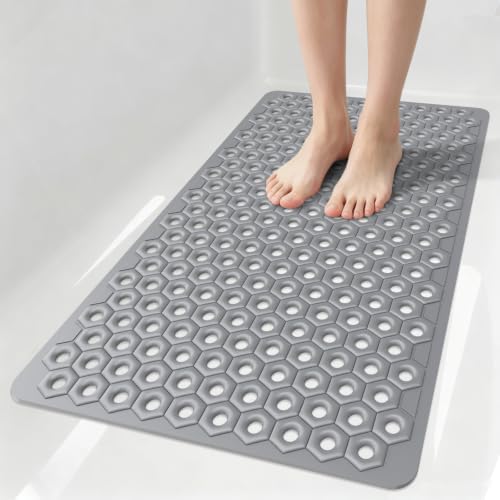
Inside the tub or shower, a suction mat with drain holes works on smooth acrylic or enameled surfaces. On a textured shower tray or over grout lines the cups cannot seal, and adhesive treads are the option that will. Size the coverage to where the feet actually stand.
Outside, use a mat with a bonded rubber or latex backing rather than a loose decorative rug, and check that the corners lie flat. Our bath mat guide covers the difference between the two in detail.
Step Five: Light, Reach and the Small Things
| Change | Why it helps |
|---|---|
| Brighter, even lighting | Edges, thresholds and wet patches become visible |
| Night light on the route | Most bathroom trips happen in the dark |
| Toiletries at seated height | Removes leaning and reaching mid shower |
| Towel within arm’s reach | Drying starts before walking anywhere |
| A long handled sponge | Feet and back reachable without bending far |
| Door that opens outward | Access is not blocked if someone is on the floor inside |
What Not to Rely On
Two things get used as handholds that were never designed to be. A towel rail is fixed for the weight of a towel, and a soap dish or a built-in shelf is not a structural fitting. Neither should be part of the plan, and both are worth pointing out explicitly if they are already being used that way.
The third is the shower door or its frame. Glass doors and their hinges are not load bearing in the way a grab bar is, and pulling on one during a step over is a habit worth replacing with a proper handhold.
A Note on Independence
Equipment changes are easier to accept when they are framed as making the bathroom work better rather than as a verdict on someone’s abilities. Involving the person in the choices, including how things look, tends to produce a setup that actually gets used. A teak bench chosen together beats a plastic chair delivered as a surprise.
It also helps to make changes early rather than in a rush after something happens. Small changes made while everything is fine are easier to live with than a bathroom rebuilt under pressure. Our bathroom checklist is a reasonable place to start that conversation.
When to Bring in a Professional
Some of this is shopping and some of it is not. Wall fixings need to reach solid structure, and where the wall build-up is unknown that is a contractor’s job. Plumbing changes are a plumber’s job. And the question of what a specific person needs, rather than what is generally sensible, is one occupational therapists answer for a living. If you are unsure what fits your situation, ask your doctor or an occupational therapist.
Frequently Asked Questions
What is the first thing to change in a shower? Usually a place to sit, because it removes the balance demand from the longest part of the routine. Which product depends on whether the bathroom has a walk-in shower or a bathtub.
Do I need a grab bar if there is already a shower chair? Yes, in most cases. The chair covers sitting; the bar covers entering, sitting down, and standing up, which are the moments a seat does not address.
Are suction grab bars enough? They are designed as a light balance aid on smooth surfaces and manufacturers state they are not intended to take a person’s full weight. For a real handhold, an anchored bar is the appropriate choice.
What can I do in a rented bathroom? A freestanding shower chair or transfer bench, a clamp on tub rail, mats, a handheld shower head, and better lighting all work without altering the property.
How much does making a shower safer cost? It varies widely with what the bathroom needs, from a few small purchases to a wider renovation. Working through the routine first keeps spending pointed at the parts that matter.
Should the bathroom door open outward? It is worth considering, because an inward-opening door can be blocked if someone is on the floor inside. It is a change to raise with a contractor rather than a quick fix.
Is a walk-in tub the answer? That is a large and permanent decision with its own trade-offs, and it is worth getting independent guidance before treating it as the default. Most bathrooms can be improved considerably without it.
Who can assess the bathroom properly? An occupational therapist commonly looks at how someone actually moves through a bathroom and suggests the setup that fits, which is different from a general checklist.
The Bottom Line
Work through the routine, find the moment that has become hard, and buy against that. In practice that usually means a seat first, an anchored handhold second, a handheld shower head third, and surfaces and lighting fourth. Skip the towel rail as a grab bar, involve the person in the choices, and get professional input on the wall fixings and on what suits them specifically. Our shower chair guide is the natural next step.
Related Reading
- Best Shower Chair: Which Type Fits Your Bathroom and Needs
- Transfer Bench for Bathtub: How to Fit One to Your Tub
- Grab Bars for the Shower: Placement and Mounting
- Non Slip Bath Mats for Seniors: Inside and Outside the Tub
- Bathroom Safety Checklist for Seniors
- Handheld Shower Head for Elderly Users: What to Look For