Last updated: August 20, 2026
The walk from the bed to the bathroom at two in the morning is the most repeated night time journey in any household, and in most homes it is made in the dark by someone who is not fully awake. A switch does not help much when it is on the far wall, and the overhead light is so bright that it wakes everyone and leaves the eyes adjusting for a minute afterwards.
Motion sensor night lights sit between those two extremes. They come on by themselves when someone moves, put a soft pool of light on the floor rather than in the eyes, and switch off again on their own. This guide covers the formats, the specifications that actually matter, and where to put them so the route is lit end to end rather than in patches.
This article contains affiliate links. If you buy through them, we may earn a commission at no extra cost to you. Learn more.
Quick Answer
What makes a good motion sensor night light for an older adult?
- Warm light rather than cold white, mounted low so it lights the floor and not the eyes.
- Enough of them to make a continuous path from the bed to the bathroom, usually two to four.
- A format that suits the wall: plug in where there is an outlet, battery or rechargeable where there is not.
- A sensor that reacts quickly and stays on long enough to complete the walk, not one that times out mid hallway.
Bottom line: buy a set rather than a single light, and place them at ankle to knee height along the route.
Why a Sensor Beats a Switch at Night
A light that turns itself on removes the two hardest parts of the night time walk: finding a switch in the dark and dealing with the jolt of full brightness afterwards. That is the whole case for motion sensing, and it is why these lights show up on almost every home safety list even though they cost very little.
They also help the person who is not the one walking. A soft floor level light along a hallway does not wake a sleeping partner the way a ceiling fixture does, which makes it far more likely to actually get used every night rather than skipped.
The Three Formats and Where Each Fits
Almost everything on the market falls into three groups: lights that plug into a wall outlet, battery or rechargeable units that stick to any surface, and flexible strips that run along a length. They are not competing formats so much as answers to different walls, and most households end up with a mix.
Plug in units are the simplest where outlets exist at a useful height. Stick on units go where outlets do not, including inside closets and along the side of a bed. Strips suit stair edges, under bed lines, and long stretches of hallway skirting.
Plug In Units for Hallways and Landings
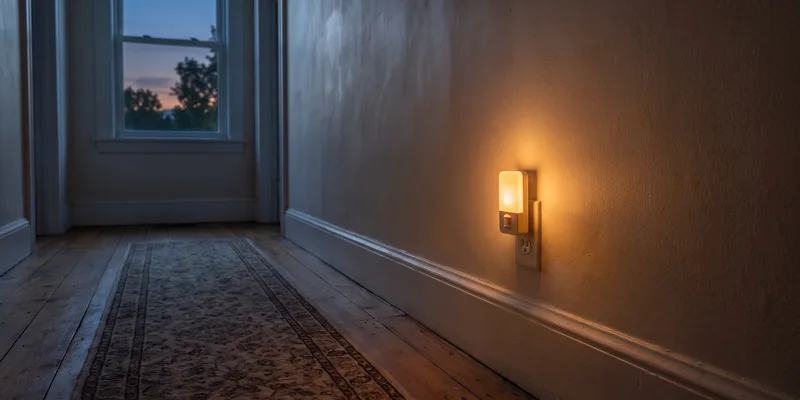
The classic format: a small unit in a wall outlet that senses movement and lights the floor beneath it. These are the mainstay of a bedroom to bathroom route because they need no charging and no maintenance beyond wiping the sensor now and then. Choose warm white output and a low outlet rather than a high one.

Battery Units Where There Is No Outlet
Rechargeable stick on lights with a magnetic or adhesive mount go where wiring does not: the inside of a closet, the wall beside a bed, a bathroom without a low outlet, or the top of a basement stairwell. The trade off is remembering to recharge them, which is easier if they are on a magnetic base that lifts off in one movement.

Strips for Under the Bed and Along a Baseboard
An under bed strip triggered by motion lights the floor the moment feet swing over the edge of the mattress, which is the exact second it is needed. Strips also work along the base of a hallway wall where a single point source would leave gaps. Look for a kit with two sensors if the bed is used from both sides.

Stair Lighting
Stairs need a different approach than a flat hallway, because what matters is seeing the edge of each tread rather than the floor in general. Small units mounted at the side of each few steps, or a strip running along the stringer, give that edge definition. Our stair safety guide covers the rest of the picture, including handrails and tread grip.

What to Look For When Comparing Models
| Feature | What to aim for |
|---|---|
| Color temperature | Warm white, roughly 2700K to 3000K, rather than cold blue white |
| Brightness | Enough to see the floor and edges, not enough to fully wake someone |
| Sensor range | Covers the width of the hallway from where it is mounted |
| On duration | Long enough to complete the walk, ideally adjustable |
| Dusk sensing | Only activates in the dark so it does not run all day |
| Mounting | Plug in, adhesive, or magnetic; magnetic is easiest to recharge |
| Power | Mains for permanent spots, rechargeable where no outlet exists |
Placement Matters More Than the Model
Mount low. A light at ankle to knee height puts brightness on the floor where obstacles are, and keeps it out of eyes that have been closed for hours. A light mounted at chest height does the opposite and can leave a dazzled walker seeing less than before.
Then think in routes rather than in rooms. Walk the path yourself in the dark: bedside, bedroom door, hallway, bathroom door, and the area beside the toilet. Anywhere the light drops out completely is where the next unit goes, and most routes need somewhere between two and four.
The Bathroom End of the Route
The bathroom is worth its own unit, because it is where the floor may be wet and where turning around happens in a small space. A low light near the door plus one near the toilet covers it. This is also the room where grab bars and non slip mats earn their place, and the bathroom checklist runs through the full pass.
Common Mistakes Buyers Make
The first is buying one light. A single unit creates a bright spot with dark stretches on either side, and the contrast between them can be harder to walk through than uniform dimness. Sets of three or four exist for exactly this reason.
The second is choosing cold white because it looks brighter in the product photo. Cold light is harsher on eyes adjusting from sleep and does nothing extra for seeing the floor. The third is mounting units too high, which turns a floor light into a glare source.
Where Lighting Fits in the Wider Picture
Lighting is designed to make the route easier to see, and it is one part of a set of changes rather than a solution on its own. The floor along that route matters just as much, which is what our guide to trip hazards deals with, and the bathroom at the end of it usually deserves the larger share of attention.
If someone is finding the dark noticeably harder than they used to, or is bumping into things they can see in daylight, that is worth raising with a doctor or an optometrist rather than solving with lighting alone. If you are unsure what fits your situation, ask your doctor or an occupational therapist.
Frequently Asked Questions
How many night lights does one hallway need? Usually two to four along the full route from the bed to the bathroom. The test is simple: walk it in the dark and add a light wherever the path goes completely black between units.
Warm white or cool white? Warm white. It is easier on eyes coming out of sleep and shows the floor just as well. Cool white looks brighter in a photo and is harsher in practice.
Plug in or rechargeable? Plug in wherever there is a low outlet, because it needs no maintenance. Rechargeable or battery units are for the spots without one, and magnetic mounts make the recharging routine much easier to keep up.
Will a motion sensor light wake a partner? A low mounted, warm, dim unit generally does not, which is one of its advantages over a ceiling light. Brightness and mounting height matter more here than the sensor itself.
Do these work for someone who uses a walker? Yes, and the placement logic is the same, though the route should be checked at the wider path a walker needs. Make sure no light unit sits where a wheel or a foot could catch on it.
What about the toilet at night? A small light near the toilet, or a bowl light that activates in the dark, avoids the overhead switch entirely. It is a minor purchase that gets used every night.
Does better lighting help with balance? Lighting changes what a person can see, not how they balance. If balance or dizziness is the concern, that belongs in a conversation with a doctor or an occupational therapist rather than with a lighting purchase.
The Bottom Line
Motion sensor night lights are one of the cheapest changes in an aging in place plan and one of the most used, provided you buy a set rather than a single unit, choose warm light, and mount everything low along the actual route from bed to bathroom. Plug in units for outlets, rechargeable stick on units for walls without them, strips for under a bed or along stairs. Pair the lighting with the floor level fixes in our home fall prevention plan.