Last updated: August 20, 2026
The decision between a plain shower stool and a full chair with a backrest looks like a comfort question, and it is often framed that way in product listings. In practice it is a support question, and the answer usually becomes obvious once you watch how someone actually sits through a shower rather than how they sit at a kitchen table.
This guide covers what a backrest and armrests add, when a backless stool is genuinely the better choice, and the specific details worth checking on a chair with a back before ordering one for a bathroom you cannot easily reconfigure.
This article contains affiliate links. If you buy through them, we may earn a commission at no extra cost to you. Learn more.
Quick Answer
Should a shower chair have a back?
- A backrest is worth it when sitting upright without support becomes tiring, when showers take more than a few minutes, or when leaning back is part of rinsing hair.
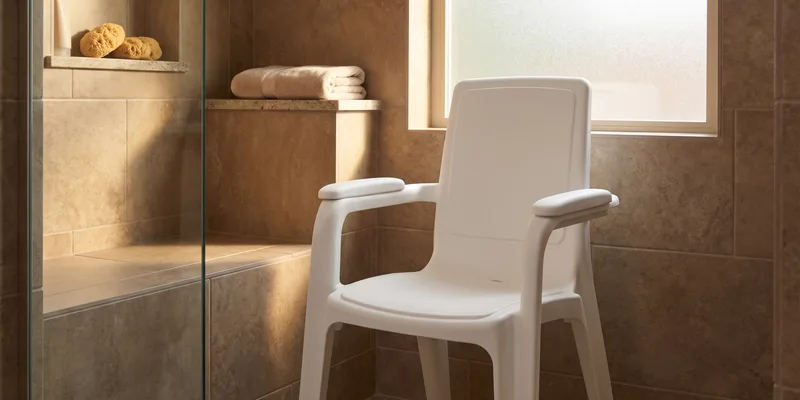
- Armrests are the feature most families end up valuing most, because they give something to push against when standing back up.
- A backless stool still makes sense in a genuinely small enclosure, or when balance is steady and the chair has to be lifted in and out daily.
Bottom line: the back supports the shower, the arms support the stand-up, and most people who need one benefit from both.
What a Backrest Actually Does
A backrest holds the trunk upright so the user does not have to. That sounds minor until you consider what a shower involves: leaning forward to wash lower legs, tilting the head back to rinse shampoo, twisting to reach a shelf. Each of those movements shifts the body’s center of balance, and a back gives the trunk something to return to.
It also removes the need to keep one hand on a wall. Many people using a backless stool end up bracing against the tile with one arm through most of the shower, which leaves only one hand free for washing. A backrest hands that second arm back.
Where the Back Style Differs
Backrests on shower chairs come in three broad forms: a low bar across the shoulder blades, a full molded panel, and a padded or contoured back on premium models. The low bar is lighter and takes less space, the full panel spreads contact over a wider area, and padded backs are usually chosen where showers are long or where sitting on a hard surface is uncomfortable.

Why Armrests Often Matter More
Standing up from a seated position uses the arms far more than most people realize, especially on a wet surface where the feet cannot be trusted to grip perfectly. Armrests give a fixed, predictable place to push down from, which is why chairs with arms are frequently what occupational therapists suggest when getting back up is the difficult part of the routine.
The trade-off is entry. Fixed arms mean stepping over or sitting down between them, which can be awkward in a narrow enclosure. Some models use removable or flip-back arms specifically to solve that, and those are worth looking for when the shower opening is tight or when a caregiver assists from the side.
Back and Arms Compared With a Plain Stool
| Factor | Chair with back and arms | Backless stool |
|---|---|---|
| Sitting support | Trunk supported, both hands free | Usually one hand bracing on the wall |
| Standing back up | Push down on arms | Push off knees or grab bar |
| Floor space | Larger footprint | Fits most enclosures |
| Moving it in and out | Heavier, more awkward | Light, easy to lift |
| Caregiver access | Better from the front, arms can block the side | Open from all sides |
What to Check on the Listing
Five figures decide fit: the seat height range, the seat width between the arms, the overall footprint, the backrest height, and the stated weight capacity. Seat width between the arms is the one most often missed, because the outer width shown in photos can be several inches wider than the usable seat.
Also look for whether the back and arms are tool-free to remove. A chair that converts to a stool covers more situations over time, particularly in a household where more than one person uses the same shower or where the setup may change.
Materials and Drainage
Aluminum frames stay light and do not rust, which matters in a room that never fully dries. Seats with drainage holes stop water pooling under the user, and a textured seat surface reduces sliding when soap is involved. Padded backs need to be genuinely closed-cell foam rather than an absorbent cover, or they hold moisture between showers.
Check the feet as well. Wide rubber tips grip better than narrow ones on wet tile, and replaceable tips extend the useful life of an otherwise sound chair by years.
When a Backless Stool Is Still the Right Call
Three situations point back toward a stool. The enclosure is small enough that a full chair blocks the valve or the door, the chair has to be lifted in and out every day by someone who would struggle with the extra weight, or the user’s sitting balance is steady and the shower is short.
In the first two cases, a wall behind the seat can substitute for a backrest, and a well-placed grab bar can substitute for armrests. That combination is often more practical than forcing a full chair into a space that cannot take one. Our small shower guide covers the compact options in more detail.
Pairing the Chair With the Rest of the Bathroom
A chair with a back changes where the user sits, which changes which grab bar positions are useful and where the shower head needs to reach. Fix those two things at the same time rather than one at a time, because a chair that sits out of reach of the controls creates a new problem while solving an old one.
A handheld shower head on a long hose is the usual companion purchase, since a fixed overhead head sprays past a seated user rather than onto them. Our guides on handheld shower heads and grab bar placement cover both.

Heavier Frames and Wider Seats
Chairs with a back and arms are also available in wider, heavier-duty versions with higher stated capacities. Take the capacity number from the specific product listing, since it varies considerably between models that look similar in photographs, and measure the seat width against both the user and the shower opening.
![360 Swivel Shower Chair with Arms and Back, Heavy Duty [300 lbs] ...](https://m.media-amazon.com/images/I/41oUEbQuBrL._AC_.jpg)
When to Ask for Guidance
If sitting upright has recently become harder, if standing up is unreliable rather than just slow, or if dizziness is part of the picture, that belongs in a conversation with a doctor rather than a product comparison. Occupational therapists routinely look at bathing routines and suggest a setup based on what they observe. If you are unsure what fits your situation, ask your doctor or an occupational therapist.
Frequently Asked Questions
Is a shower chair with a back better than a stool? It is better when sitting upright unsupported is tiring or when showers run long. For a short shower in a small enclosure with steady balance, a stool can be the more practical choice.
Do I need armrests as well as a back? Armrests help most with standing back up. If getting up from a seated position is the difficult part, arms are the feature to prioritize, and many models offer both together.
Can the back and arms be removed later? On many models yes, and tool-free removal is worth looking for. It lets one chair cover both a supported setup now and a simpler one later.
Are padded shower chairs worth it? They are more comfortable for longer showers, but only if the padding is closed-cell foam that does not soak up water. An absorbent cushion in a shower stays damp between uses.
Will a chair with arms fit through my shower door? Measure the door opening and compare it to the outer width of the chair, not the seat width. Models with flip-back or removable arms are easier to get through a narrow opening.
How high should the seat be set? Set it so the feet rest flat on the shower floor with knees roughly level with the hips. A seat that is too low makes standing up considerably harder.
Does a chair with a back work in a bathtub? It can sit inside a tub, but it does nothing about stepping over the rim. If the rim is the obstacle, look at a transfer bench instead.
The Bottom Line
A backrest earns its place when the trunk needs support through a longer shower, and armrests earn theirs at the moment of standing up. Together they turn a seat into something a person can use without bracing against the wall. Check seat width between the arms, seat height range, and the listed weight capacity before ordering, and pair the chair with a handheld shower head and a grab bar in reach. The full type comparison lives in our shower chair guide.