Last updated: August 20, 2026
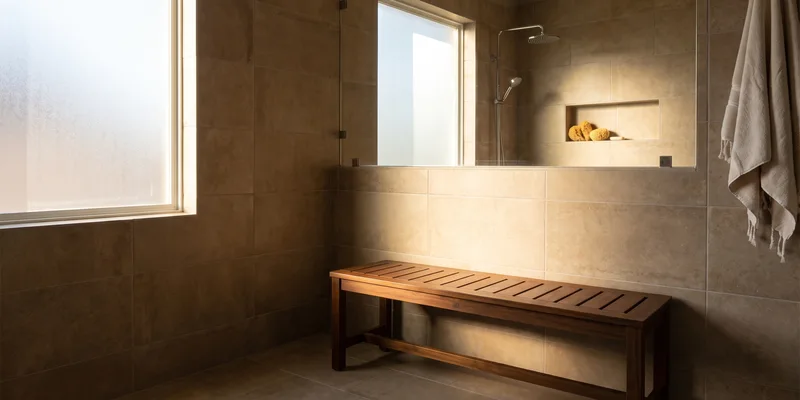
There is a reason teak benches sell well in a category otherwise dominated by white plastic and aluminum tubing: nobody wants their bathroom to look like a hospital room. A teak bench reads as furniture rather than equipment, and for a lot of households that is the difference between a seat that gets used and a seat that gets resented.
That said, wood in a wet room comes with its own rules. This guide covers what teak actually offers, where it falls short compared with an adjustable aluminum chair, and how to choose and look after a bench so it stays sound for years rather than months.
This article contains affiliate links. If you buy through them, we may earn a commission at no extra cost to you. Learn more.
Quick Answer
Is a teak shower bench a good choice?
- Teak suits bathrooms where the seat should look like furniture, and where the shower has drying time between uses.
- The trade-off is adjustability: most teak benches are a fixed height, so the seat has to suit the user as delivered.
- Slatted seats drain well, and the natural oils in teak help it cope with a wet room, but the bench still needs to dry and gets oiled occasionally.
Bottom line: choose teak for appearance and durability, choose adjustable aluminum when seat height has to be set precisely.
Why Teak Is Used in Wet Rooms
Teak contains natural oils and a tight grain that make it far more tolerant of constant moisture than most timbers, which is why it has been used on boat decks and outdoor furniture for generations. In a bathroom that means a bench that does not swell, warp, or split the way a softwood would under the same conditions.
It also feels different to sit on. Wood does not carry the cold of a plastic or aluminum seat, and a slatted top drains rather than holding a pool of water. Those two things sound like details until someone sits on the bench every day.
Where the Appearance Argument Actually Matters
Many families delay bathroom equipment because it makes a home look institutional, and the person who has to live with it is often the one resisting most. A teak bench sidesteps that conversation, since it looks like something chosen rather than something prescribed. That is a legitimate reason to pay attention to a material.

Teak Versus an Adjustable Shower Chair
| Factor | Teak bench | Adjustable aluminum chair |
|---|---|---|
| Seat height | Usually fixed as built | Adjustable in increments |
| Armrests | On some models only | Widely available |
| Appearance | Reads as furniture | Reads as equipment |
| Weight | Heavier, stays put | Light, easy to move |
| Maintenance | Rinse, dry, oil occasionally | Rinse and check tips |
| Grip on wet tile | Depends on the feet fitted | Wide rubber tips as standard |
Fixed Height Is the Real Constraint
Most teak benches are built at a single height, so the seat has to work for the person as delivered. The target is the same as with any shower seat: feet flat on the floor, knees roughly level with the hips. Measure from the floor to the back of the knee with shoes on before comparing that number against the listing.
If the person using it sits at an unusual height, or if more than one person with different heights uses the same shower, an adjustable chair is the more practical choice regardless of how the bench looks. Some teak models do offer adjustable feet, so it is worth checking rather than assuming.
Shapes and Where They Fit
Corner Benches
A corner teak bench uses the triangle of floor a rectangular seat wastes, which makes it the practical option in a compact stall. Measure the internal floor at the corner rather than the stall’s outer dimensions, and check the door opening separately.

Benches With a Back and Arms
Full teak benches with a backrest and arms exist and behave more like a proper shower chair, at the cost of a considerably larger footprint. If standing back up is the difficult part of the routine, armrests are worth prioritizing over shape.

Benches With a Shelf
A lower shelf keeps bottles off the floor, which matters more than it sounds when bending down is part of the problem. It does reduce the space under the seat, so check that it does not interfere with how the person tucks their feet back to stand up.
Looking After a Teak Bench
Rinse the bench after use and let air get to it, which usually means not leaving it pressed into a corner with a towel over it. Teak copes with water; what it does not cope with well is staying permanently damp with no airflow, particularly in a small bathroom with a slow extractor.
Oiling once or twice a year keeps the color and helps the surface shed water, though an unoiled bench weathers to a silver grey without losing strength. Check the joints and any hardware periodically and retighten as needed, since a wooden frame moves slightly more than a metal one over time.
The Feet Deserve a Look
Grip on wet tile comes from the feet, not the wood. Some benches ship with rubber tips or pads and some do not, and a bare wooden leg on a glazed tile floor is not what you want. If the model has no rubber feet, adding them is a simple upgrade worth making before the first use.
What a Bench Does Not Solve
A teak bench is a seat, and like any seat it does nothing about getting into the shower or standing back up. A properly anchored grab bar in reach of the seated position is what handles those moments, and in a bathroom where the bench was chosen partly for appearance, the bar can be too: many are sold in finishes matching bathroom fittings.
If the bathroom has a bathtub rather than a walk-in shower, a bench standing inside the tub still leaves the step over the rim. That is a transfer bench problem rather than a seating one. If you are unsure what fits your situation, ask your doctor or an occupational therapist.
Common Mistakes
- Buying on looks without checking the height. A fixed-height bench that sits too low makes standing up harder every single day.
- Leaving it permanently damp. Teak handles water but needs airflow between uses.
- Assuming the feet grip. Check for rubber tips or pads and add them if the model ships without.
- Ignoring the weight capacity. Take the figure from the listing for the specific bench, exactly as with any other seat.
- Choosing a full bench for a small stall. A corner shape fits where a rectangle does not.
- Skipping the grab bar. A bench without armrests leaves nothing to push against when standing.
Frequently Asked Questions
Does teak hold up in a shower? Teak’s natural oils and tight grain make it well suited to wet environments, which is why it is used on boats and outdoor furniture. It still needs airflow to dry between uses rather than sitting permanently damp.
Do teak shower benches need oiling? Oiling once or twice a year maintains the color and helps the surface shed water. An unoiled bench weathers to a silver grey, which is a cosmetic change rather than a structural one.
Are teak benches height adjustable? Most are built at a fixed height, though some models offer adjustable feet. If the seat height has to be set precisely for one person, an adjustable chair is the safer choice.
Will a teak bench slip on wet tile? Grip comes from the feet rather than the wood. Look for rubber tips or pads on the listing, and add them if the bench ships with bare wooden legs.
How much weight can a teak shower bench hold? Capacities vary by model and are published on the listing. Use the figure for the exact bench you are buying rather than assuming that solid wood means a high rating.
Is teak better than an aluminum shower chair? Different, not better. Teak wins on appearance and feel, aluminum wins on height adjustment, weight, and being easy to move in and out.
Can a teak bench go in a bathtub? Some fit inside a tub, but the bench does not address stepping over the rim. Where that step is the difficulty, a transfer bench is the product designed for it.
The Bottom Line
Teak earns its place when a bathroom seat needs to look like furniture and the shower has time to dry between uses. Check the fixed seat height against the user before anything else, look for rubber feet, and plan to rinse, dry, and occasionally oil the bench. If seat height has to be adjustable or the bench needs to move in and out daily, an aluminum chair from our shower chair guide is the more practical answer.