
Last updated: August 20, 2026
Some links on this page are affiliate links. See our affiliate disclosure.
Most bathrooms give you nothing to hold onto near the toilet. There is a towel rail on one wall, a vanity edge on the other, and neither was designed to take a person’s weight. Toilet safety rails fill that gap by putting a proper handhold on both sides of the seat, either on a frame that stands around the toilet or on a bracket that bolts to the same holes the seat uses.
This guide covers the three mounting approaches, how to judge which one suits a given bathroom, and the practical checks that decide whether a frame will actually sit level and stay put. It also covers when a frame is the wrong tool and a wall-anchored bar is the better answer.
Quick Answer
Which type of toilet safety rail should you choose?
- A floor-standing frame is the most stable and usually the most adjustable, and needs level flooring and clear space on both sides.
- A bolt-on rail attaches at the seat hinge and takes up almost no extra width, which suits a narrow bathroom.
- A combination frame with a raised seat handles height and handholds in one unit, useful when both are needed.
- None of these substitute for a properly anchored wall grab bar if the user needs support while turning or stepping away.
Bottom line: pick by how much floor space you have and whether the flooring is level, then check the stated weight capacity.
What Toilet Safety Rails Are For
A toilet safety rail gives the user something solid to push against on both sides while sitting down and standing up. That two-sided symmetry is the main difference from a single wall bar, and it is why frames are commonly suggested when someone needs to press evenly with both hands rather than pull with one.
They are designed to provide support during the transfer at the toilet itself. What they do not do is follow the user around the bathroom, so a frame handles the sit-to-stand well and leaves the walk to the sink unsupported. Households often end up with both a frame and a wall bar for that reason.
The Three Mounting Types
Rails differ mainly in what carries the load: the floor, the toilet itself, or the wall. That single distinction drives everything else, including how much space the unit needs and how much weight the manufacturer rates it for.
Floor-Standing Frames
Four legs stand on the floor around the toilet, with arms across the top on each side. Because the load goes into the floor rather than the porcelain, these usually carry the highest stated weight capacities in the category, and most have height-adjustable legs and sometimes adjustable width. They need a reasonably level floor and enough clearance beside the bowl.
Bolt-On Rails
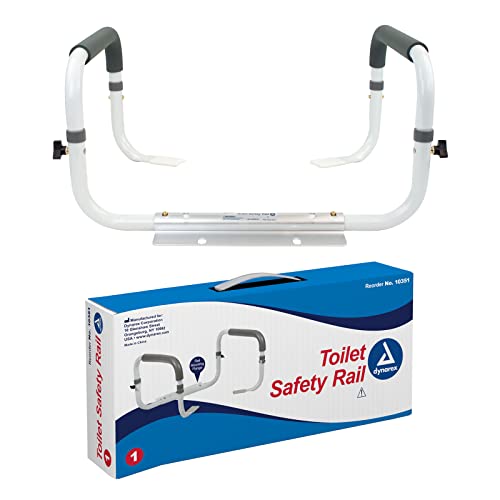
These use a bracket that sandwiches between the toilet seat and the bowl, fastened with the existing seat bolts, with arms extending forward on each side. They add hardly any width, install in about ten minutes with a wrench, and leave the floor completely clear for cleaning. The load transfers into the porcelain, so the weight rating is typically more modest than a floor frame.
Frames With a Raised Seat Built In
A combination unit carries a raised seating surface on the frame itself, so the height and the handholds arrive together. This suits someone who needs both, and it avoids stacking a clamp-on riser inside a frame, which can end up sitting too high. Our raised toilet seat guide covers the seat side of that decision.
Toilet Safety Rails by Situation
The Most Common Choice
An adjustable floor-standing frame covers the majority of homes. Legs adjust in height, most fold for storage, and nothing gets attached to the toilet, which matters in a rental. Check that the width setting clears the tank and any nearby vanity.

When Floor Space Is Tight
A bolt-on rail keeps the footprint to the toilet itself, so a narrow bathroom or a toilet tucked between a wall and a vanity stays usable. It also leaves the floor clear, which makes mopping around the toilet much easier.
When Height and Handholds Are Both Needed
A frame with an integrated raised seat handles both jobs in one piece of equipment, with the height set once on the legs rather than stacked from two products. Confirm the seat shape matches your bowl if the unit clamps to it.

When a Higher Weight Capacity Is Needed
Bariatric frames use heavier tubing, wider spacing between the arms, and higher stated weight ratings. Take that rating from the manufacturer’s listing rather than assuming it scales with size, and check the width against the bathroom before ordering.

Comparing the Mounting Types
| Type | Load goes to | Best where |
|---|---|---|
| Floor-standing frame | The floor, through four adjustable legs | Space allows, floor is level, higher capacity needed |
| Bolt-on rail | The toilet, via the seat bolts | Narrow bathrooms, clear floor for cleaning |
| Frame with raised seat | The floor, seat carried on the frame | Height and handholds both needed at once |
| Wall grab bar | Wall studs or proper anchors | Support needed while turning and stepping away |
Fitting Checks Before You Order
Measure three things: the distance from the wall behind the toilet to the front edge of the bowl, the free space to the left and right of the bowl, and the current seat height. Compare those against the frame’s footprint and its height adjustment range, since a frame that only adjusts within a narrow band may not suit an unusually low or comfort-height toilet.
Then look at the floor. A frame on uneven tile or a thick bath mat will rock slightly, and rocking is the fastest way to lose confidence in a support. Rubber-tipped feet grip well on tile and vinyl, and any wobble should be corrected by adjusting the leg heights individually rather than accepted as normal.
Renting? Check Before You Drill
Both floor frames and bolt-on rails install without making a hole in a wall, which is why they come up so often in rentals. If a wall bar would genuinely suit better, the conversation with a landlord is usually easier than expected, and our guide to grab bars for renters covers the no-drill options and how to ask.
Common Mistakes When Buying Toilet Rails
The first is stacking equipment without checking the total height. A clamp-on riser inside a frame set to its tallest position can leave the user’s feet off the floor, which makes standing up less controlled. Set the frame height to the user, not to the maximum.
The second is treating a frame as a general bathroom support. Frames are stable at the toilet and useless three feet away, so if the user needs a handhold on the route to the sink or shower, that is a job for a wall-anchored bar. Our grab bar placement guide covers the zones worth covering in a typical bathroom.
A Note on Getting Advice
Whether a frame, a bolt-on rail, a wall bar, or a combination suits best depends on how the user moves and where the difficulty actually shows up. If you are unsure what fits your situation, ask your doctor or an occupational therapist. A short home assessment often points to a simpler setup than a catalog would suggest.
Frequently Asked Questions
Do toilet safety frames need to be bolted down? Most floor-standing frames stand freely on rubber-tipped feet and are not fixed to the floor. Some models offer optional floor brackets. Bolt-on rails, by contrast, fasten through the existing toilet seat holes.
Will a frame fit around any toilet? Most adjust in height and many in width, but tank shape and nearby fixtures still decide it. Measure the clearance on each side of the bowl and the depth from the wall to the front rim, then compare against the frame’s footprint.
How much weight can toilet safety rails hold? It varies widely by model and mounting type, and the only reliable figure is the weight capacity the manufacturer states in the listing. Floor-standing frames generally carry higher ratings than rails that bolt to the porcelain.
Can you use a raised seat and a frame together? Yes, and many households do. Watch the combined height, because the aim is feet flat on the floor with the knees around ninety degrees, not the highest possible seat.
Are toilet rails suitable for a rental? Yes, since neither floor frames nor bolt-on rails require drilling into a wall. That makes them a common first step where a permanent grab bar is not an option.
Do the arms fold or swing out of the way? On many frames the arms flip or swing back so another household member can use the toilet normally, and so a caregiver can assist from the side. Check the listing, since fixed-arm models exist too.
Is a frame or a wall grab bar the better option? They cover different moments. A frame gives symmetrical support right at the toilet, a wall bar keeps supporting the user as they turn and step away. Where the budget and the wall allow, having both is common.
The Bottom Line
Toilet safety rails come down to where the load goes. A floor-standing frame is the most stable and adjustable and needs space and level flooring, a bolt-on rail keeps the footprint tiny in a narrow bathroom, and a combination frame handles height and handholds at once. Measure the clearance around the bowl, take the weight capacity from the listing, and treat a wall-anchored bar as the complement rather than the competitor. For the height side of the decision, see our raised toilet seat guide.