Last updated: August 20, 2026
A sofa is usually the lowest and softest seat in the house, with arms too far away and too rounded to push against. That combination is why plenty of people who manage fine in a dining chair need a hand getting off the couch. A stand assist rail gives them something solid and correctly placed to hold onto instead.
The category covers several designs that work differently: rails that slide under the sofa leg and are held by its weight, freestanding poles and frames, and handles that clamp to the arm. This guide explains which suits which piece of furniture, and how to check whether your sofa will actually hold one.
This article contains affiliate links. If you buy through them, we may earn a commission at no extra cost to you. Learn more.
Quick Answer
What is a couch stand assist rail?
- A handle beside the seat that gives you something solid to hold while standing up from a sofa or armchair.
- Most use a flat plate that slides under the furniture and is anchored by the weight of the sofa; others are freestanding or clamp to the arm.
- The plate design needs a sofa with a flat, solid base and enough weight to hold it, which is the first thing to check.
Bottom line: designed to provide something stable to push against; the design you need depends on how your sofa is built.
Why the Sofa Is the Hardest Seat in the House
Three things make a sofa difficult to stand up from. The seat is generally lower than a dining or office chair, the cushion is soft so it gives way rather than pushing back, and the arms are often wide, rounded, and too far to the side to press down on effectively.
A stand assist rail addresses the third of those directly by putting a solid vertical or angled handle right beside the hip, at a height where the arms can do useful work. Pairing it with a firmer seat, or with a lift assist cushion, addresses the other two.
The Three Main Designs
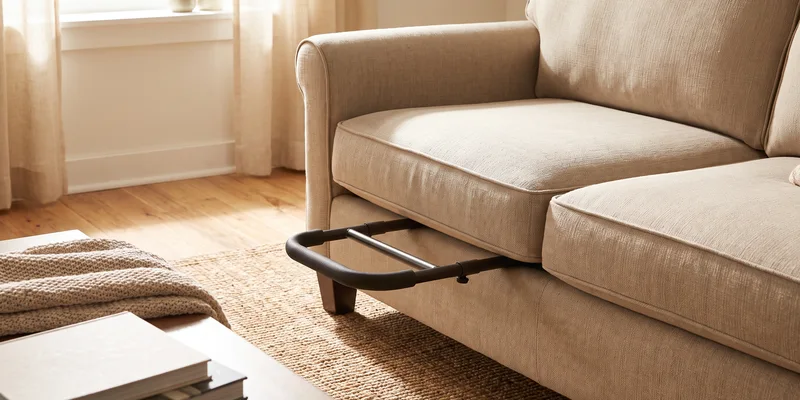
Under-furniture plate rails are the most common. A steel plate slides beneath the sofa or chair, the furniture’s own weight holds it in place, and an upright handle rises beside the seat. Nothing is screwed into the floor or the furniture, so they suit rentals.
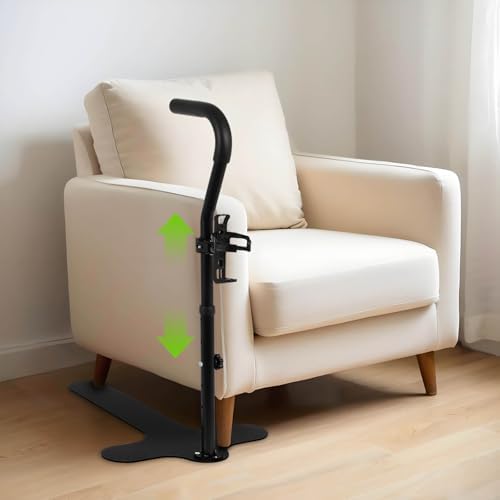
Freestanding floor-to-ceiling poles and weighted base frames sit independently of the furniture, which makes them an option where the sofa has no usable base. Arm-mounted handles clamp or strap to the sofa arm itself and are the lightest option, though they depend entirely on the arm being solid.
Which One Your Sofa Allows
Check underneath first. A plate rail needs a flat clearance under the furniture, typically a low gap between the floor and the frame, and it needs the sofa to be heavy enough to anchor it. A sofa on tall thin legs with an open underside, or a lightweight frame, may not suit a plate design at all, and that is when a freestanding option becomes the practical answer.
Stand Assist Rails by Situation
The Standard Under-Sofa Rail
A plate-style rail is the usual starting point for a conventional sofa with a solid base. Installation means lifting one side of the sofa, sliding the plate under, and setting it back down. Most models offer some adjustment in handle height or position.

Furniture That Cannot Take a Plate
Where the sofa is too light or has no flat underside, a freestanding stand assist pole or a weighted base handle stands on its own beside the seat. It takes more floor space and needs a level surface, but it does not depend on the furniture at all.

Recliners and Armchairs
A recliner is a different problem because the base moves and the footrest swings out. Rails designed for recliners account for that clearance, and some armchair users are better served by a handle that clamps to the arm rather than anything sitting on the floor beside a moving mechanism.
Comparing the Options
| Design | Needs | Suits |
|---|---|---|
| Under-furniture plate | Flat solid base, sufficient sofa weight | Conventional sofas, rentals, no tools |
| Freestanding pole | Floor space, level surface | Light furniture, awkward sofa bases |
| Weighted base frame | Floor space beside the seat | Where a pole is not wanted |
| Arm-mounted handle | A solid sofa or chair arm | Lightest option, easiest to move |
Checking Capacity and Stability
Every rail states a weight capacity in its listing, and that figure covers the load applied to the handle rather than the sitter’s body weight alone. Read it in the specifications and choose with headroom. Where a listing does not state one, that absence is worth asking about.
Stability is the practical test. Once installed, push down and pull on the handle with the sofa unoccupied and see whether anything shifts. If the rail moves, the plate is not sufficiently anchored and the design is not suited to that piece of furniture, whatever the listing says about compatibility.
Common Mistakes
Buying a plate rail for a sofa on tall thin legs is the most common one, because the underside offers nothing for the plate to sit against. Measuring the clearance under the furniture takes a minute and avoids a return.
The second mistake is placing the handle where it looks tidy rather than where it works. The handle should be beside the hip, within easy reach from a seated position, not out at the end of the sofa. Test the reach while seated before finalizing the position.
A Note on Getting Advice
A rail changes what someone has to hold onto; it does not change why standing has become harder. If you are unsure what fits your situation, ask your doctor or an occupational therapist, who can look at the movement itself and suggest whether a rail, a cushion, or a different chair would suit better.
Frequently Asked Questions
Does a stand assist rail damage the sofa? Plate designs sit under the furniture and are held by its weight, so nothing is screwed into it. Check the plate has a smooth or padded surface if the floor beneath is a delicate finish.
Will it work on any sofa? No. Plate rails need a flat, solid underside and enough furniture weight to anchor them. Sofas on tall thin legs or very light frames usually need a freestanding design instead.
Can it be used on a recliner? Only with a model designed for one, since the moving base and extending footrest need clearance. Check the listing specifically mentions recliner compatibility.
How much weight can a stand assist rail take? Each model states its own capacity in the listing. Compare that figure per product and choose one with clear headroom rather than assuming a category standard.
Do I need tools to fit one? Plate rails typically need no tools, only enough help to lift one side of the sofa. Some models require light assembly of the handle itself.
Is a rail better than a lift cushion? They solve different problems. A rail gives something to hold; a lift assist cushion raises and tilts the seat. Many people use both on the same sofa.
Where should the handle sit? Beside the hip, within comfortable reach from a seated position. Test the reach while sitting before deciding the final position.
The Bottom Line
A couch stand assist rail is a small change that makes a low sofa manageable again, provided the design matches the furniture. Check the underside clearance and the sofa’s weight before choosing a plate rail, consider a freestanding pole where the base is unsuitable, and test the handle for movement before relying on it. Pair it with a lift assist cushion if the seat is also too low, or look at a lift chair recliner if the sofa is beyond helping.