
Last updated: August 20, 2026
A lift chair recliner looks like an ordinary recliner until you press the button. Then the whole seat tilts forward and rises, moving the person sitting in it toward a standing position rather than asking them to push up out of a low seat. For a lot of households that one motion is the difference between a parent who settles into their favorite chair comfortably and a parent who quietly stops using it.
The category is bigger than it first appears. Chairs differ in how far they recline, how much weight they are rated to carry, how tall the seat sits off the floor, and whether the frame is sized for a person who is five feet tall or six foot four. This guide walks through those differences so you can match a chair to an actual body and an actual room, instead of guessing from a product photo.
This article contains affiliate links. If you buy through them, we may earn a commission at no extra cost to you. Learn more.
Quick Answer
How do you choose a lift chair recliner?
- Start with fit, not features. Seat height, seat depth, and the manufacturer’s listed user height range decide whether the chair is usable at all.
- Then pick a recline type: two-position for sitting and light reclining, three-position for a near-flat nap position, infinite position for independent back and footrest control.
- Check the weight capacity stated in the listing, confirm you have wall clearance behind the chair, and look for whether a battery backup is included for power outages.
Bottom line: measure the person and the room first, then choose the recline type and extras that match how the chair will actually be used.
What a Lift Chair Recliner Actually Does
A lift chair recliner is a powered recliner with an extra function: a motor tilts the base and seat forward and upward, bringing the sitter closer to standing so the effort of rising comes from the chair rather than from the arms and knees. It is designed to provide support during that transition, and it also reclines like a normal chair once the person is seated.
That dual role matters when you are comparing products, because a chair that lifts well is not automatically a chair that is comfortable to sit in for four hours. Many families end up prioritizing the recline comfort as heavily as the lift, since the chair usually becomes the seat someone uses all day.
Two-Position, Three-Position, and Infinite Position
Recline type is the first real fork in the road. Two-position chairs recline to roughly 45 degrees, enough for watching television but not for sleeping. Three-position chairs go back much further, close to flat, which suits napping. Infinite position chairs use two motors so the back and the footrest move independently, allowing a true zero gravity style posture.
Price and complexity rise across those three, and so does the chair’s footprint when reclined. If the chair will be used mainly for sitting up and getting up, a two-position model is often plenty. If it is going to serve as a place to sleep some nights, look at three-position or infinite position models instead.
Why the Number of Motors Matters
Single motor chairs move the back and footrest together on one linkage, so you cannot raise the legs while sitting upright. Dual motor chairs separate them. Anyone who has been told to keep their legs elevated while remaining upright will find that difference significant, and it is worth confirming in the listing rather than assuming, since some listings describe a chair as infinite position without stating the motor count.
Lift Chair Recliners by Situation
The Standard Starting Point for Most Homes
A mid-size two-position or three-position lift recliner in a durable fabric covers the majority of situations: a person of average height who wants an easier stand, a comfortable recline, and simple two-button operation. Chairs in this bracket are widely stocked, which also means replacement parts and hand controls are easier to source later.

Shorter Users Who Sink Into a Standard Chair
A petite or small frame lift chair uses a lower seat height and a shallower seat, so the feet reach the floor and the back is actually supported. On a standard chair, a shorter person is often pushed forward at the knees with their lower back unsupported, which no amount of cushioning fixes. Our guide to small lift chairs covers the measurements to compare.
Higher Weight Capacity and a Wider Seat
Heavy duty and bariatric models use reinforced frames, stronger lift motors, and wider seats. The number that matters here is the weight capacity printed in the listing, and it should be treated as a hard limit rather than a rough guide. See our bariatric lift chair guide for what changes at higher capacities.

Households That Want an Easy-Clean Surface
Leather and faux leather upholstery wipes down rather than absorbing spills, which is why it is a common choice where the chair is used for meals or where cleanup needs to be quick. The tradeoffs, including how the material behaves in hot rooms, are covered in our leather lift chair guide.

Comfort Extras for All-Day Sitting
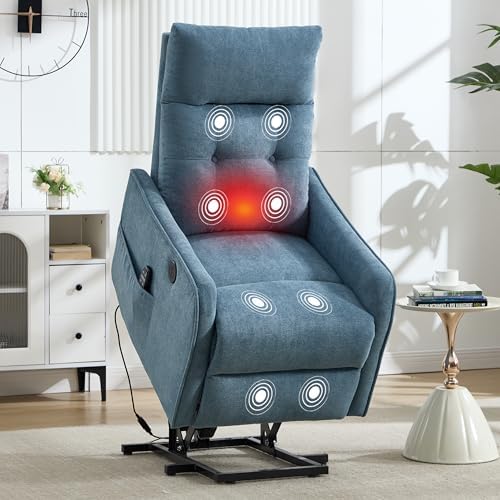
Heat and massage functions appear on many mid-range and upper-range chairs. They are comfort features rather than anything clinical, and they add wiring and a second controller. If they appeal to you, our heat and massage lift chair guide explains what the settings usually do.

Comparing the Main Choices
| Type | Recline | Best suited to |
|---|---|---|
| Two-position | To roughly 45 degrees | Sitting, reading, television; simplest mechanism |
| Three-position | Close to flat | Napping in the chair as well as sitting |
| Infinite position | Back and legs move separately | Legs up while upright, zero gravity style positions |
| Petite frame | Varies | Shorter users whose feet do not reach the floor |
| Bariatric frame | Varies | Higher listed weight capacity, wider seat |
Sizing Is the Part People Get Wrong
The most common regret with a lift chair is not the recline type, it is the size. A seat that is too deep leaves the lower back unsupported. A seat that is too high leaves the feet dangling. A back that is too short stops below the shoulders. Manufacturers publish a user height range and a seat height for exactly this reason, and it is worth writing those numbers down before shopping.
Measure the person sitting in a firm kitchen chair: floor to the back of the knee, back of the hip to the back of the knee, and seated shoulder height. Those three numbers map directly onto seat height, seat depth, and back height in the product specifications. Our lift chair sizing walkthrough takes each measurement step by step.
Power, Clearance, and What Happens in an Outage
Lift chairs run on mains power through a transformer, and most need clearance behind them to recline. Wall-hugger designs slide forward as they recline and need only a few inches, while traditional frames may need a foot or more. Measure the wall space before ordering, not after the box arrives.
Many chairs include a battery backup that will run the lift function once or twice during a power cut, usually on a pair of nine volt batteries. Check whether the batteries are included and whether the chair returns to the seated position or the standing position when the backup is used, since that behavior differs between models.
Common Mistakes When Buying a Lift Chair
Buying on upholstery color and recline type alone, without checking the user height range, is the mistake that leads to the most returns. Lift chairs are heavy and awkward to send back, so the specification check is worth doing carefully the first time.
The second is underestimating delivery. These chairs weigh a great deal and usually need two people to position, so ask whether room-of-choice delivery is offered.
When a Full Chair Is More Than You Need
If the existing armchair is otherwise comfortable and the only problem is the last few inches of standing up, a powered lift assist cushion sits on the existing seat and does a smaller version of the same job. A stand assist rail beside the sofa is another lower-commitment option worth comparing before buying a full chair.
A Note on Getting Advice
A lift chair is a piece of furniture, not a medical intervention, and this guide describes products rather than care. If you are unsure what fits your situation, ask your doctor or an occupational therapist, who can look at how someone actually moves and suggest what would suit them. Occupational therapists commonly help families with exactly this kind of home equipment decision.
Frequently Asked Questions
What is the difference between a lift chair and a power recliner? A power recliner reclines electrically but does not tilt forward to help you stand. A lift chair does both, using a motor that raises and tilts the whole seat toward standing.
How much space does a lift chair need behind it? It depends on the frame. Wall-hugger models slide forward as they recline and typically need only a few inches, while traditional frames can need a foot or more. The clearance figure is usually listed in the product specifications.
Do lift chairs work during a power outage? Many include a battery backup that powers the lift for a limited number of cycles, usually on standard nine volt batteries. Check whether the backup is included and what position the chair returns to when it is used.
Is a two-position or three-position chair better? Neither is better in general. Two-position chairs suit sitting and light reclining, three-position chairs recline close to flat for napping, and infinite position chairs move the back and legs independently.
How do I know what size lift chair to order? Compare the person’s seated measurements against the manufacturer’s stated seat height, seat depth, and user height range. Our lift chair sizing guide walks through how to take each measurement.
Will Medicare pay for a lift chair? Coverage rules differ by plan and by individual situation, and no website can tell you what applies to you. The official information is at medicare.gov, and our neutral overview of lift chairs and Medicare explains what questions to ask.
Can a lift chair be used as a bed? Some three-position and infinite position models recline close to flat and are used for sleeping. Whether that is appropriate for a particular person is a question for their doctor or an occupational therapist rather than a product decision.
The Bottom Line
The best lift chair recliner is the one sized to the person who will sit in it every day, with a recline type that matches how it will be used and a weight capacity that comfortably covers them. Take the three seated measurements first, decide between two-position, three-position, and infinite position second, and treat heat, massage, and upholstery as the last decisions rather than the first. If a full chair is more than the situation calls for, start with a lift assist cushion instead.