Last updated: August 20, 2026
A transfer bench arrives in a box, gets assembled in ten minutes, and then sits there while everyone works out how it is actually meant to be used. The physical product is simple; the sequence of movements is what makes it work, and getting that sequence wrong is why some households give up on a bench that was the right purchase.
This guide walks through setting the bench up correctly, the order of movements getting in and getting out, what a helper should and should not do, and the small setup details that make the difference between a bench that gets used daily and one that gets pushed against a wall.
This article contains affiliate links. If you buy through them, we may earn a commission at no extra cost to you. Learn more.
Quick Answer
How do you use a transfer bench?
- Sit down on the outer section of the seat first, with both feet still on the bathroom floor, before anything else happens.
- Then move one leg at a time over the rim, sliding along the seat as you go, rather than lifting a leg while standing.
- Getting out reverses the same order: slide out first, both feet down on the bathroom floor, then stand.
Bottom line: sit before you cross, and cross before you stand. Ask your doctor or an occupational therapist if you are unsure what suits your situation.
Set the Bench Up Before Anyone Uses It
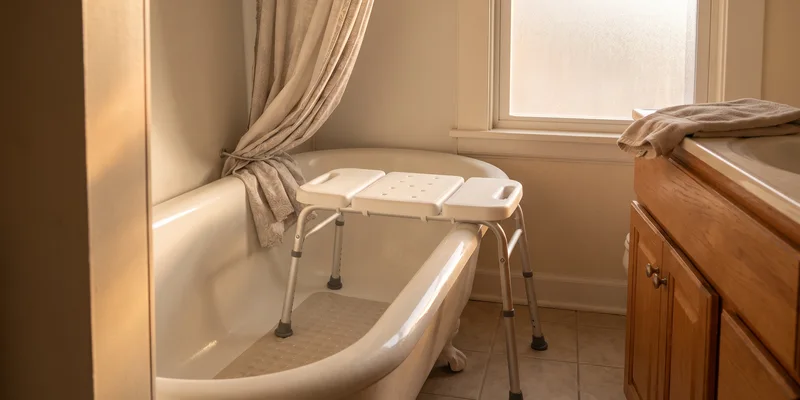
Adjust all four legs independently so the seat sits level, with the two outer legs on the bathroom floor and the two inner legs standing flat on the tub floor. Then press down on each corner of the seat in turn. Any rock at all means a leg needs adjusting; a bench that rocks slightly when empty will rock more with weight on it.
Check the manufacturer’s instructions for the specific model, because leg ranges, backrest fittings, and any locking mechanism differ between benches. If the model has a sliding or swivel seat, test the lock with a hand pressed hard on the seat before anyone sits on it.
Set the Room Up Too
Solve the curtain before the first use, with a split arrangement or a curtain that tucks inside the tub, so water does not end up on the bathroom floor. Move soap and shampoo to within reach of the seated position, and put a non-slip mat on the bathroom floor where feet land on the way out.
Getting In, Step by Step
The whole sequence is built around never lifting a leg over the rim while standing. Work through it slowly the first few times, in the order below, and let it become habit before speeding up.
- Stand with your back to the bench, beside the tub, feeling the front edge of the seat against the back of your legs.
- Reach back for the seat or the grab bar with one or both hands, and lower yourself onto the outer section of the bench.
- Settle fully onto the seat, both feet still on the bathroom floor, before moving anything else.
- Lift the leg nearest the tub over the rim, using a hand under the thigh if that helps, and place the foot on the tub floor.
- Slide or shuffle along the seat toward the tub, or release the swivel lock and rotate if the model has one.
- Bring the second leg over the rim and place it beside the first, then reset any lock before starting the water.
Getting Out, Step by Step
Getting out is the same sequence in reverse, and it is the half people rush because the shower is finished. Turn the water off first, and if there is a towel or robe within reach, use it before moving rather than after.
- Turn the water off and let the immediate drips clear before moving.
- Slide back along the seat toward the outer section, using the same handhold you used coming in.
- Lift one leg over the rim and place the foot flat on the bathroom floor, ideally onto a non-slip mat.
- Bring the second leg across so both feet are down and stable.
- Pause, then stand using the arms of the bench or a grab bar rather than pushing off the tub rim.
If Someone Is Helping
A helper’s job with a transfer bench is mostly steadying and prompting, not lifting. Stand on the open side, keep one hand available at the shoulder or upper back for balance, and let the person move themselves at their own pace. Talking through the next step before it happens usually does more than any physical help.
Where more support than that is needed, a gait belt is the equipment designed for it, and it has its own technique. That is covered in our gait belt guide. Lifting someone under the arms is not the approach to use, and a professional should show the technique before it becomes routine.
Setup Details That Change Everything
| Detail | Why it matters |
|---|---|
| Handheld shower head | A fixed head sprays past a seated user rather than onto them |
| Long hose | Needs to reach the far end of the seat comfortably |
| Grab bar or tub rail | Gives a fixed handhold during the slide across |
| Split shower curtain | Keeps water in the tub where the bench crosses the rim |
| Non-slip mat outside | Feet land there on the way out |
| Toiletries within reach | Removes the need to lean or stand mid shower |

Common Mistakes
- Standing to lift a leg over the rim. The bench exists so that leg lift happens while seated.
- Standing up while still over the tub. Slide out fully so both feet are on the bathroom floor first.
- Pushing off the tub rim to stand. A wet porcelain edge is not a handhold; use the bench arms or a grab bar.
- Leaving a sliding seat unlocked. Set the lock as a fixed step, not an occasional check.
- Leaving the bench rocking. Adjust each leg until all four corners are solid.
- Reaching for shampoo across the tub. Move everything within reach before the water starts.
Keeping the Bench in Good Shape
Rinse and dry the frame after use, and check the rubber tips every few months. Tips that have gone smooth and glazed no longer grip a wet floor, and replacements are usually available for the same model. Recheck the leg locks and any fasteners periodically, since repeated weight cycles loosen fittings over time.
If the bench starts to rock again after months of use, that is normally a leg that has slipped rather than a fault. Reset all four and press each corner again before assuming the bench needs replacing.
When to Ask for Guidance
The sequence above is the standard pattern, but the right technique for a specific person depends on which side is stronger, how they sit down, and what else is going on. Occupational therapists commonly watch a tub transfer once and adjust the sequence to the person. If you are unsure what fits your situation, ask your doctor or an occupational therapist.
Frequently Asked Questions
Which leg goes over the tub rim first? Usually the leg nearest the tub, moved while fully seated. Where one side is stronger than the other, the sequence may need adapting, which is a good question for an occupational therapist.
Should the bench be attached to the tub? Most transfer benches are not clamped. They rely on four independently adjusted legs and rubber feet, so the setup step is to adjust each leg until the seat sits level and does not rock.
How do you stop water going all over the bathroom floor? Use a split curtain, one panel inside the tub and one outside, or a curtain cut to overlap at the bench. Aiming a handheld shower head downward rather than across helps a great deal.
Can a transfer bench be used alone? Many people use one independently. Whether that is appropriate depends on balance and strength on the day, and it is worth having the routine watched once by a professional before assuming it is.
What if the bench rocks? Readjust all four legs on the surfaces they actually stand on, then press each corner of the seat in turn. Rocking usually means one leg is set slightly short rather than that the bench is faulty.
Do I need a grab bar as well? A fixed handhold during the slide across makes the movement considerably easier, and a clamp on tub rail or a properly anchored grab bar both do that job.
How long does the routine take at first? Slower than the old way, which is normal. The sequence becomes automatic within a week or two, and rushing it in the first days is what causes problems.
The Bottom Line
The rule that makes a transfer bench work is simple: sit before you cross, and cross before you stand. Set the legs so nothing rocks, solve the curtain and the shower head before the first use, and keep a fixed handhold within reach. If the bench itself is still on the shopping list, our transfer bench buying guide covers fit and the sliding versus fixed decision.