Last updated: August 20, 2026
Some links on this page are affiliate links. If you buy through them we may earn a commission at no extra cost to you. See our affiliate disclosure.
Suction grab bars are appealing for obvious reasons. No drilling, no landlord conversation, no holes in the tile, and a package that arrives ready to press onto a wall in about ten seconds. For a lot of households that combination is exactly what they were looking for, which is why these bars sell in volume.
They also come with a limit that is easy to miss in the listing photos, and it is the single most important thing to understand before buying one. This guide covers what suction bars are actually designed to do, where they make sense, where they do not, and how to use one properly if you decide it fits your situation.
Quick Answer
Are suction grab bars safe to use?
- Manufacturers describe suction cup bars as balance aids, not weight bearing supports, and their own instructions say they should not be used to hold a person’s full body weight.
- They need a smooth, non porous, completely flat surface, which rules out textured tile, small tiles with wide grout lines, and most stone.
- The seal weakens over time and with temperature change, so the indicators must be rechecked before every single use.
- They are genuinely useful for travel, hotels, and short stays where drilling is impossible.
Bottom line: a suction bar is a steadying handle for a person who is already stable, not a substitute for a mounted bar.
What a Suction Grab Bar Is Designed to Do
A suction grab bar holds itself to the wall with two vacuum cups and a locking lever at each end. When the lever is thrown, air is pushed out of the cup and atmospheric pressure holds it in place. That is real force, and the bar will feel solid to the hand when it is correctly seated on the right surface.
What it is not designed for is a sudden, full body load applied at an angle. Manufacturers are consistent about this in their own documentation: these products are positioned as balance assists and steadying handles. The difference matters most in exactly the moment when it is hardest to think about, which is why the limit deserves to be taken literally rather than treated as legal caution.
The Language on the Box
Look at how the product describes itself. Phrases like balance assist, steadying handle, or not for supporting body weight appear in the instructions of most reputable brands. A listing that promises otherwise is worth being skeptical of, and the stated limits in the manual outrank any marketing copy on the page.
Where Suction Bars Genuinely Make Sense
Dismissing suction bars entirely misses the situations where they are the best available answer. The common thread is that the alternative is nothing at all, and the person using it has reasonably good balance already.
Travel, Hotels, and Visits
An unfamiliar bathroom in a hotel or a family member’s home is where these bars come into their own. Pack it, press it onto the tile, use it as a steadying point, and take it home. This is the use case the category was really built for, and travel sized versions fold or pack down small.

As a Second Handhold Next to a Mounted Bar
Where a properly mounted bar already carries the real load, a suction bar can add a convenient handhold at a spot that is awkward to drill, such as on a shower door frame area or a small return wall. It supplements a mounted bar rather than replacing it.

While a Permanent Installation Is Being Arranged
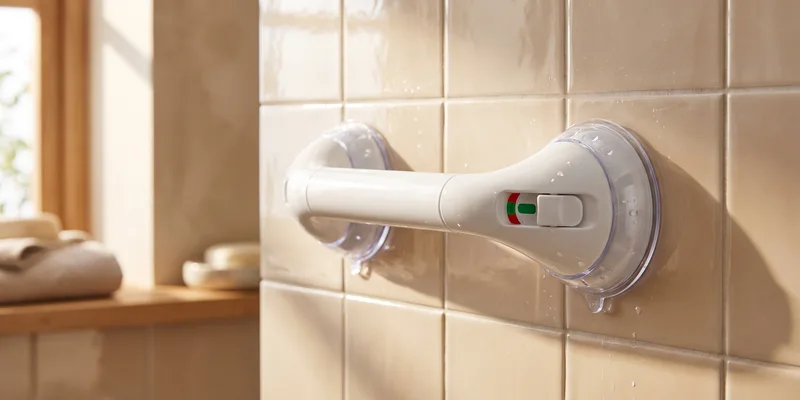
Waiting for a contractor, an assessment, or a landlord’s approval can take weeks. A suction bar covers a gap in the meantime, on the understanding that it is a stopgap and the mounted bar is still the plan. Choose a model with clear red and green seal indicators so the check is unambiguous.

When It Is Not the Right Product
If someone leans heavily, pulls hard to stand up, or has lost their balance in that bathroom before, a suction bar is not the answer and a mounted bar is. The same applies to a bathroom used daily by someone who needs support every time. If you are unsure what fits your situation, ask your doctor or an occupational therapist, who can look at the actual movement.

Surface Requirements Nobody Reads
Most suction bar disappointments come down to the wall rather than the bar. The cup needs a completely smooth, non porous, flat, clean surface with no grout line running underneath it, and the seal degrades quickly on anything else.
| Surface | Suitability for suction cups |
|---|---|
| Large smooth glazed tile | Generally suitable if the cup sits entirely within one tile |
| Small tile or mosaic | Not suitable; grout lines break the seal |
| Textured or matte tile | Not suitable; the surface is not airtight |
| Fiberglass or acrylic surround | Often suitable if smooth and flat, but the shell may flex |
| Natural stone | Usually not suitable; most stone is porous |
| Painted drywall | Not suitable; the paint layer can lift away with the cup |
Soap film, body oils, and cleaning residue also break a seal, so the wall and the cup both need cleaning before mounting. So does a temperature change, which is why a bar that felt solid before a hot shower can be looser afterwards.
How to Use One Properly
If a suction bar is the right call, the routine matters more than the model. Clean the wall and the cups, position the bar entirely within a single smooth area, press firmly, and throw both levers fully. Then check the seal indicators, which show green when the vacuum is holding and red when it is not.
Recheck those indicators before every use, not once a week. A suction bar that has been on the wall for three days through several hot showers is a different proposition from one mounted five minutes ago, and the indicator is the only reliable way to know which one you are looking at.
Signs It Should Come Off the Wall
Any red indicator, any visible gap at the edge of a cup, any movement when you press on the bar, or any slow slide down the tile means the bar comes off, gets cleaned, and gets remounted. If it will not hold reliably on that wall, the wall is telling you the answer.
The Alternatives Worth Comparing
Before settling for a suction bar because drilling seems impossible, it is worth knowing that no drill does not have to mean suction. Clamp on tub rails grip the rim of a bathtub, tension mounted floor to ceiling poles brace between solid surfaces, and freestanding toilet frames need no wall at all.
All three carry considerably more load than a suction cup and none of them put a hole in the tile, which is why they are usually the better first stop for renters. Our guides to no drill grab bars and grab bars for renters compare those options side by side.
Frequently Asked Questions
How much weight can a suction grab bar hold? Manufacturers position these as balance aids rather than weight bearing supports, and most instruction sheets state explicitly that the bar should not be used to hold a person’s full body weight. Any figure quoted in a listing applies only under ideal seal conditions, so it should not be planned around.
Do suction grab bars work on textured tile? No. The cup needs a completely smooth, non porous surface to form a vacuum, so textured tile, matte finishes, and most natural stone are unsuitable, as is any position where a grout line runs under the cup.
How often should I check a suction grab bar? Before every use. The seal weakens with time, temperature change, and soap residue, which is why reputable models include red and green indicators at each cup.
Are suction grab bars good for elderly parents? They can be reasonable as a steadying handle for someone with good balance, particularly when traveling. For daily use by someone who needs real support, a properly mounted bar is the appropriate product, and an occupational therapist can advise on which applies.
Can suction grab bars be used on a fiberglass shower? Often yes if the surface is smooth, flat, and clean, though the shell may flex under load. See our guide to grab bars for fiberglass showers for mounted options in that situation.
What is the difference between a suction bar and a no drill grab bar? Suction is one type of no drill mounting, and the weakest. Clamp on tub rails, tension poles, and freestanding frames are also drill free and carry far more load.
Why does my suction grab bar keep falling off? Almost always the surface: a grout line under the cup, a textured or porous finish, soap film, or a temperature swing after a hot shower. Clean both surfaces and reposition, and if it still will not hold, that wall is not suitable.
Can I leave a suction bar mounted permanently? It can stay on the wall, but it still needs its indicators checked before each use, so it never becomes a fixture you can stop thinking about the way a mounted bar does.
The Bottom Line
Suction grab bars are a legitimate product with a narrow job: a steadying handle on a smooth, clean surface for someone who already has reasonable balance, checked before every use. They are excellent for travel and reasonable as a stopgap, and they are not a substitute for a bar anchored into the wall. If drilling is the obstacle, look at clamp on rails and tension poles first, and see our grab bar buying guide for the mounted options.