Last updated: August 20, 2026
Standard cutlery is designed around an assumption: that the hand holding it can close firmly around a thin handle and hold a steady angle for the length of a meal. When that stops being true, eating gets slower and messier, and a lot of people quietly start avoiding certain foods rather than mention it.
Adaptive utensils are the direct answer, and there are more variations than most people expect. This guide covers built-up handles, weighted sets, angled and swivel designs, one-handed cutting tools, and the plates and cups that go with them, along with which situation each one suits.
This article contains affiliate links. If you buy through them, we may earn a commission at no extra cost to you. Learn more.
Quick Answer
Which adaptive utensils should you choose?
- Built-up handles suit a hand that cannot close tightly around a thin handle, because a thicker grip needs less finger closure.
- Weighted handles are commonly suggested by occupational therapists when an unsteady hand makes a loaded spoon hard to keep level.
- Angled and swivel designs help when the wrist cannot rotate far enough to bring the spoon to the mouth.
- A rocker knife lets one hand cut, which matters when the other hand cannot hold a fork steady.
If you are unsure what fits your situation, ask your doctor or an occupational therapist, who can watch an actual meal.
Matching the Utensil to the Difficulty
Adaptive cutlery is easier to shop for once you separate three different problems: holding the utensil, steadying it, and getting it to the mouth at the right angle. Different designs address different ones, and a set that solves the wrong problem gets abandoned quickly.
| Design | What it addresses | Notes |
|---|---|---|
| Built-up handle | Difficulty closing the hand around a thin handle | Foam or molded grips, typically much thicker than standard cutlery |
| Weighted handle | An unsteady hand carrying a loaded spoon | Heavier than standard; the added weight is stated in the listing |
| Angled or bent | Limited wrist rotation | Sold in separate left and right hand versions |
| Swivel | Keeping a spoon level through the whole movement | The bowl pivots so it stays horizontal as the arm moves |
| Rocker knife | Cutting with one hand | A curved blade rocks through food instead of sawing |
| Universal cuff | Very limited grip | A strap holds the utensil against the hand without gripping |
Built-Up Handles
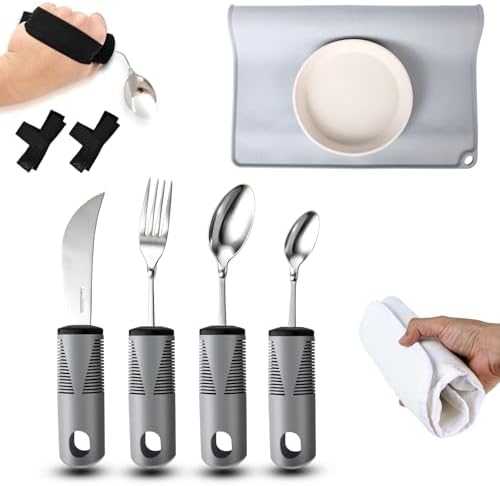
A built-up handle is simply a much thicker grip, usually foam or a molded rubber shape. The mechanics are straightforward: the less far the fingers have to curl, the less strength is needed to hold on, and a thicker handle also spreads pressure across more of the hand instead of concentrating it on the fingertips.
Sets come as fixed-handle cutlery or as separate foam tubes you slide onto existing cutlery. The tubes are worth knowing about, because they also fit toothbrushes, pens, and razors, which are usually the next things to become awkward. Fixed sets tend to be more dishwasher-friendly, so check that in the listing if it matters.
Weighted Utensils
Weighted cutlery uses added mass in the handle to make small involuntary movements less pronounced at the end of the utensil. Occupational therapists commonly suggest them when a hand is unsteady and a full spoon tends to tip before it arrives.
Weight is a trade-off rather than a free improvement, because a heavier utensil is more tiring to hold through a whole meal, and someone with limited arm strength may find a light one easier overall. This is exactly the situation where a professional opinion is worth more than a product description, since the right answer depends on the balance between steadiness and stamina.

Angled, Bent, and Swivel Designs
Angled utensils bend the neck so the bowl of the spoon sits at an offset to the handle, which lets the hand approach the mouth without the wrist having to rotate as far. They are handed, so check whether a listing is for left or right hand use before ordering.
Swivel utensils go further: the bowl is mounted on a pivot so it stays level on its own as the arm moves through the arc. That removes the need to control the angle at all, which is a different problem from strength and a common reason food ends up on the table rather than in the mouth.
Which One First
If the difficulty is holding, start with built-up handles. If food spills on the way up, look at swivel or weighted designs depending on whether the issue is angle or steadiness. Trying to solve all three at once with one expensive set usually ends with something that suits none of them.
Cutting With One Hand
Cutting normally needs two hands doing different jobs, and it is often the first thing to become impossible when one hand is out of action. A rocker knife solves it with a curved blade that rocks down through food using body weight rather than a sawing motion, so one hand can cut without a fork holding the food in place.
Some versions combine the rocker blade with a fork edge on one side, which lets the same tool cut and lift. Look for a handle that matches whatever grip design suits the rest of the set, since a rocker knife with a thin standard handle reintroduces the original problem.

Plates, Bowls, and Cups
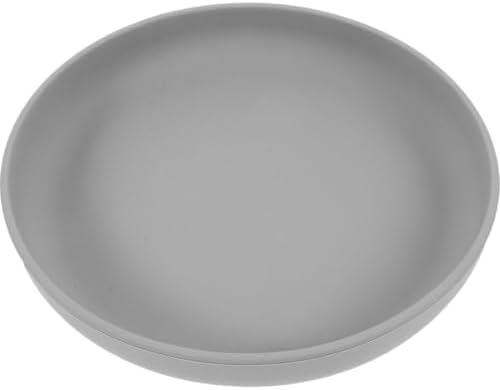
Cutlery is only half the table. A plate that slides while being pushed against is as much of an obstacle as a fork that cannot be held, and the fixes are cheap. Scoop dishes have one raised curved side that food can be pushed against to load a spoon, and plate guards clip onto ordinary plates to do the same job.
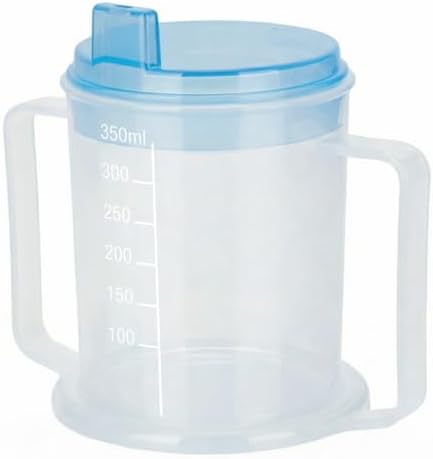
Non-slip mats under the plate stop it traveling, and two-handled mugs with a lid make drinking possible with less grip and less spillage. Cut-out cups, which have a notch for the nose, allow drinking without tilting the head back.
Practical Buying Notes
Check three things before ordering: whether the set is dishwasher safe, whether handle sizes are stated, and whether the pieces are sold individually. Many people need a spoon and a fork but not a full set, and buying separately is often the better answer.
Presentation matters more than product descriptions admit. Cutlery that looks obviously clinical gets used less at a family table than something that reads as ordinary, and several manufacturers now make sets in stainless steel with discreet grips for that reason. It is a small thing that affects whether the utensils actually get used.
Frequently Asked Questions
What are adaptive utensils? Eating utensils modified so they need less grip strength, less wrist rotation, or less steadiness than standard cutlery. The common variations are built-up handles, weighted handles, angled necks, swivel bowls, and rocker knives.
Are weighted utensils better than built-up handles? They solve different problems. Built-up handles help when holding the utensil is hard; weighted handles help when an unsteady hand cannot keep a loaded spoon level. Weight also makes a utensil more tiring to hold, so it is not automatically the better choice.
What is a swivel spoon? A spoon whose bowl is mounted on a pivot so it stays level on its own as the arm moves. It removes the need to control the angle of the wrist through the movement.
What is a rocker knife used for? Cutting food with one hand. The curved blade rocks down through food using body weight rather than a two-handed sawing motion.
Can you adapt regular cutlery instead of buying a set? Yes. Foam tubing slides over existing handles to build them up, and the same tubes fit toothbrushes, pens, and razors. Fixed-handle sets tend to be easier to clean.
What is a universal cuff? A strap that holds a utensil against the palm so it can be used without gripping at all. It is usually chosen when hand closure is very limited.
Do adaptive utensils go in the dishwasher? Some do and some do not, particularly foam-handled versions. The listing states it, and it is worth checking, because hand-washing awkward handles is its own chore.
The Bottom Line
Pick adaptive utensils by the specific difficulty rather than by the size of the set. Built-up handles for holding, weighted handles for steadiness, angled or swivel designs for wrist movement, a rocker knife for one-handed cutting, and a scoop dish with a non-slip mat to make loading the spoon possible. An occupational therapist watching one meal will identify the right combination faster than any product page. If lids and packaging are also difficult, jar openers for weak or stiff hands cover the rest of the kitchen.