Last updated: August 20, 2026
The awkward thing about a grab bar beside a toilet is that it is in the way for everyone who does not need it. In a family bathroom, in a guest bathroom, or in any room where the toilet sits close to a doorway or a vanity, a fixed horizontal bar sticking out into the space is a nuisance eleven times a day and a support the twelfth.
A flip up grab bar solves that by hinging at the wall or at the floor. Pull it down when it is needed, push it up flat against the wall when it is not. This guide covers how the two mounting types differ, what the wall behind one actually has to be, and where a flip up bar is the wrong answer.
This article contains affiliate links. If you buy through them, we may earn a commission at no extra cost to you. Learn more.
Quick Answer
What should you know before buying a flip up grab bar?
- Wall-mounted flip up bars need solid backing behind the drywall, because a hinged bar puts far more leverage on its fixings than a straight bar bolted at both ends.
- Floor-mounted versions bolt into the floor instead and suit walls that cannot take the load, though they do occupy floor space permanently.
- Check that the bar locks positively in the down position and that the up position clears whatever is beside the toilet.
Bottom line: choose wall or floor mounting based on what your bathroom structure can actually carry, then check the locking action before anything else.
What a Flip Up Grab Bar Does Differently
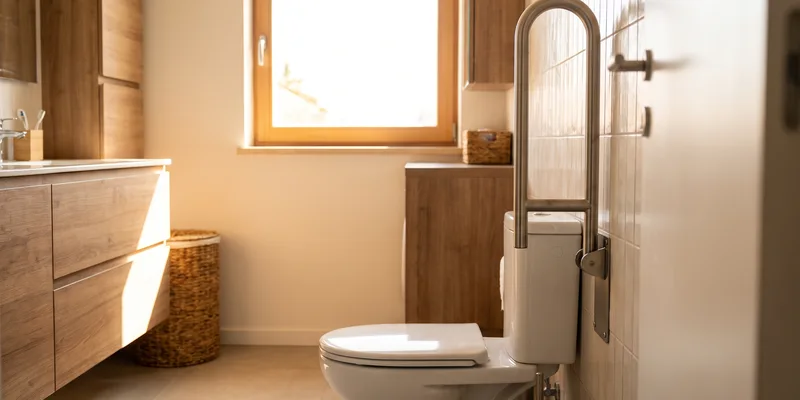
A flip up bar, sometimes sold as a swing up or fold away rail, is hinged at one end. In the down position it sits horizontal at roughly armrest height beside the toilet, giving something to push down on when standing up. In the up position it rests vertically against the wall and takes up almost no space.
That single hinge is the whole appeal and the whole complication. It means the bar can live in a bathroom that is too tight for a permanent horizontal rail, and it also means all the load ends up at one end rather than being shared between two mounting plates. Everything below follows from that.
Where They Are Usually Fitted
Beside a toilet is the classic position, on the side someone leads with when standing up, or on both sides where the transfer is from a wheelchair. They also appear beside a shower seat and in narrow entryways, though the toilet is where most households start. Our overview of grab bars for the toilet covers the fixed alternatives.
Flip Up Grab Bars by Situation
A Standard Wall-Mounted Flip Up Bar
The most common configuration: a single mounting plate on the wall beside the toilet, with the bar swinging up and down from it. It keeps the floor completely clear, which matters for cleaning and for anyone using a walker in the same room. It also asks the most of the wall.

When the Wall Cannot Take the Load
Older bathrooms, hollow partition walls, and tiled walls with an unknown structure behind them are all reasons to shift the load to the floor instead. Floor-mounted flip up rails bolt into the floor beside the toilet and lean nothing on the wall at all, which makes them the practical choice in a lot of retrofits.

Where Both Sides Need Support
A transfer from a wheelchair or a commode usually wants a bar on the approach side that lifts out of the way and a fixed support on the other. Pairs of flip up rails are sold for exactly this, and they let the same toilet serve a standing user and a seated transfer without rearranging anything.
Doubling as a Paper Holder
Some flip up bars carry an integrated toilet roll holder on the underside of the arm, which puts the roll within easy reach and removes one more wall fixture from a tight room. It is a small thing that matters more in a small bathroom than it sounds.

Higher Listed Weight Capacity
Heavy duty and bariatric flip up rails use thicker tube, larger mounting plates, and in some cases a floor leg that drops down when the bar is lowered. That leg transfers part of the load straight to the floor, which changes the demand on the wall considerably. Read the capacity from the listing for the exact model.

Mounting: The Part That Decides Everything
A hinged bar is a cantilever. All of the load applied at the free end is multiplied at the mounting plate, which is why manufacturers of wall-mounted flip up rails specify solid backing, usually a stud or a piece of blocking spanning studs, rather than any drywall anchor.
In practice that often means opening the wall to add blocking, or choosing a model whose plate is wide enough to catch two studs. Where neither is possible, the floor-mounted version exists precisely for that situation. Our guide to grab bar anchors and mounting hardware goes through the fixing options in detail.
Height and Distance From the Toilet
Most flip up rails are fitted so the arm sits at roughly the height of a chair armrest above the toilet seat, close enough to push down on without reaching out. The ADA standard specifies grab bars at 33 to 36 inches above the floor for accessible toilet compartments, which is a useful reference point though a home bathroom is not bound by it. Set the final height around the person who will use it.
Comparing Flip Up Bar Types
| Type | Best suited to | Watch out for |
|---|---|---|
| Wall mounted | Clear floor, easy cleaning | Needs solid blocking behind drywall |
| Floor mounted | Walls that cannot carry the load | Permanent footprint on the floor |
| With support leg | Higher listed capacity | Leg must land on firm flooring |
| Paired left and right | Wheelchair or commode transfers | Needs backing on both sides |
| With paper holder | Small bathrooms, fewer fixtures | Roll can foul the up position |
Weight Capacity and the Locking Action
Two specifications matter more than the rest. The first is the weight capacity stated in the product listing, which assumes the bar has been installed into the backing the manufacturer requires. It is a figure for the whole installed assembly, not for the metal alone, and it should be read from the listing for that model.
The second is how the bar behaves at each end of its travel. A good flip up rail stays put in the up position rather than drifting down, and sits firmly at horizontal without any droop when weight goes on it. A bar that creeps downward while nobody is touching it is a bar that will move at the wrong moment.
Check It Every Few Months
Hinges loosen and fixings work slightly free with repeated use, more so on a bar that gets swung up and down several times a day than on a fixed rail. A quick check that the mounting plate is tight against the wall and the hinge has no play takes a minute and is worth putting on the same schedule as changing smoke alarm batteries.
Common Mistakes When Buying a Flip Up Bar
Buying one because the wall is difficult is the biggest mistake, and it is exactly backwards. A flip up bar asks more of the wall than a straight bar, not less. If the wall is the problem, the answer is a floor-mounted rail or a toilet safety frame that stands on its own.
The second is measuring the down position and forgetting the up. Swing the arm mentally through its full arc before choosing the spot, since a bar that hits the cistern, a shelf, or the door on its way up will simply stop being used in the up position.
Assuming It Solves Seat Height Too
A rail gives something to hold, but it does not change how far someone has to lower themselves. Where the height of the toilet itself is the difficulty, a rail alone will not fix it and a raised toilet seat is the more direct answer, often used alongside a bar rather than instead of one.
A Note on Choosing the Right Support
Which support suits a particular bathroom depends on how someone stands up, which side is stronger, and how much room there is to move. If you are unsure what fits your situation, ask your doctor or an occupational therapist, who can look at the actual bathroom before hardware is bought and mounted.
Frequently Asked Questions
What is a flip up grab bar? It is a grab bar hinged at one end so it can be lowered to horizontal when support is needed and folded up flat against the wall when it is not. They are most often fitted beside a toilet in bathrooms too tight for a permanent rail.
Do flip up grab bars need studs? Wall-mounted models generally require solid backing such as a stud or blocking, because the hinge concentrates all the load at one mounting plate. Drywall anchors alone are not an accepted fixing for this type. Floor-mounted versions avoid the issue entirely.
Are floor mounted or wall mounted flip up bars better? Neither is better in general. Wall mounted keeps the floor clear and is easier to clean around; floor mounted works where the wall structure cannot carry a cantilevered load. The bathroom decides.
How high should a flip up toilet rail be? Around the height of a chair armrest relative to the toilet seat, so the user can push down without reaching. The ADA standard specifies 33 to 36 inches above the floor in accessible toilet compartments, which is a reasonable reference for a home fitting.
What weight capacity do flip up grab bars have? It varies widely, and models with a drop-down support leg generally list higher figures. Take the number from the specific product listing, and remember it assumes the installation the manufacturer specifies.
Can you install a flip up bar in a tiled bathroom? Yes, though drilling tile takes the right bit and a careful hand, and you still need to reach solid backing behind it. Our guide to grab bars for tile showers covers that drilling method.
Will a flip up bar stay up on its own? A well-made one holds firmly in the up position rather than drifting downward. That behavior is worth checking in the product listing and on delivery, since a bar that creeps down is both a nuisance and a hazard in a narrow room.
Do you need one on both sides of the toilet? Only if the transfer requires it, which is typical when someone approaches from a wheelchair or commode. Many households find a single bar on the stronger side is enough.
The Bottom Line
A flip up grab bar buys back the floor space and the walkway that a fixed rail beside a toilet takes up, at the cost of asking considerably more of whatever it is mounted to. Decide between wall and floor mounting on the basis of what your bathroom structure can carry, check the arc of the arm in both directions, and read the weight capacity from the listing. For the fixed alternatives, start with our grab bar buying guide.
Related Reading
- Grab Bar Buying Guide: Types, Sizes, and Placement
- Grab Bars for the Toilet: Placement and Types
- Grab Bar or Toilet Safety Frame: Which Fits
- Raised Toilet Seat Guide: Heights and Fitting
- Grab Bar Anchors and Mounting Hardware Explained
- Toilet Safety Rails: Freestanding and Fixed Options
- Grab Bar Weight Capacity Explained