Last updated: August 20, 2026
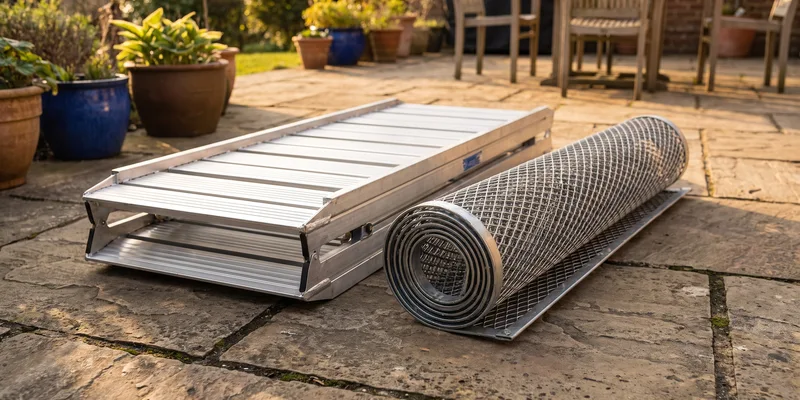
Both of these are portable ramps with a continuous surface, both pack down, and both get recommended for the same job. The difference is in how they collapse. A folding ramp hinges along one or more lines and closes like a case. A roll up ramp is made of hinged slats or a flexible mat that curls into a cylinder.
That single mechanical difference works its way into everything else: how rigid the ramp feels underfoot, how big the packed shape is, how long it takes to deploy, and how much of the household’s storage it occupies. This comparison works through those differences honestly rather than declaring a winner.
This article contains affiliate links. If you buy through them, we may earn a commission at no extra cost to you. Learn more.
Quick Answer
Folding or roll up: which portable ramp should you choose?
- Folding ramps are more rigid and usually available in longer lengths, which makes them the better choice for a taller rise or for a heavier load.
- Roll up ramps pack into a smaller, rounder bundle and deploy in seconds, which suits frequent travel and tight storage.
- Check the packed shape against where it will actually live, and read the listed weight capacity per model rather than by category.
Bottom line: rigidity and length favor folding; compactness and speed favor roll up. Measure the rise first, then decide which trade you would rather make.
How Each One Packs Away
A single fold ramp hinges once down the middle lengthwise and closes into a flat case with a handle, which is why it is often sold as a suitcase ramp. A multi fold hinges both lengthwise and crosswise, producing a smaller but thicker package. Both end up as a rectangle with hard edges.
A roll up ramp is built from narrow slats joined by flexible hinges, or from a mat with stiffeners running across it. It curls into a cylinder held by a strap, and that cylinder is usually shorter than a folded ramp of the same length and easier to wedge into a corner.
Rigidity Is the Real Difference
A folding ramp is a stiff panel with hinge lines. Once it is placed, it behaves like a solid surface, and that stiffness is what makes longer lengths and higher capacities possible. It also means the ramp bridges an uneven landing rather than following it.
A roll up ramp has many small joints along its length, so it flexes slightly under load and tends to conform to whatever it is lying on. On a smooth, firm surface that is fine. On a soft or wavy surface it can feel less certain underfoot, which is why roll up ramps are usually offered in shorter lengths.
What That Means for the Person Crossing
Someone self propelling a chair will notice the difference in how much the surface gives. Someone pushing will notice the hinge lines. Someone walking behind will notice both. If any of those descriptions matter in your household, place a folding ramp higher on the list.
Length, Rise, and Slope
Whichever type you pick, the length has to match the rise. The 2010 ADA Standards for Accessible Design set a maximum running slope of 1:12 for ramps, meaning twelve inches of ramp for every inch of rise. Those standards apply to public accommodations and commercial facilities, not to private homes, so no house is obliged to meet them, and they remain the benchmark most families use when deciding what is reasonable.
In practice that ratio is what pushes the choice. Roll up ramps tend to be sold in shorter lengths, which suits a single step or a vehicle sill. A porch with three steps needs a longer ramp, and the long end of the market is almost entirely folding. Our guides to ADA ramp slope and choosing ramp length cover the numbers.
Comparing the Two Types
| Factor | Folding | Roll up |
|---|---|---|
| Rigidity | Stiff panel, bridges unevenness | Flexes and follows the surface |
| Lengths offered | Short through long | Mostly shorter lengths |
| Packed shape | Flat rectangle with a handle | Compact cylinder with a strap |
| Deploying | Unfold, align, seat both ends | Unroll and straighten |
| Surface | Continuous with hinge lines | Slatted, small gaps between slats |
| Storage | Behind a seat or against a wall | Fits a footwell or a closet corner |
Where Folding Wins
Folding is the sensible default for a fixed rise at home, for anything more than a single step, and for a household where the ramp is placed once and left in position most of the time. The rigidity is worth having, the length range is wider, and the handle makes it a single lift.
It is also the type to choose where somebody walks on the ramp alongside the chair, because the surface is continuous. Our suitcase ramp guide covers the single and multi fold variations in detail.

Where Roll Up Wins
Roll up ramps are for movement. If the ramp travels in a car every week, gets used at a friend’s front step, and has to live somewhere small in between, the cylinder shape is genuinely easier to handle than a rigid case. Deploying one takes seconds.
They also suit a low, wide obstacle such as a vehicle sill or a single shallow step, where the short length is not a limitation. What they do not suit is a tall rise or a soft landing surface.

Multi Fold as the Middle Ground
A multi fold ramp sits between the two. It folds twice, so it packs smaller than a single fold of the same length while keeping the rigidity of a folding panel. The cost is weight, since more hinges mean more hardware, and a thicker packed shape.
For households that want a long ramp and still need it to fit in a trunk, multi fold is usually the answer rather than roll up. Check the folded dimensions against the actual trunk or closet before ordering.

Capacity, Width, and Surface Grip
Capacity is stated per model and covers everything crossing at once, meaning the user, the device, and anyone pushing. It is not a property of the folding mechanism, so read it from the specific listing rather than assuming folding ramps always carry more. Our page on choosing ramp weight capacity works through the sum.
Width matters just as much and gets less attention. A ramp narrower than the device forces precise steering every crossing. Grip differs too: most ramps use a punched, ribbed, or grit surface, and roll up slats have small gaps that shed water. Both types need clearing of ice and leaves, and traction tape is an option where the surface has worn. See non slip ramp surfaces for that.
Setting Up and Putting Away
Both types need the same discipline. Seat the top end squarely on the step or sill so it cannot shift sideways, make sure the bottom lands on firm level ground, and check the ramp is straight rather than skewed before anyone crosses. Our guide to setting up a portable ramp safely covers the routine.
Putting away is where the difference shows in daily life. A roll up ramp needs the strap fastened or it uncoils in the car. A folding ramp needs the latch closed or it opens on the first corner. Neither is difficult, and both are the sort of thing that gets skipped on trip number twenty.
A Note on Getting Advice
Whether a given slope and surface work for a household depends on the person and the device rather than on the ramp specification. If you are unsure what fits your situation, ask your doctor or an occupational therapist, who can watch an actual crossing and comment on the length and the approach. A ramp that feels marginal is worth lengthening rather than getting used to.
Frequently Asked Questions
Is a folding or roll up ramp better? Folding is more rigid and available in longer lengths, which suits taller rises and heavier loads. Roll up packs smaller and deploys faster, which suits frequent travel and single steps. Neither is better in general.
Are roll up ramps sturdy enough for a wheelchair? Models are sold with stated weight capacities and are designed for the job, though they flex more than a rigid folding panel and are usually offered in shorter lengths. Read the capacity and length on the specific listing.
Which packs smaller? Roll up, generally, because a cylinder tucks into a footwell or a closet corner more easily than a flat case. A multi fold ramp is the compromise if you need length and compact storage together.
Can you walk on either type? Both have a continuous surface, unlike telescoping channels, so both can be walked on. A folding ramp feels firmer underfoot, which matters if someone walks alongside the chair.
How long should the ramp be? Long enough for a slope you can manage at your measured rise. Twelve inches of ramp per inch of rise is the ratio the ADA standard uses for public buildings and the benchmark most households work from.
Do roll up ramps slide on smooth surfaces? They can, like any portable ramp, which is why the top end must be seated squarely and the bottom must land on firm ground. Check both ends before every crossing rather than only on the first day.
Which is easier for one person to handle? A short roll up is the lightest thing to carry, and a single fold with a handle is the easiest to place accurately. Longer ramps of either type are a two person job to position well.
What weight capacity do portable ramps have? It differs by model, and the figure has to cover the user, the device, and anyone pushing at the same time. Take the number from the specific product listing rather than from the ramp type.
The Bottom Line
Measure the rise, work out the length, and then let storage and rigidity decide the type. Folding ramps handle taller rises, heavier loads, and anyone walking alongside; roll up ramps handle travel and small storage spaces better than anything else with a continuous surface. Multi fold sits usefully between them. Whichever you choose, read the capacity and width from the specific listing. For the full range including channels and threshold pieces, see our portable wheelchair ramp guide.