
Last updated: August 20, 2026
Some links on this page are affiliate links. See our affiliate disclosure.
Three concrete steps at the front door can be the difference between someone leaving the house regularly and someone not leaving it at all. A portable ramp is the answer families reach for first, because it goes down in minutes, comes up again when it is not needed, needs no permission from a landlord, and travels in the trunk to an appointment.
The catch is that ramp length is not a preference. It follows from the height being climbed and the slope the user can manage, and a ramp that is too short turns a helpful product into a struggle. This guide covers the types available, how length and slope relate, and what to check on the surface and edges.
Quick Answer
How do you choose a portable wheelchair ramp?
- Measure the total rise first, from the ground to the top surface the ramp will land on. Length follows from that number, not from what looks about right.
- The ADA standard specifies a maximum running slope of 1:12 for ramps, which means twelve inches of ramp for every inch of rise. Manufacturers publish their own recommended slopes for portable ramps, so follow the figure for the model you buy.
- Pick the type by where it is used: threshold ramps for a doorsill, folding or suitcase ramps for steps, telescoping channels for a vehicle.
- Check the weight capacity in the listing, and confirm it accounts for the chair, the user, and anything being carried.
Bottom line: measure the rise, then let the slope requirement decide the length, then choose the style that suits the location.
What Portable Ramps Are Good At
Portable ramps handle short rises: a doorsill, one or two steps, the lip at a garage entrance, a van’s rear opening. They set up in minutes, store against a wall or in a trunk, and need no fixings, which is why they suit rentals and temporary situations so well.
They are not a substitute for a permanent ramp where the rise is substantial. Past a few steps, the ramp needs to be long enough that portability stops being realistic, and permanent construction involves local building codes and a contractor. This guide stays with the portable end of the category.
The Main Types
Ramps split by how they fold and what they land on. Getting this right first narrows the choice quickly, because a design meant for a doorsill behaves badly on steps and the reverse is also true.
Threshold Ramps
Short wedges, in rubber or aluminum, that sit against a doorsill or a small lip. They handle rises of roughly an inch to several inches and stay in place permanently in most homes. Our guides to threshold ramps and to the rubber versions cover that end of the range in detail.
Folding and Suitcase Ramps
Single or multi-fold aluminum ramps with a solid or perforated surface, hinged so they close into a carrying shape with a handle. These are the workhorses for one to three steps and for taking along in a car. Our suitcase ramp guide looks at the folding designs specifically.
Telescoping Channel Ramps
Two separate channels that extend to length and sit under the wheels on each side. They are lighter to carry than a full-width ramp and store compactly, but they need the wheels lined up accurately, which is easier with a helper and harder for someone propelling themselves.
Solid-Surface Track Ramps
A full-width solid deck, usually one piece or single-fold, giving a continuous surface with nothing to line up. These suit power chairs and users who prefer not to think about wheel placement, at the cost of more weight to lift.
Rise, Length and Slope
Measure the rise before anything else: hold a tape vertically from the lower surface up to the level the ramp will land on, including any lip at the top. That single measurement drives the length, and the arithmetic is simple once you know which slope ratio applies.
The ADA standard specifies a maximum running slope of 1:12 for ramps in accessible construction, meaning one inch of rise needs twelve inches of ramp. Portable ramp manufacturers publish their own recommended slopes as well, often differing between a chair that is occupied and one that is not, and between manual and powered use, so use the figure for the model in front of you. Our ramp length calculator works through the arithmetic, and our guide on choosing ramp length covers the practical judgment around it.
Portable Ramps by Situation
The Most Common Choice for Steps
A multi-fold aluminum ramp covers one to three steps in most homes, folds into a case with a carrying handle, and stows behind a door. Look at the closed dimensions as well as the open length, since a long ramp is still bulky when folded.
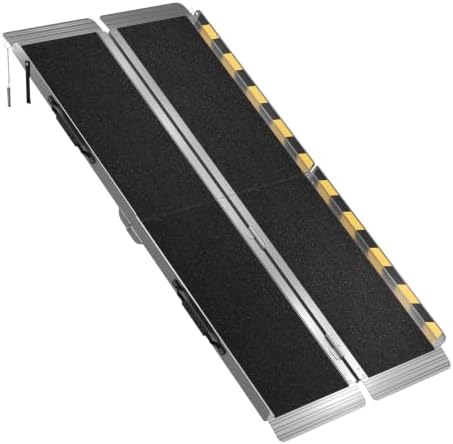
For Taking Along in a Car
A suitcase-style ramp in a shorter length is the practical travel option, handling a single step or a curb at a destination that has no ramp of its own. Weight is the deciding factor here, since someone has to lift it out of a trunk.

For Loading Into a Van
Telescoping channel ramps extend to the length a vehicle opening needs and collapse short enough to store inside. They call for accurate wheel alignment, so they suit setups where someone is assisting.

For a Doorsill or Small Lip
A threshold ramp handles the inch or two at a doorway, which is the most common single obstacle in a house and often the only one that needs solving.

When a Continuous Surface Matters
A single-fold solid-surface ramp gives an uninterrupted deck with nothing to line up, which suits power chairs and users who find channel alignment awkward.

Comparing the Types
| Type | Handles | Trade-off |
|---|---|---|
| Threshold ramp | Doorsills and small lips | Stays in place, only covers a few inches of rise |
| Multi-fold ramp | One to three steps | Bulky when folded, heavier to carry |
| Suitcase ramp | A single step or curb, travel use | Shorter, so limited to a small rise |
| Telescoping channels | Vehicle loading | Lighter, but wheels must be lined up accurately |
| Solid-surface single fold | Power chairs, continuous deck | Heaviest of the portable options |
Surface, Edges and Capacity
Look for a textured, slip-resistant surface rather than bare smooth aluminum, and check whether it stays usable when wet, since a ramp at a front door will see rain and snow. Raised side edges keep a wheel from running off, and are worth having even on short ramps.
Weight capacity is the number to take straight from the listing, covering the user, the chair, and anything on it. A power chair is considerably heavier than a manual one, so a capacity that suits one may not suit the other.
How the Ramp Sits at Each End
At the top, the ramp lip should sit flat on the landing with no gap or rocking. At the bottom it should meet a firm, level surface rather than soft ground or loose gravel. A ramp that shifts when a wheel crosses the transition is the most common complaint about otherwise good products, and it is nearly always about how the ends are seated.
Common Mistakes When Buying a Portable Ramp
The biggest is buying by eye. A ramp that looks like it reaches usually produces a slope steeper than any manufacturer recommends, which makes going up hard work and going down harder to control. Measure the rise and do the arithmetic.
The second is forgetting the space at the bottom. A ramp needs somewhere flat to land, and if it ends in a flowerbed, on a slope, or at a car door, the setup does not work however good the ramp is. Pace out the run before ordering.
A Note on Getting Advice
Slope tolerance varies a lot between a self-propelling manual chair user, someone being pushed, and a power chair, and the right length depends on which applies. If you are unsure what fits your situation, ask your doctor or an occupational therapist. For anything beyond a few steps, a permanent ramp is a construction question subject to local codes, not a shopping one.
Frequently Asked Questions
How long should a portable wheelchair ramp be? It follows from the rise. The ADA standard specifies a maximum running slope of 1:12, so twelve inches of ramp per inch of rise, and portable ramp manufacturers publish their own recommended ratios per model. Measure the rise, then apply the ratio.
Can a portable ramp go over three or four steps? Rarely in a practical way, because the length needed makes it heavy and awkward to move. Beyond a couple of steps, a permanent ramp designed to local code is the appropriate route.
How much weight can a portable ramp hold? It varies by model, and the manufacturer states the figure in the listing. Make sure it covers the chair, the user, and anything being carried, and note that power chairs weigh considerably more than manual ones.
Are portable ramps safe in rain or snow? Look for a textured, slip-resistant surface and check what the manufacturer says about wet conditions. Keeping the ramp clear of leaves, ice, and standing water matters as much as the surface itself.
Do portable ramps need to be fixed down? Most are designed to sit in place without fixings, which is the point of them. Some models include optional brackets or straps for the top edge, and using them is worthwhile where the ramp stays in one spot.
What is the difference between a threshold ramp and a folding ramp? A threshold ramp is a short wedge for a doorsill or a small lip, usually left in place. A folding ramp is a longer aluminum deck for steps or a vehicle, designed to be set up and put away.
Do portable ramps need handrails? Portable ramps generally do not include them, and adding rails is only possible on models designed to accept them. Our guide to wheelchair ramp railings covers when rails matter and what the options are.
The Bottom Line
A portable wheelchair ramp is the right tool for a doorsill, a step or two, or a vehicle opening, and the choice starts with a tape measure rather than a catalog. Measure the rise, apply the slope ratio the manufacturer specifies for that model, and only then pick between threshold, folding, telescoping, and solid-surface designs based on where it will be used. Check the surface texture, the side edges, and the stated weight capacity, and make sure both ends land on something flat. For the arithmetic, see our guide to choosing ramp length.