
Last updated: August 20, 2026
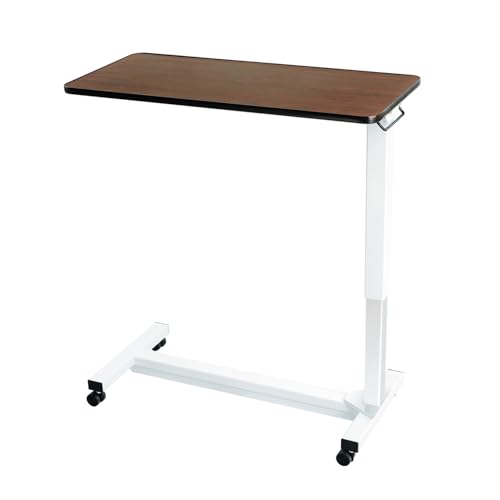
An overbed table is a small piece of furniture with an outsized effect on a bedroom. The C shaped base rolls under the bed so the top can sit across someone’s lap, which turns a bed into somewhere to eat a proper meal, use a laptop, sort medications, or do a jigsaw without everything sliding off the duvet.
The buying decision is mostly about the base and the height range, not the tabletop. This guide covers what actually determines whether a table will roll under your bed, how the tilting tops differ, and the details that separate a table someone uses daily from one that ends up pushed into a corner.
This article contains affiliate links. If you buy through them, we may earn a commission at no extra cost to you. Learn more.
Quick Answer
What should you look for in an overbed table?
- Measure the clearance under the bed first. The C base has to roll underneath, and low platform beds and storage beds often leave no room.
- Check the height range covers your mattress top plus lap height, since a table that will not go high enough is unusable over a tall bed.
- Decide between a flat top and a tilting top. Tilting suits reading and tablets; a flat surface is better for meals and drinks.
Bottom line: base clearance and height range decide whether it works at all. Everything else is preference.
Base Style Decides Everything
Overbed tables come in a handful of base designs, and the base is what determines whether the table reaches across the bed or stops short at the side. Get this right and the rest of the specification is comparatively forgiving.
| Base style | How it works | Suits |
|---|---|---|
| C base | Rolls under the bed, top cantilevers over the lap | Beds with clearance underneath |
| H base | Wider footprint, more stable, needs more clearance | Heavier use, laptops, wider tops |
| Split top | One half tilts, one half stays flat | Reading and a drink at the same time |
| Sofa or chair table | Shorter base for a recliner or armchair | Living room use rather than bedside |
Measure Before You Order
Three measurements decide fit. Clearance from the floor to the underside of the bed frame, which the base must pass beneath. Height from the floor to the top of the mattress, which the tabletop must clear. And the depth of clear floor beside the bed, since a base needs somewhere to sit and casters need somewhere to roll.
Bed clearance is where most returns come from. Platform beds, storage beds with drawers, and beds with a solid base to the floor often leave nothing for a base to slide under, and no amount of height adjustment fixes that. If the bed has no clearance, look at a table designed to sit beside the bed rather than over it.
Height Adjustment Mechanisms
Most tables adjust by one of three methods: a knob or lever you loosen and retighten, a spring assisted lift, or a hand crank. Knob adjusters are the most common and the most fiddly for weak hands, while spring assisted columns move with a squeeze of a lever and are easier to change position on your own. If the person will adjust the table themselves, that difference matters more than any surface finish.
Overbed Tables by Situation
Meals and General Bedside Use
A flat top on a C base covers the standard case. Look for a surface wide enough for a plate and a glass together, casters that lock so the table does not drift when leaned on, and a height range that comfortably clears your mattress with a margin.

Reading, Tablets, and Laptops
Tilting tops angle the surface toward the reader, which is far more comfortable for a book or a tablet than a flat surface. Split tops give you both, a tilting section and a flat section for a mug, which is the version most people end up preferring for mixed use.

Easier Height Changes
Spring assisted or lever operated columns let someone raise and lower the table without loosening a knob and holding the weight, which matters when hand strength is limited or when the table gets adjusted several times a day.
Recliners and Armchairs
Chairs are lower than beds, and a table sized for a bed often will not come down far enough. Tables built for a recliner have a shorter height range and a base shaped for a chair, which is worth checking if the main use is a living room rather than a bedroom. Our guide to the lift chair recliner covers the chair side of that setup.

Details That Decide Daily Use
Locking casters are the first thing to check. A table that rolls away when someone leans on it to reach a glass is not just annoying, it removes a surface someone was steadying against. Look for locks on at least two casters, and test that they hold on your flooring rather than assuming.
Weight capacity is stated by the manufacturer and matters more than people expect once a laptop, a lamp, a drink, and a stack of books are all on the same surface. Check the tabletop material too: laminate wipes clean easily, while some finishes mark from hot mugs.
The Table Is Not a Grab Bar
This is worth saying plainly. Overbed tables roll, and even with casters locked they are not built to take a person’s weight during a stand. If someone is reaching for the table to push up from the bed, that is a signal they need a proper grip point instead, such as a bed assist handle designed to provide support for exactly that movement.
Where It Fits in the Room
An overbed table works best when it has a parking spot that is not in the walking route. Clear floor beside the bed matters for the base, and a table left across a path at night is a trip hazard in a room where someone may be moving in low light. Our bedroom safety guide covers the room layout questions alongside lighting and the route to the bathroom.
If the table is mainly for meals, think about where the food comes from and whether someone has to carry a tray past it. Small layout decisions like that are usually what determine whether a table gets used or gets pushed against a wall after a week.
Frequently Asked Questions
Will an overbed table fit my bed? Only if there is clearance under the bed frame for the base to roll beneath, and if the height range covers your mattress top. Measure both before ordering, since platform and storage beds frequently have no clearance at all.
What is the difference between a C base and an H base? A C base is a single upright with an arm that reaches under the bed, easier in tight spaces. An H base has a wider footprint and is generally more stable, but needs more clearance underneath.
Are tilting tops worth it? For reading, tablets, and laptops, yes. For meals and drinks, a flat surface is better. Split tops give both, which is why they are a common choice for mixed use.
Can an overbed table be used with a recliner? Only if its height range comes down far enough, since chairs sit lower than beds. Tables made specifically for recliners have a shorter range and a base shaped for a chair.
How much weight can an overbed table hold? Whatever the manufacturer states for that model, and it varies. Consider the realistic load of a laptop, a lamp, a drink, and books together rather than one item at a time.
Can someone lean on an overbed table to stand up? No. Even with locking casters, these tables are not built to take a person’s weight during a transfer. Use a product designed for that, such as a bed assist handle, and ask an occupational therapist if standing up is becoming difficult.
The Bottom Line
Choose an overbed table by measuring first: clearance under the bed for the base, height range against your mattress, and clear floor beside the bed. Then pick the top and the adjustment mechanism to match how it will be used, favoring a lever or spring assisted column if the person adjusts it themselves. Keep it out of the walking route, and never treat it as something to push up from. See our bedroom safety guide for the rest of the room.