Last updated: August 20, 2026
A pill organizer answers one question that gets harder to answer as the list of medications grows: did I already take those. Filling a week in advance turns that question into something you can settle by looking at a box, which is why the humble plastic tray remains one of the most used items in the house.
The variations matter more than they look. Number of doses per day, compartment size, lid style, and whether the tray can be carried all change how well the organizer fits a real routine. This guide covers the layouts, what to check before buying, and when an organizer is no longer the right tool.
This article contains affiliate links. If you buy through them, we may earn a commission at no extra cost to you. Learn more.
Quick Answer
Which pill organizer should you choose?
- Count the doses per day first: a once-daily routine fits a simple 7-day box, while two or more doses need a tray with separate compartments per time of day.
- Check compartment size against the actual tablets, since large capsules fill a small compartment fast.
- Lids are the part that fails: look for a design that opens with one hand and stays shut in a bag.
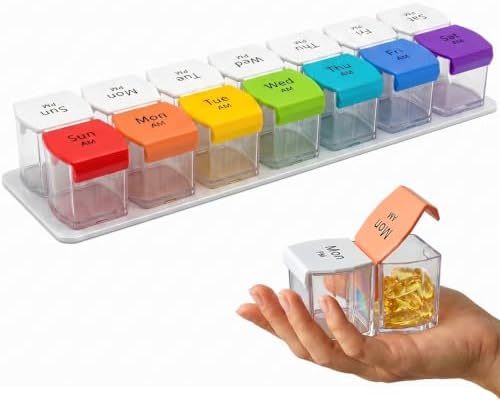
- Pop-out daily trays let one day travel without carrying the whole week.
Ask the pharmacist before transferring anything out of its original packaging, since some medications are not meant to leave it.
The Layouts Compared
Organizers are built around how many times a day the routine repeats. Getting this wrong is the most common reason a box gets abandoned, because a single daily compartment cannot represent a morning and evening dose without guesswork.
| Layout | Suits | Watch out for |
|---|---|---|
| 7-day, one compartment per day | A single daily dose | No way to separate morning from evening |
| 7-day, AM and PM | Two doses a day | Compartments are smaller than on a single-dose box |
| 7-day, three or four times daily | Complex schedules | Large footprint; needs a permanent spot on a counter |
| Pop-out daily trays | Days out of the house | A loose tray can open in a bag |
| Monthly, 31 day | Filling once a month | Small compartments, and a month of doses in one box |
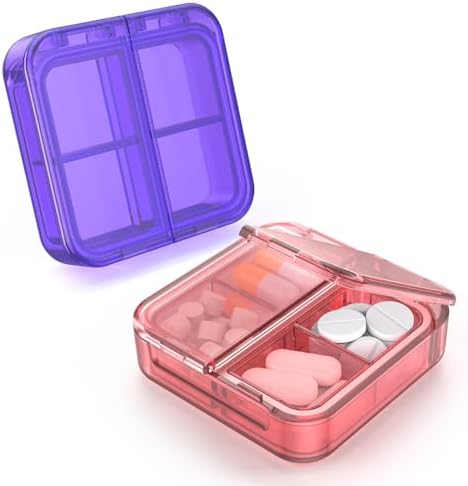
| Travel pouch or case | Trips and appointments | Check it is stated as a sealed or latching design |
| Locking organizer | Households where access needs limiting | Keys and combinations have to live somewhere findable |
Start With Doses per Day
Write out the actual schedule before shopping: how many separate times a day something is taken, and how many tablets at each. That gives you the two numbers that decide everything else, the number of compartments and the volume each one needs to hold.
A common mistake is buying a once-daily box for a twice-daily routine and using two boxes, or using one compartment for both doses. Both defeat the purpose, since the whole value of the organizer is being able to see at a glance whether a specific dose has been taken.

Compartment Size and Lids
Compartment volume is where product photos mislead. A tray that looks generous can be tight once several large capsules go in, and a compartment that has to be forced shut will pop open. If several large tablets are involved, look specifically for a listing describing extra-large or high-capacity compartments and check any stated dimensions.
Lids decide whether the box is usable for someone with a weak or stiff hand. Push-button lids that spring open ask the least of the fingers. Hinged lids with a small tab need a pinch grip, which is exactly what tends to be difficult. Sliding covers avoid pinching but can be stiff. Whichever style, it has to be openable with one hand, since the other hand is usually holding a glass.
Monthly Boxes and Filling Routines
A 31-day organizer trades convenience for compartment size. Filling once a month is less work, and for a simple once-daily routine it works well. For anything more complex it usually does not, because a month’s worth of a four-times-daily schedule is 124 compartments.
Whatever the layout, filling is the part worth building a habit around. Doing it at the same time each week, in good light, with the original bottles lined up and the pharmacy labels visible, is what keeps errors out. Many families do this together on a set day, and it doubles as a check that nothing is running low.

Keep the Original Labels
Once tablets leave their bottle, the label goes with the bottle rather than the tray. Keep the original containers, and ask the pharmacist whether anything on the list should stay in its original packaging, since some medications are supplied in packaging designed to protect them and some are dispensed in blister packs for a reason.
Travel and Days Out
The weekly box is a home fixture, and carrying it around is how doses go missing. Organizers with pop-out daily trays solve this properly: one day detaches and travels, and the rest of the week stays on the counter. Check that the detached tray latches rather than simply resting in place.
For longer trips, a dedicated travel case with a positive closure is a better answer than a loose tray in a bag. Look for something described as latching or sealed rather than a soft pouch, and keep the original labelled containers with you as well, which is also useful if a pharmacy or a clinician needs to see exactly what is being taken.
When an Organizer Is Not Enough
A pill organizer answers whether a dose was taken. It does not remind anyone that it is time. If missed doses rather than double doses are the recurring problem, that is a different tool: an automatic dispenser that holds the compartments closed until the scheduled time and signals when they open.
Our guide to automatic pill dispensers covers how those work and what to look for, including which models involve an ongoing service. A large-format day clock showing the day and part of the day solves a related problem, since a routine anchored to morning or evening only works when those are unambiguous.

A Note on Sorting Someone Else’s Medication
Filling an organizer for another adult is a common family task and a responsible one, but it is worth doing with their pharmacist in the loop. Pharmacists will usually go through the list, flag anything that should not be transferred, and in many cases can supply medication already sorted into dated packs, which removes the job entirely. If you are unsure what fits your situation, ask the pharmacist or the prescribing clinician.
Frequently Asked Questions
What size pill organizer do I need? Count the separate times a day medication is taken and the number of tablets at each. That gives the number of compartments per day and the volume each has to hold, which is what to match against the listing.
Is it safe to put medication in a pill organizer? For many medications it is routine, but not all of them. Some are supplied in packaging that protects them, and blister packs are sometimes used deliberately. Ask the pharmacist about the specific list before transferring anything.
What is the easiest pill organizer to open? Push-button lids that spring open ask the least of the hands. Hinged lids with a small tab need a pinch grip, which is often the difficult movement, and sliding covers can be stiff.
Weekly or monthly organizer? Weekly for anything more than one dose a day, because compartments stay usable in size. Monthly suits a simple once-daily routine and reduces filling to a single session.
How do I carry medication for a day out? Use an organizer with pop-out daily trays so one day detaches, or a dedicated latching travel case. Keeping the original labelled containers with you is useful if a clinician needs to see the list.
Do pill organizers remind you to take your medication? No. They record whether a dose has been taken. If the problem is forgetting the time rather than losing track, an automatic dispenser with an alarm is the tool that addresses it.
What is a locking pill organizer for? Limiting who can open it, in households where that matters. The practical catch is that the key or combination has to live somewhere it will actually be found.
The Bottom Line
Choose the organizer around the schedule rather than around the box: one compartment for every dose time, enough volume for the actual tablets, and a lid that opens with one hand. Fill it at the same time each week with the original labelled bottles in front of you, and ask the pharmacist whether anything should stay in its packaging. If the recurring problem is missed doses rather than doubled ones, look at an automatic pill dispenser instead.