Last updated: August 20, 2026
A shower chair with wheels is a different category from a static shower chair, and buying one on the assumption that it is simply a chair with casters added leads to a product that does not fit through the door, will not enter the shower, and rolls when it should not. The wheels are there to solve a specific problem: moving someone between rooms without a separate transfer at each end.
This guide covers what rolling shower chairs are actually designed for, the three things that decide whether one can work in a given home, and what to check on the listing before ordering. It is written for households where someone else is assisting, because that is where these chairs make sense.
This article contains affiliate links. If you buy through them, we may earn a commission at no extra cost to you. Learn more.
Quick Answer
Is a shower chair with wheels the right choice?
- It suits homes where someone is pushed from bedroom to bathroom, and where a curbless or very low-threshold shower lets the chair roll straight in.
- Every caster must have a working lock, and the locks go on before anyone sits down or stands up. A rolling chair with unlocked wheels is not a seat.
- A raised shower curb, a narrow doorway, or a bathtub rules the type out; a static chair or a transfer bench is the answer in those bathrooms.
Bottom line: wheels solve a transport problem, not a balance problem, and only in bathrooms the chair can physically enter.
What Wheels Are Actually For
The point of a rolling shower chair is to reduce the number of transfers in a bathing routine. Instead of moving from bed to a wheelchair, into the bathroom, and then onto a shower seat, the person sits down once and stays seated. For households where each transfer takes effort from two people, removing two of them changes the whole morning.
What wheels do not do is add stability while seated. A rolling chair is designed to be locked in position for use, and the locks are the safety feature, not an accessory. If the reason for buying is that sitting feels safer than standing, a static chair does that job with fewer moving parts.
The Three Questions That Decide It
Before comparing models, answer three things about the home. Is the shower entry curbless or low enough that casters can roll over it? Is every doorway on the route wide enough for the chair, measured at the widest point including the wheels? And is there someone able to push, steer, and set the locks each time?
A no to any of the three usually means a different product. A raised curb can sometimes be handled with a small threshold ramp, but a bathtub or a shower tray with a high lip cannot, and a chair that has to be lifted over an obstacle every day stops getting used.
Doorways Are Measured at the Wheels
Product listings give an overall width that includes the casters, and that is the number to compare against the narrowest doorway on the route. Bathroom doors are commonly the tightest point in a house, and a chair that clears the bedroom door by an inch may not clear the bathroom one at all.
Rolling Chair Versus Static Chair
| Factor | Rolling shower chair | Static shower chair |
|---|---|---|
| Main purpose | Fewer transfers, moving between rooms | Sitting through the shower |
| Shower entry | Needs curbless or very low threshold | Works in most enclosures |
| Caregiver | Usually assumes one | Often used independently |
| Locks | Essential, checked every use | Not applicable |
| Footprint | Larger, plus turning space | Compact |
| Storage | Stays assembled | Often folds away |
Choosing by Situation
Standard Rolling Shower Chair
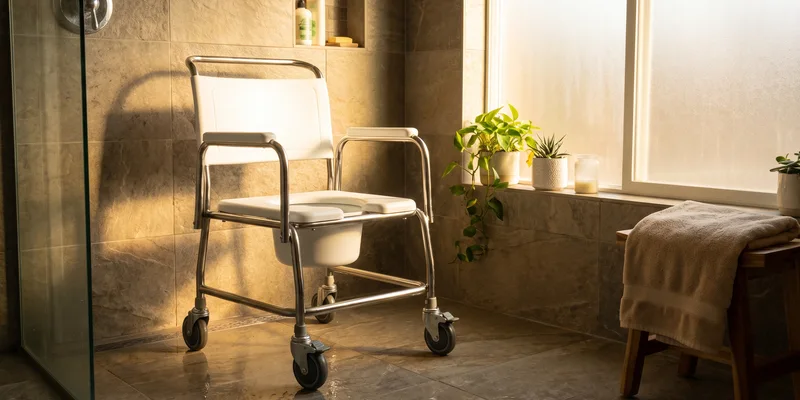
The basic version is a padded or perforated seat on a frame with four locking casters, armrests, and often a backrest. It suits a curbless shower and a short indoor route. Look for locks on all four casters rather than two, and for a lock lever the caregiver can reach without bending fully to the floor.
Shower Commode Chair
A commode version has an open or cut-out seat and can be positioned over a toilet, which removes another transfer from the routine. It is a larger and more specific product, and the seat cut-out shape and the height over the toilet bowl both need checking against the actual bathroom.

Reclining and Tilt Models
Reclining frames allow the backrest to tilt, which some families use for hair washing or for people who cannot hold an upright position for long. These are heavier and considerably larger, and the extra length has to fit both the shower and the turning space outside it.

What to Check on the Listing
Read the overall width including casters, the seat width and height, the total length, the stated weight capacity, and whether the footrests are removable or swing away. Removable footrests matter more than they look on paper, because they are usually what gets in the way during a transfer at the side of the chair.
Frame material and hardware are the second layer. Stainless or coated aluminum frames handle constant wet use better than plain steel, and plastic-bodied casters usually outlast metal ones in a shower environment. Check that replacement casters and tips are available, since those are the parts that wear.
Locks Are the Feature to Test First
When the chair arrives, set it up and test every lock on the actual floor surface it will be used on. A lock that holds on carpet but creeps on wet tile is not doing its job. Make locking a fixed step in the routine, before sitting down and before standing up, rather than something checked occasionally.
Safety Points Families Ask About
Rolling chairs put a seated person on wheels on a wet, hard surface, so the routine matters as much as the product. Locks on before any transfer, footrests swung clear before feet touch the floor, and someone within reach during the transfer are the three habits that matter most.
Water temperature deserves a separate mention, because a seated person cannot step away from a stream that suddenly runs hot. A handheld shower head with an on and off control at the handle gives the user or the caregiver direct control. If you are unsure what fits your situation, ask your doctor or an occupational therapist.
Common Mistakes
- Measuring the seat instead of the chair. Doorway clearance is decided by the width across the casters.
- Buying a rolling chair for a shower with a curb. A raised lip stops the wheels, and lifting the chair over it daily is not sustainable.
- Two locking casters instead of four. Partial locking still allows the chair to pivot during a transfer.
- Leaving footrests in place during transfers. Swing-away or removable footrests exist for exactly this moment.
- Assuming a capacity figure. Take the weight rating from the listing for the specific model.
- Forgetting turning space. The chair needs room to turn outside the shower as well as room inside it.
Frequently Asked Questions
Can a shower chair with wheels go into any shower? No. It needs a curbless entry or a threshold low enough for the casters to roll over, plus a doorway wide enough for the chair measured across the wheels.
Are rolling shower chairs safe to sit in? They are designed to be used with all casters locked. Locking before sitting down and before standing up is the step that matters, and a chair with locks on only two wheels can still pivot.
What is the difference between a shower chair with wheels and a shower commode chair? A commode chair has an open or cut-out seat and can be positioned over a toilet, which removes an extra transfer. It is larger and needs to be checked against the toilet height and shape.
Do I need a caregiver to use one? Most rolling shower chairs assume someone is pushing and setting the locks. Self-propelled versions exist, but the wheels are there mainly to move a seated person from room to room.
Can a rolling shower chair be used in a bathtub? No. A bathtub rim cannot be rolled over, and a transfer bench is the product designed for that situation.
Will the wheels rust? Frame and hardware quality vary. Coated aluminum or stainless frames and plastic-bodied casters generally cope better with constant wet use, and rinsing and drying the chair after showers slows corrosion.
Does insurance cover a rolling shower chair? Coverage differs per plan and per situation. Check medicare.gov and the specific plan rather than relying on a general answer, since equipment categories are treated differently.
The Bottom Line
A shower chair with wheels earns its place when the bathing routine involves moving someone between rooms and a curbless shower makes that possible. Measure the doorways across the casters, confirm the shower entry, insist on locks at all four wheels, and take the weight capacity from the listing. If the shower has a curb or the bathroom has a tub, look instead at a static chair or a transfer bench in our shower chair guide.