
Last updated: August 20, 2026
Weight capacity on a lift chair is not a suggestion. It is a structural figure that covers the frame, the lift mechanism, and the motor, and a chair used above its rating wears out in ways that are neither cheap nor safe. That is the whole reason the bariatric and heavy duty categories exist: reinforced frames and stronger motors, plus the wider seats that go with them.
This guide explains what actually changes at higher capacities, how to read the numbers in a listing without guessing, and what to check on width and doorways before a very large chair arrives at the house.
This article contains affiliate links. If you buy through them, we may earn a commission at no extra cost to you. Learn more.
Quick Answer
What makes a lift chair bariatric or heavy duty?
- A reinforced frame and a stronger lift motor, rated for a higher user weight than a standard chair.
- A wider seat, so the arms are not pressing inward on the hips, and often a deeper seat as well.
- The stated weight capacity in the listing is the figure that defines the category, and it should be treated as a limit rather than a target.
Bottom line: match the listed weight capacity and the seat width to the person, then measure the doorways the chair has to pass through.
What Changes at Higher Weight Capacities
Three things change. The frame gets heavier gauge steel or a reinforced hardwood structure, the lift motor and actuator are rated for a larger load, and the seat gets wider so the sitter is not wedged between the arms. Suspension under the cushion is usually upgraded too, since sagging shows up faster under a heavier load.
None of that is visible in a product photo, which is why the specification list carries the whole message. Read the weight capacity, the seat width, and the overall width, and compare them across models rather than relying on the words heavy duty in the title.
Why the Rated Capacity Should Not Be Cut Fine
A chair rated to a given weight is rated for that weight in normal use, and the lift action puts the highest load on the mechanism. Choosing a model with clear headroom above the user’s weight is the sensible approach, both for the life of the motor and because the chair will still fit if things change. Manufacturers publish these figures for a reason and they are not interchangeable between models.
Seat Width Is as Important as Capacity
Weight rating and seat width are two separate specifications, and a chair can be strong enough while still being too narrow to sit in comfortably. Measure the person seated, across the widest point at the hips, and add a few inches so the arms of the chair are not in contact.
Overall width matters separately, because that is the number that has to fit through doorways and around corners. A wide seat plus substantial arms can produce a chair that is several inches wider than the room’s tightest passage, which is a problem best discovered before delivery day rather than after.
Bariatric Lift Chairs by Situation
The Standard Heavy Duty Choice
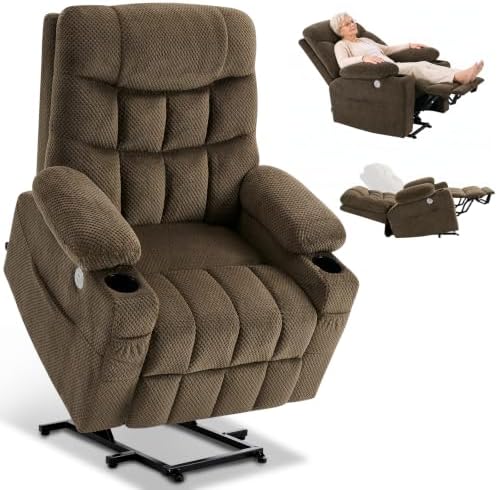
A heavy duty lift recliner with a reinforced frame and a wider seat handles most situations where a standard chair is not rated high enough. Two-position and three-position versions both exist in this category, so the recline decision stays the same as in the standard range.

Higher Capacities and Extra Wide Seats
Above the common heavy duty ratings, a smaller group of extra wide models offers a broader seat and a higher stated capacity again. Selection is narrower, delivery is more involved, and the specification check becomes more important rather than less.

Independent Back and Leg Movement
Dual motor and infinite position models exist in heavy duty frames too, allowing the legs to be raised while the back stays upright. If the chair will be occupied for most of the day, that flexibility is often the feature people miss most on a single motor model.
Reading the Specifications Without Guessing
| Specification | What it tells you | How to use it |
|---|---|---|
| Weight capacity | Rated maximum user weight | Choose clear headroom above actual weight |
| Seat width | Usable width between the arms | Measure across the hips seated, add clearance |
| Overall width | Widest point of the chair | Compare against doorways and hallway turns |
| Seat height | Floor to top of the cushion | Compare against floor to back of knee |
| Shipping weight | How heavy the delivery is | Decide whether room-of-choice delivery is needed |
Every one of these numbers is published per model. Where a listing omits one, that is worth asking about rather than estimating.
Delivery, Placement, and Floor Protection
Heavy duty chairs are genuinely heavy, and shipping weights well above a hundred and fifty pounds are common. Two people is the minimum for positioning one, and room-of-choice delivery is worth paying for if nobody at home can help. Check the hallway turns as well as the doorway width.
Once in place, consider what is under it. Concentrated weight on small feet can mark soft flooring, and furniture cups or a firm mat spread the load. The chair also needs its rear clearance to recline, so measure the wall gap before deciding exactly where it sits.
Common Mistakes When Buying
Choosing a model whose rating sits just above the user’s weight is the most common one. There is no margin left, and the lift action is the hardest thing the chair does. The second is treating heavy duty as a synonym for wide, when the two specifications are independent and a strong chair can still be a narrow one.
The third mistake is skipping the doorway measurement. A chair that cannot be carried into the room it was bought for becomes an expensive return, and returns in this category are difficult because of the weight.
A Note on Getting Advice
This guide describes furniture specifications, not care. If you are unsure what fits your situation, ask your doctor or an occupational therapist, who can look at how the person transfers in and out of a chair and suggest what would suit them at home. That is particularly worth doing when transfers have become harder recently.
Frequently Asked Questions
What weight capacity do bariatric lift chairs have? It varies by model, and the rating is always printed in the product specifications. Compare the listed figure per chair rather than assuming a category-wide number.
Is heavy duty the same as bariatric? The terms are used loosely and neither is standardized. Both usually indicate a reinforced frame and a higher rating, so the listed weight capacity and seat width are the reliable comparison points.
How much headroom should I leave above the user’s weight? Enough that the rating is not being approached in everyday use. Choosing the next capacity up is a common approach, since the lift action places the greatest load on the mechanism.
How wide should the seat be? Measure across the hips while seated and add clearance so the arms of the chair are not pressing inward. Seat width is listed separately from overall width.
Will a bariatric lift chair fit through a standard doorway? Often, but not always. Compare the chair’s overall width against your narrowest doorway and any hallway turns before ordering.
Do heavy duty chairs come with heat and massage? Some do, though the selection is narrower than in the standard range. Our heat and massage guide explains what those functions offer.
Can two people share a heavy duty lift chair? Yes, provided the rating covers the heaviest user and the seat suits the person who uses it most.
The Bottom Line
A bariatric lift chair is defined by two numbers rather than a label: the stated weight capacity and the seat width. Pick a rating with real headroom, match the seat width to a seated hip measurement, then check the overall width against your doorways before anything ships. For the broader category and the recline options, see our lift chair recliner guide, and use the sizing walkthrough for the height measurements.