
Last updated: August 20, 2026
Showering asks more of the body than most daily tasks: standing on a wet surface, turning, reaching overhead, closing your eyes to rinse, all while balancing on a slick floor. A shower chair removes the standing part of that equation, which is why it is usually the first piece of equipment families look at when a bathroom starts to feel like the hardest room in the house.
This guide walks through the main types of shower chair, who each one suits, and the details that decide whether a chair actually fits the bathroom you already have. It is written for the person doing the shopping as much as for the person bathing.
This article contains affiliate links. If you buy through them, we may earn a commission at no extra cost to you. Learn more.
Quick Answer
Which shower chair should you choose?
- Match the chair to the enclosure first: a walk-in shower takes a freestanding chair or stool, a bathtub usually calls for a transfer bench that spans the rim.
- Choose a back and arms if sitting upright unsupported is tiring or if standing up again needs a push; choose a backless stool if space is tight and balance is steady.
- Measure the floor space, check the seat height range against knee height, and read the weight capacity stated on the product listing before ordering.
Bottom line: the enclosure decides the type, and the person’s sitting balance decides whether it needs a back and arms.
What a Shower Chair Actually Changes
A shower chair is designed to provide a stable seated position so that washing, rinsing, and drying can happen without holding a standing balance the whole time. That matters because the riskiest moments in a shower are rarely the washing itself: they are the turns, the reaches, and the seconds spent with eyes closed under running water.
It also changes how long a shower can comfortably last. Many families find that the person bathing stops rushing once sitting is an option, and that a caregiver standing nearby has an easier job because they are steadying a seated person rather than supporting a standing one. If you are unsure what fits your situation, ask your doctor or an occupational therapist.
The Main Types at a Glance
Six shapes cover almost everything sold in this category, and the differences are mostly about where the chair sits and how much support it offers. The table below is a shortlist you can hold against your own bathroom before reading further.
| Type | Best suited to | Watch out for |
|---|---|---|
| Backless stool | Walk-in showers, steady sitting balance, tight floor space | Nothing to lean against while rinsing |
| Chair with back and arms | Longer showers, help getting back up, less trunk control | Takes more floor area than a stool |
| Folding or wall mounted seat | Shared bathrooms where the shower is used by everyone | Wall mounting needs solid backing |
| Rolling shower chair | Rolling in from the bedroom, caregiver-assisted routines | Casters must lock; needs a curbless or low-threshold entry |
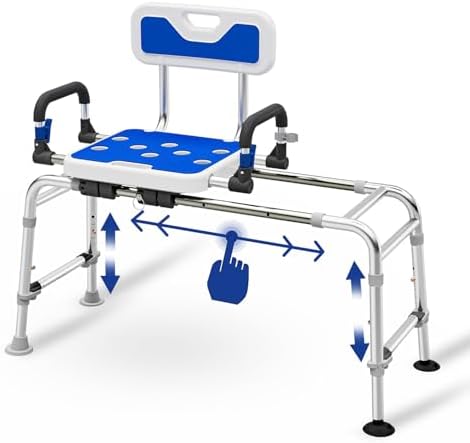
| Tub transfer bench | Standard bathtubs, where stepping over the rim is the problem | Requires a shower curtain solution to control splashing |
| Teak bench | Walk-in showers where the room doubles as a normal family bathroom | Wood needs occasional oiling and drying time |
Shower Chairs for Elderly Users and Seniors
Most shower chairs sold as senior or elderly models are ordinary shower chairs with a few extras: adjustable legs so the seat height can be set to the user, wider rubber tips for grip on a wet floor, and drainage holes so water does not pool on the seat. None of that is exotic, but the combination is what makes a chair usable day after day rather than only in theory.
The feature that matters most in this group is seat height adjustment. A seat that sits too low turns every stand-up into a deep squat, and a seat that sits too high leaves feet dangling without a stable base. Aim for a height where feet rest flat on the shower floor and knees sit roughly level with the hips.
When Arms and a Back Earn Their Space
Armrests give something to push down on when standing, which many families report is the single most useful part of the chair. A backrest matters when sitting upright without support becomes tiring, or when a shower routine takes more than a few minutes. If the bathroom is genuinely small, a wall behind the chair can substitute for a backrest, but arms have no substitute.

Choosing by Situation
A Walk-In Shower With Room to Spare
A freestanding chair with a back and arms is the default here. Look for independently adjustable legs, since shower floors are rarely perfectly level, and for a seat with drainage holes rather than a solid pan that holds water.

A Bathroom Everyone Else Uses Too
A folding seat, either freestanding or wall mounted, keeps the shower usable for the rest of the household. Wall mounted seats free the floor completely but need solid backing behind the wall surface, which is worth confirming before buying. Our folding shower chair guide goes deeper on the trade-offs.

Wider Seats and Higher Weight Capacities
Bariatric models are built with wider frames, thicker tubing, and higher stated weight capacities. Always take the capacity figure from the product listing itself rather than assuming a category standard, and check the seat width against the shower opening as well as the user.

A Standard Bathtub Instead of a Shower
If the problem is stepping over a tub rim, a chair inside the tub does not solve it. A transfer bench spans the rim so the person sits down outside the tub and slides across. That is a different product with different fitting rules, covered in our transfer bench guide.
A Small or Awkwardly Shaped Enclosure
Corner stools and narrow-footprint seats exist specifically for showers where a full chair simply will not fit without blocking the door or the valve. Measure the usable floor, not the outer dimensions of the enclosure.

What to Measure Before You Order
Four measurements prevent most returns. Take the internal floor width and depth of the enclosure, the height from the shower floor to the back of the user’s knee while wearing shoes, the width of the doorway or shower opening the chair has to pass through, and the distance from the seat position to the shower valve and controls.
Then read the listing for the seat height range, the seat width, the overall footprint, and the stated weight capacity. Manufacturers publish those four numbers precisely because they are the ones that decide fit, and a chair that misses on any one of them tends to get pushed into a corner and never used.
Details That Only Show Up After a Week
Rubber tips glaze over and stop gripping, so check that replacements are available. Aluminum frames stay light and do not rust, which matters if the chair is carried in and out daily, and tool-free height pins are far easier to adjust when more than one person uses the same chair.
A Chair Is Only Half the Setup
A seated user still has to get in, sit down, stand up, and get out, and each of those moments benefits from something solid to hold. A properly anchored grab bar next to the chair position does more for confidence than almost any chair feature, which is why the two are usually bought together.
Placement is specific rather than general: a vertical bar near the entry helps with stepping in, a horizontal or angled bar along the side wall helps with sitting and standing. Our guides on grab bars for the shower and where to place grab bars cover the positions in detail.
Common Mistakes When Buying a Shower Chair
- Buying for the tub without checking the rim. A chair standing inside a bathtub still leaves the step over the side, which is often the actual difficulty.
- Skipping the height adjustment check. A fixed-height stool that sits too low makes standing up harder than it needs to be.
- Ignoring the shower curtain problem. Benches and wider chairs change where water lands; a curtain that tucks inside the tub or a second curtain is usually needed.
- Assuming a weight capacity. Take the figure from the listing for the exact model, since it varies widely even within one brand.
- Buying the chair alone. Non-slip flooring, a handheld shower head, and a grab bar usually matter just as much.
When to Involve a Professional
Equipment choices are easier once someone has watched the actual routine. Occupational therapists commonly assess how a person gets in and out of a bathroom and suggest a setup based on that, including whether a chair, a bench, or a different arrangement makes more sense. If mobility, balance, or dizziness has changed recently, that is a conversation for a doctor rather than a shopping decision.
Frequently Asked Questions
What is the best shower chair for elderly parents? The one that matches their bathroom and their sitting balance. For a walk-in shower, an adjustable-height chair with a back and arms suits most people; for a bathtub, a transfer bench is usually the better starting point.
Do shower chairs slip on a wet floor? Quality chairs use rubber tips designed to grip wet tile, but tips wear down over time and can glaze. Check them every few months and replace them when they feel smooth rather than tacky.
Can a shower chair go inside a bathtub? Yes, many chairs fit inside a standard tub, but the person still has to step over the rim to reach the seat. If that step is the problem, a transfer bench is the more appropriate product.
What weight can a shower chair hold? It varies by model, commonly from around 250 pounds on standard frames up to considerably more on bariatric models. Always use the capacity stated on the specific product listing rather than a general figure.
Should a shower chair have a back? A back is helpful when sitting upright unsupported is tiring or when showers take a while. If space is tight and balance is steady, a backless stool is easier to store and move.
How do you keep water inside the shower with a chair in place? Tuck the curtain inside the enclosure and check that the chair does not hold the curtain open at one corner. With a transfer bench spanning a tub rim, a split curtain arrangement is the usual answer.
Does insurance cover a shower chair? Coverage differs per plan and per situation, and shower chairs are frequently treated differently from other home equipment. Check the official guidance at medicare.gov and with the specific plan rather than relying on general advice.
How often should a shower chair be replaced? When the frame develops play at the joints, when height pins no longer lock firmly, or when the feet stop gripping even after replacing the tips. Rinsing and drying the frame slows corrosion considerably.
The Bottom Line
Start with the enclosure, because that decides whether you are shopping for a chair, a stool, or a transfer bench. Then let sitting balance decide whether a back and arms are needed, and let four measurements decide the specific model. Pair whatever you choose with a solid grab bar and a non-slip surface, and the bathroom becomes a room the household stops worrying about. Our bathroom safety checklist pulls the whole room together in one pass.