Last updated: August 20, 2026
Some links on this page are affiliate links. See our affiliate disclosure.
These two products get compared constantly, and the comparison usually goes wrong in the same way: people treat them as two versions of the same thing at different prices. They are not. A riser changes how far the user has to travel to sit down and stand up. A frame changes what their hands can hold while they do it. Those are different problems, and quite often only one of them is actually present.
This comparison lays out what each product does, which difficulty each one addresses, how the two behave in a small bathroom, and when running both together makes sense. By the end you should be able to look at how the person in your household actually moves and know which one to order.
Quick Answer
Should you buy a toilet riser or a toilet frame?
- Choose a riser if the seat is simply too low and the user’s legs do the work once they are close to standing.
- Choose a frame if the user reaches for something to push against, or currently grabs the sink, a towel rail, or the wall.
- Choose a combination frame with a built-in seat when both are true, rather than stacking two separate products.
- Neither one supports the user once they turn and walk away, which is what a wall-anchored grab bar covers.
Bottom line: height problem points to a riser, hand-support problem points to a frame, and both together points to one combination unit.
What Each One Actually Does
A toilet riser lifts the seating surface several inches, shortening the distance the user lowers into and pushes up from. It attaches to the toilet, adds nothing to the width of the fixture, and comes off in seconds on most clamp-on models. Its entire job is the vertical distance.
A toilet frame stands on the floor around the toilet, or bolts on at the seat hinge, and puts an armrest on each side at hand height. Its job is giving the arms something solid and symmetrical to press against. On its own it changes nothing about how low the seat sits.
Which Problem Are You Solving?
The quickest diagnostic is to watch one sit-and-stand without interfering. Two patterns show up, and they point in different directions.
Signs You Need Height
The user lowers themselves in a controlled way until near the end, then drops the last few inches. Standing up starts with a rock forward to build momentum, and the effort is clearly in the thighs. They manage fine on a dining chair but not on the toilet. That is a height problem, and a riser addresses it directly.
Signs You Need Hand Support
The user reaches for something before they commit to sitting, and reaches again before standing. Common targets are the sink edge, a towel rail, the tank lid, or the wall. Height may be fine, but they are looking for a handhold and finding nothing that was designed for it. That is a frame problem.
Differences at a Glance
| Factor | Toilet riser | Toilet frame |
|---|---|---|
| Solves | Seat is too low | Nothing solid to push against |
| Mounts to | The toilet bowl or seat bolts | The floor, or the seat bolts on bolt-on rails |
| Extra width | None beyond the toilet | Several inches on each side |
| Height adjustable | Fixed per model, sold in set lifts | Usually adjustable on the legs |
| Removal | Seconds on clamp-on models | Lift away, or unbolt on rail models |
| Cleaning around it | Floor stays completely clear | Four legs to mop around, unless bolt-on |
How Each One Behaves in a Small Bathroom
Space is where this decision often gets settled regardless of the diagnosis. A riser adds no footprint at all, so it works in a powder room where the toilet sits between a wall and a vanity with inches to spare. A floor-standing frame needs clear space on both sides, and if one side is a wall, the frame simply will not fit as intended.
There is a middle path worth knowing about. Bolt-on rails attach at the seat hinge and extend forward rather than outward, so they give two-sided hand support in a bathroom too narrow for a frame. Our guide to toilet safety rails covers those in more detail, including the trade-off in stated weight capacity.
When to Use Both
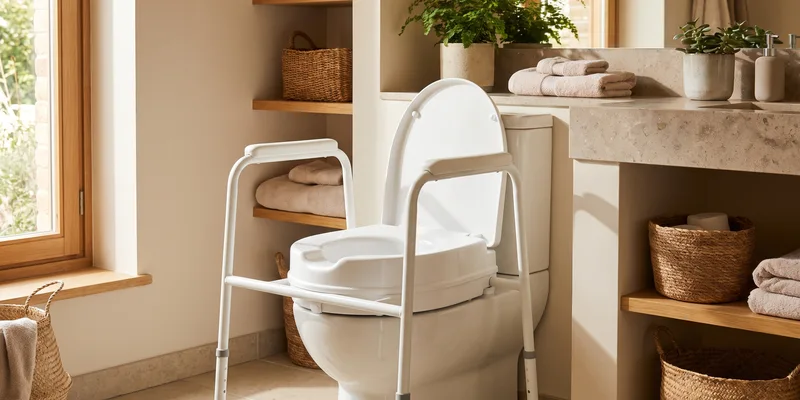
Plenty of households need height and hand support at once, and the tidy answer is a single combination unit: a frame with a raised seat carried on adjustable legs. One product, one height setting, nothing stacked, and the load goes into the floor rather than the porcelain.
Stacking a separate clamp-on riser inside a frame is possible, and it works, but it needs care. Set the frame low enough that the finished seat height still leaves the user’s feet flat on the floor. Our guide to choosing raised toilet seat height covers how to arrive at that number rather than defaulting to the maximum.
What Neither One Covers
Both products stop working the moment the user stands up and turns. A riser has nothing to hold, and a frame’s arms end at the toilet, so the walk to the sink or the door is unsupported. If that part of the trip is where the difficulty shows, the answer is a wall-anchored grab bar rather than either of these.
That is not an argument against buying one, it is an argument for checking the whole sequence rather than just the moment of standing. Our guide to where to place grab bars walks through the zones in a typical bathroom and how they connect.
Picking a Product Once You Have Decided
If the answer is height, a clamp-on riser in the correct bowl shape is the direct fix and installs without tools on most models.

If the answer is hand support, an adjustable floor-standing frame gives symmetrical arms and sets its own height on the legs.

And if both apply, a combination frame with an integrated raised seat handles the pair in one unit without stacking.

A Note on Getting Advice
Watching one sit-and-stand tells you a lot, but it is not the same as an assessment. If you are unsure what fits your situation, ask your doctor or an occupational therapist. They will often spot a third option, such as repositioning a nearby fixture or improving the lighting on the route, that costs nothing at all.
Frequently Asked Questions
Is a toilet frame better than a riser? Neither is better in general, because they address different difficulties. A riser handles a seat that sits too low, a frame handles the lack of anything solid to push against. Watch one sit-and-stand to see which applies.
Can you use a riser and a frame together? Yes, and many households do. Watch the combined height so the user’s feet still rest flat on the floor. A combination frame with a built-in seat achieves the same result in one product.
Which one is better for a small bathroom? A riser, since it adds no width beyond the toilet itself. Where two-sided hand support is genuinely needed in a narrow room, a bolt-on rail that extends forward rather than outward is the compromise to look at.
Which one is better for a rental? Both work without drilling into a wall. A clamp-on riser is the least invasive of all, since it lifts off in seconds and leaves no trace.
Do either of them help with balance while walking? No. Both stop at the toilet, so the walk to and from it is unsupported. That is the job of a wall-anchored grab bar placed along the route.
Which holds more weight? Floor-standing frames generally carry higher stated capacities than clamp-on risers, because the load goes into the floor rather than the porcelain. Take the exact figure from the manufacturer’s listing for the model you are considering.
Can a frame be used over a toilet that already has a bidet attachment? Usually yes, since a frame straddles the fixture rather than clamping to it. Check that the frame legs clear the supply hose and any side-mounted control panel.
The Bottom Line
Toilet riser versus toilet frame is not a value comparison, it is a diagnosis. If the seat is too low and the legs do the work, buy the riser. If the user is reaching for the sink or the wall before they commit, buy the frame. If both are true, buy one combination unit rather than stacking two products, and remember that neither supports the walk away from the toilet, which is where a wall-anchored bar belongs. Start with our raised toilet seat guide or our toilet safety rails guide once you know which side you are on.