Last updated: August 20, 2026
Some links on this page are affiliate links. See our affiliate disclosure.
Plenty of families buy a plain toilet riser, watch it help a little, and realize within a week that the height was only half the problem. The other half is what the hands do. Standing up from a low seat is a pushing movement as much as a leg movement, and if there is nothing solid within reach, the user ends up grabbing a towel rail, a sink edge, or the wall, none of which were built for that.
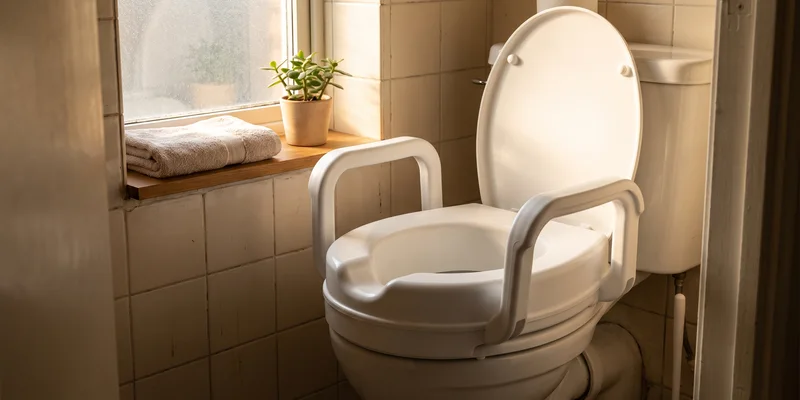
A raised toilet seat with handles puts a fixed armrest on both sides at the height where the hands naturally land. This guide covers the arm designs available, how to judge whether arms are the right answer at all, and what to check on the listing before ordering, including the bowl shape and weight capacity that decide whether the unit fits your toilet.
Quick Answer
Do you need a raised toilet seat with handles?
- Choose one if the user pushes down with their hands to stand. If the legs do the work and balance is steady, a plain riser is simpler and takes less space.
- Padded arms are more comfortable to grip for longer, molded plastic arms are easier to wipe down and usually narrower.
- Removable or swing-back arms matter in a small bathroom, since fixed arms add several inches to the total width.
- Check the stated weight capacity and the bowl shape in the listing before ordering, and confirm the arms clear the tank and any nearby wall.
Bottom line: arms help when the hands do the lifting, and the arm style should follow how narrow the bathroom is.
When Arms Actually Help
Arms earn their place when the user leans forward, plants both hands, and pushes to complete the stand. That pattern is common when leg strength has dropped, after a period of limited activity, or when hip or knee flexion is restricted. Having a solid armrest under each hand is designed to provide support at exactly that moment.
Arms are the wrong answer in two situations. If the user already stands with a walker parked in front of them, fixed arms can get in the way of positioning the walker close enough. And if the difficulty is genuinely with balance while standing rather than the push itself, a wall-anchored grab bar beside the toilet often gives a better hold, because it stays useful throughout the whole turn and step away.
The Arm Designs You Will See
Arm style affects comfort, cleaning, and how much floor space the unit needs. There are three common approaches, and the right one usually comes down to how narrow the bathroom is and how long the seat will stay in place.
Fixed Molded Arms
The arms are part of the same molded plastic shell as the seat, which makes the whole unit rigid with nothing to work loose. They wipe clean in seconds and cost the least. The trade-off is total width, which is fixed, so measure the space between the toilet and any wall or vanity before ordering.
Padded or Foam-Covered Arms
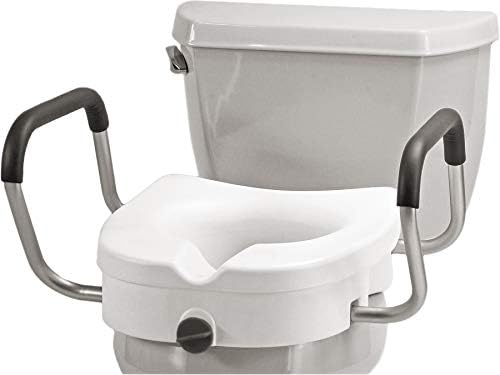
These add a softer surface over a steel or aluminum frame, which is easier on the hands when the user leans hard or holds on while adjusting clothing. They tend to be a little wider overall, and the padding needs a wipe-down routine of its own since it does not shed moisture the way molded plastic does.
Removable and Swing-Back Arms
These detach or hinge backward, so the unit can go narrow when someone else needs the bathroom, or when a caregiver needs to assist from the side. This is the version to look at in a tight bathroom or where a transfer happens from a wheelchair, since a swing-back arm clears the path without taking the whole seat off.
Raised Seats With Handles by Situation
The Straightforward Choice
A molded riser with fixed arms and a lift of around four or five inches covers most households. It clamps onto the bowl, needs no tools on most models, and lifts off when the need passes. If the bathroom has reasonable clearance on both sides, this is where to start.

When the Hands Need a Softer Grip
Padded armrests suit users who hold on for longer, or who find hard plastic uncomfortable under the forearm. The padding also gives a little grip, which helps if hands are dry or weak.

For Narrow Bathrooms and Side Transfers
Swing-back or fully removable arms keep the width down when the arms are not in use, which matters if the toilet sits close to a vanity or if someone transfers across from a wheelchair or transport chair.
When a Higher Weight Capacity Is Needed
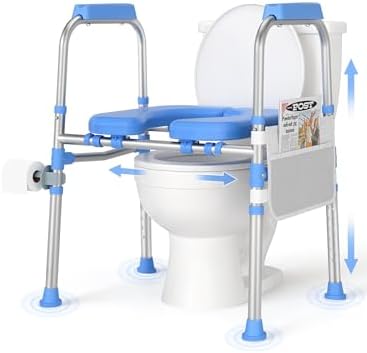
Heavy-duty models use a wider seating surface and a reinforced frame, and many transfer the load to the floor through legs rather than resting entirely on the bowl. Read the weight rating printed in the listing rather than assuming it matches a standard model.
Comparing the Arm Styles
| Arm style | Strength | Watch out for |
|---|---|---|
| Fixed molded | Rigid, easiest to clean, lowest cost of the three | Total width is fixed, so measure side clearance first |
| Padded | More comfortable for a longer or harder grip | Padding needs its own cleaning routine, slightly wider |
| Removable or swing-back | Clears the side for transfers and other household members | More moving parts, check the locking mechanism holds firmly |
| Frame around the toilet | Load goes to the floor, height often adjustable | Takes the most floor space, needs level flooring |
What to Check Before Ordering
Three numbers decide whether the unit fits. Bowl shape comes first, measured from the seat bolts to the front edge of the rim, since round and elongated are not interchangeable. Then the lift height, then the total width including the arms, measured against the free space beside the toilet.
One more check catches a frustrating return: look at where the arms end relative to the tank. On toilets with a low or forward-set tank, some longer arms foul the tank or the flush handle, which either blocks installation or makes flushing awkward. Product photos taken from the side are more useful than the front-on shots for judging this.
Weight Capacity Comes From the Listing
Every model states a maximum user weight, and the figure varies widely between a basic clamp-on unit and a floor-standing frame. Take that number from the manufacturer’s listing rather than from a category assumption, and treat the arms as rated for support during a stand rather than for bearing full body weight sideways.
Common Mistakes When Buying One
The most common mistake is buying arms to solve a balance problem. Arms help with the push, but they end where the toilet ends, so the moment the user turns and steps away there is nothing left to hold. That gap is what a wall-mounted bar covers, and our guide to grab bars for toilets explains where to place one so the two work together.
The second is ordering on lift height alone and ending up with feet that no longer reach the floor. A seat that is too high makes the stand less controlled, not more. Our walkthrough on choosing the right height covers how to arrive at a number that suits the user rather than the catalog.
A Note on Getting Advice
Whether arms, a frame, a wall bar, or some combination suits best depends on how a particular person moves, and that is genuinely hard to judge from a product page. If you are unsure what fits your situation, ask your doctor or an occupational therapist. A short assessment often changes the answer, and it is quicker than working through returns.
Frequently Asked Questions
Are the handles strong enough to pull up on? They are designed to provide support during a sit-to-stand movement, within the weight capacity the manufacturer states. Check that figure in the listing, and if someone needs to pull their full weight sideways, a wall-anchored grab bar is the more appropriate fixture.
Can the arms be removed later? On some models yes, on molded one-piece units no. If you expect the need to change, or the bathroom is narrow, look specifically for removable or swing-back arms rather than assuming a model offers them.
Will a seat with arms fit a small bathroom? Measure the free space on each side of the bowl and compare it against the total width in the listing. Where clearance is tight, a swing-back arm model or a plain riser paired with one wall-mounted bar usually fits better.
Does it work with an elongated bowl? Most designs come in both round and elongated versions. Measure from the center of the seat bolts to the front of the rim, roughly sixteen and a half inches for round and eighteen and a half for elongated, then order the matching version.
Is a seat with arms better than a toilet frame? Not better, different. A frame stands on the floor and surrounds the toilet, which suits a higher weight capacity and adjustable height, while an integrated seat is simpler and takes less space. Our riser versus frame comparison works through both.
How do you keep the arms from feeling wobbly? Check that the clamp under the bowl rim is fully tightened and that the seat sits flat with no rocking before use. Persistent movement usually means a bowl shape mismatch, and a locking model or floor-standing frame is the more stable option.
Can a caregiver still assist with the arms in place? Fixed arms limit access from the side, which is exactly why swing-back designs exist. If someone regularly helps with the transfer, choose arms that hinge or lift out.
The Bottom Line
A raised toilet seat with handles is the right pick when the user’s hands do part of the work of standing, and the arm style should follow the bathroom rather than the catalog: molded arms where space allows, padded where comfort matters, swing-back where clearance is tight or a caregiver assists. Confirm bowl shape, lift height, total width, and the stated weight capacity before ordering. For the full picture across the category, start with our raised toilet seat guide.