Last updated: August 20, 2026
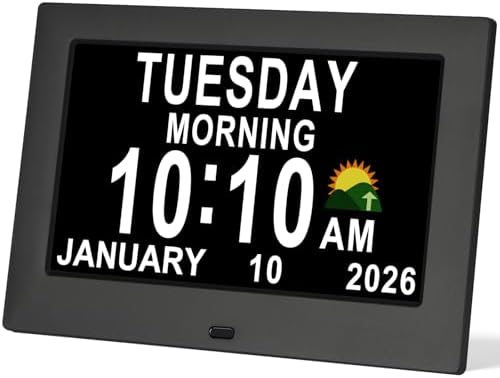
A day clock does one thing an ordinary clock refuses to do: it says the day out in full. Not a number in a corner, not an abbreviation, but “Wednesday” in letters large enough to read from a chair across the room, usually with the date and the part of the day alongside it.
It sounds almost too simple to buy. In practice it removes a small, repeated annoyance for anyone whose week is no longer marked out by a work schedule, and it is one of the least intrusive devices you can put in a living room.
This article contains affiliate links. If you buy through them, we may earn a commission at no extra cost to you. Learn more.
Quick Answer
What should you look for in a day clock?
- The day written out in full words, not abbreviated, in the largest text on the display.
- A screen big enough to read from where the person actually sits, with high contrast and adjustable brightness for evening.
- Automatic time keeping and a battery backup, so a power cut does not leave a clock that quietly shows the wrong day.
Bottom line: measure the reading distance first, then buy the largest high contrast display that fits the room, and check it holds the date through a power cut.
What a Day Clock Actually Shows
A day clock leads with the day of the week spelled out, then adds the date and often a plain language segment such as morning, afternoon, evening, or night. Some show the month and year as well. The layout is the product: everything is sized by importance rather than crammed in evenly.
That ordering is the difference from an ordinary digital clock, which puts the time first and the date last in small print. When the question is which day it is rather than what time it is, the standard layout answers the wrong question.
Who Tends to Buy One
Households where the week has lost its markers. Retirement removes the weekday and weekend distinction that a working schedule imposed, and a clock that names the day is a quiet way to keep the calendar anchored without anyone having to ask.
Day Clocks by Situation
The Standard Digital Day Clock
A digital display showing the day in full, with date and part of day underneath, is the common format. Screen sizes vary widely, and the specification list gives the display dimensions, which is the number worth comparing between models.
Reading From Across the Room
If the clock will be read from a chair several steps away, screen size becomes the deciding factor rather than a nice extra. The larger models are usually described by screen inches in the title, and a wall mountable version puts the display at eye level.

Adding Reminders to the Same Screen
Some day clocks include programmable text reminders that appear at a set time, which suits a household already using a clock as the reference point on the sideboard. The number of reminders and whether they repeat daily are both listed in the specifications.

An Analog Alternative
There are analog wall clocks with a single hand that points at the day of the week, which some people find easier to read at a glance than text. They suit a hallway or a kitchen, and they need nothing but a battery.

What to Compare Before Buying
| Feature | What to check |
|---|---|
| Display size | Stated in inches; match it to the reading distance in the room |
| Wording | Day spelled in full, not abbreviated to three letters |
| Contrast | Dark text on light, or bright text on black; avoid low contrast styling |
| Brightness | Adjustable or automatic dimming for a bedroom at night |
| Time keeping | Automatic setting or a manual set with clear instructions |
| Power | Mains with battery backup keeps the date through an outage |
| Mounting | Desk stand, wall bracket, or both included |
Where to Put It
Put the clock in the room where the day gets asked about, usually the living room or the kitchen rather than the bedroom. Eye level from a seated position is the target, and a wall mount often beats a sideboard because it cannot be turned around while dusting.
If it goes in a bedroom, brightness matters more than size. A display that lights a room at three in the morning gets covered with a cloth, so look for automatic dimming or a night mode in the specifications.
Setting It Up Once, Properly
Models that set themselves from a radio signal or a wifi connection stay correct without anyone touching them, which is the main practical advantage over a manually set clock. If the clock is manual, set it together, and keep the instruction sheet taped to the back rather than in a drawer.
Common Mistakes
The first is buying on price and ending up with a display too small for the room, which is the one thing that makes the clock pointless. Measure the distance from the chair to where the clock will sit, and buy the size that suits it.
The second is a mains only clock in a house with frequent outages. Without a battery backup it may restart on a default date, and a clock quietly showing the wrong day is worse than no clock at all.
Frequently Asked Questions
What is a day clock? A clock that displays the day of the week written out in full as the largest element, usually with the date and a plain language part of day such as morning or evening. The time is present but secondary.
What size day clock do we need? It depends on the reading distance. Measure from the chair to where the clock will sit and compare that against the stated display size, since screens in this category range from small bedside units to large wall panels.
Do day clocks set themselves? Some do, either from a radio time signal or over wifi, and those stay correct without intervention. Others are set by hand, which is fine as long as the instructions stay with the clock.
What happens after a power cut? Models with a battery backup keep the date and time. Mains only models may restart on a default setting, so check the listing for a backup battery if outages are common.
Are day clocks too bright for a bedroom? Some are. Look for adjustable brightness, automatic dimming, or a night mode. In a living room this matters less, and a brighter display is usually the better choice there.
Digital or analog? Digital shows more information and can include reminders. An analog day clock with a pointer is simpler and needs only a battery. Personal preference decides this more than anything else.
Can a day clock show reminders? Several models let you program short text messages that appear at set times. Check how many reminders the clock stores and whether they repeat daily before relying on that feature.
Is a tablet or a smart speaker a better option? They can announce the day and manage reminders, but they need setting up and stay switched on. A day clock does one thing permanently with no interface. Our smart speaker guide covers the alternative if the household wants more than a clock.
The Bottom Line
A day clock is a small purchase that removes a recurring small irritation, and the only decisions that really matter are display size, contrast, and whether it keeps the date through a power cut. Measure the reading distance before buying, put it where the question actually comes up, and prefer a model that sets itself. If reminders matter as much as the day itself, look at our Alexa setup guide alongside this.