Last updated: August 20, 2026
Some links on this page are affiliate links. See our affiliate disclosure.
Rubber is the default material for a doorway ramp, and the reason is almost embarrassingly simple: it is heavy. A ramp that stays exactly where you put it, without brackets, screws, or adhesive, solves a whole category of frustration that lighter materials create. Add a naturally grippy surface and the fact that wheels roll over it quietly, and the appeal for an indoor doorway is obvious.
That weight has a cost, and there are a few things about rubber worth knowing before it goes at a front door rather than a hallway. This guide covers what these ramps are made from, how they behave in cold and wet conditions, the sizes on offer, and where aluminum is the better call.
Quick Answer
When is a rubber threshold ramp the right choice?
- Choose rubber where the ramp should stay put without fixings, which covers most interior doorways and sheltered exterior sills.
- Its weight is the main advantage and the main drawback: it does not shift under a wheel, and it is not something you carry around.
- Most are molded from recycled rubber, which gives a textured, slip-resistant surface that stays grippy when damp.
- Check the rated rise, the width of the opening, and the door clearance, then decide between a one-sided wedge and a double-sided design.
Bottom line: rubber wins on staying put and gripping, aluminum wins on being carried and on higher loads.
What Rubber Threshold Ramps Are Made Of
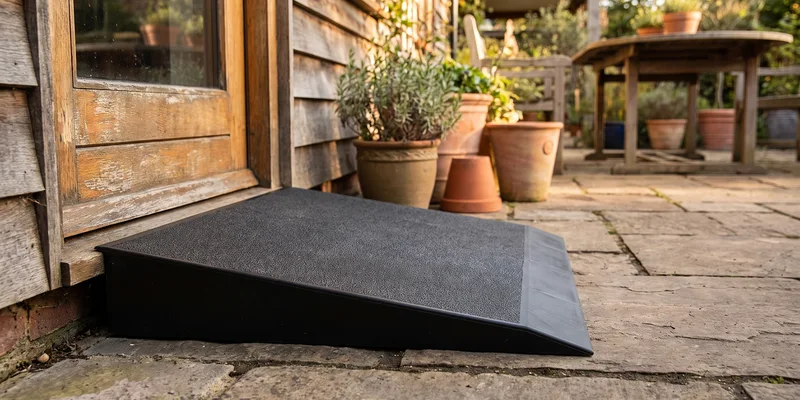
Most are molded from recycled rubber, often reclaimed tire material, compressed into a solid wedge with a textured top surface. The result is dense and heavy for its size, which is exactly what a doorway ramp wants, and it resists chipping in a way that molded plastic does not.
The texture is molded in rather than applied as a coating, so it does not wear off the way a painted grit surface can. That matters at a doorway that sees traffic every day, and it is one of the practical reasons rubber holds its place in a category where aluminum otherwise dominates.
Where Rubber Beats Aluminum
The comparison comes down to four things: whether the ramp needs to stay put, how much noise and vibration it transmits, how it grips, and how much load it carries. Rubber takes the first three in a typical home.
Staying Put Without Fixings
A rubber wedge is heavy enough that a wheel crossing it does not push it out of position. That means no screws into a doorsill, which matters in a rental, and no adhesive strips to lift later. Aluminum ramps of the same size are light enough that many need fixing down to behave.
Quiet and Forgiving Underfoot
Wheels crossing rubber make far less noise than wheels crossing aluminum, and the material absorbs some of the jolt at the transition. For a walker or rollator user, a rubber edge is also more forgiving to clip a foot on than a metal one.
Where Aluminum Is Better
Aluminum is the right call where the ramp needs to be carried, where the rise is at the taller end of the range, and where the highest weight capacities are needed. It also handles prolonged outdoor exposure without the softening that heat can cause in rubber. Our overview of threshold ramps compares the materials across the whole category.
Sizes and Shapes
Rubber ramps are sold by the rise they are built for, commonly from around half an inch up to several inches, in a range of widths to suit standard doorways. Taller versions get noticeably heavier, which is the practical limit rather than any design limit.
| Sill height | Typical shape | Notes |
|---|---|---|
| Under 1 inch | Low-profile wedge or double-sided strip | Common at interior transitions and slider tracks |
| 1 to 2.5 inches | One-sided wedge for exterior doors | The most widely stocked range |
| 2.5 to 6 inches | Larger wedge, sometimes in sections | Heavy, and best treated as a permanent fixture |
| Above 6 inches | Not a threshold ramp | Move to a longer portable ramp instead |
Shape matters as much as height. A one-sided wedge suits an exterior door where the outside surface sits lower, while a double-sided design is needed wherever there is finished floor on both sides, such as an interior doorway or a sliding patio track.
Rubber Threshold Ramps by Situation
The Standard Exterior Doorsill
A one-sided wedge matched to the sill height is the common case, sitting outside the door where the path or patio is lower. Its weight keeps it in position through daily use without any fixings.

Low Interior Transitions
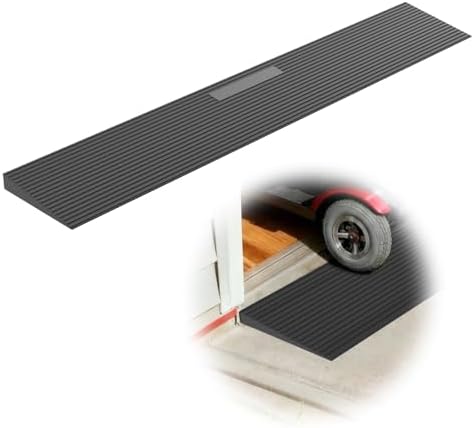
A low-profile double-sided strip smooths the metal transition between rooms or the raised track of a slider, where a one-sided wedge would just move the problem to the other side.

Taller Back Door or Garage Steps
Larger rubber wedges cover the upper end of the range, and at that size they are best regarded as a fixture rather than something to move. Check the weight capacity in the listing against the chair and user together.

Sliding Glass Door Tracks
Track-specific rubber ramps are shaped to straddle the rail rather than sit on it, which stops the ramp rocking each time a wheel crosses.
Weather, Cold and Cleaning
Rubber grips well when wet, which is its strongest argument for a back door. In freezing conditions the material stiffens, and ice on the surface is as slippery there as anywhere else, so clearing snow and ice off the ramp belongs on the same list as clearing the step it covers.
Cleaning is straightforward: sweep off grit and leaves, and hose or wipe the surface periodically so the molded texture stays open rather than packed with debris. Check underneath a few times a year too, since a solid wedge against an exterior door can trap water and grit where you cannot see it.
The New Rubber Smell
Recycled rubber often has a noticeable odor for the first days or weeks, particularly in a warm room or a closed hallway. Airing the ramp outdoors before bringing it inside usually shortens that considerably, and it fades on its own. It is worth knowing about in advance rather than discovering it after installation.
Fitting Checks
Measure the sill at its highest point, measure the width of the opening, and check the door clearance with the ramp height in mind. Where there is a storm or screen door, measure to the bottom of that instead, since it sits closer to the sill and is the tighter limit.
Then look at what the ramp lands on. Rubber sits best on a firm, level surface, and on soft ground or loose gravel a heavy wedge will gradually settle out of level. A paving slab or a firm pad under the lower edge solves that and costs very little.
A Note on Getting Advice
If more than one threshold in the house is causing problems, it is worth reviewing the whole route rather than treating each doorway separately. If you are unsure what fits your situation, ask your doctor or an occupational therapist, who can look at how the person actually moves through the house.
Frequently Asked Questions
Do rubber threshold ramps move around? Rarely, because their weight is the point. Under normal use a rubber wedge stays where it is placed without screws or adhesive, which is the main reason it gets chosen for rentals and interior doorways.
Can a rubber threshold ramp be cut to size? Some models can be trimmed to width with the right tools, and others are sold in fixed widths only. Check the manufacturer’s guidance first, since cutting can affect how the ramp seats and may affect the warranty.
Are rubber ramps slippery when wet? The molded texture grips well in the rain. Ice is a different matter, and a frozen surface needs clearing just like the step underneath it.
How much weight can a rubber threshold ramp take? It varies by model and the manufacturer states the figure in the listing. Make sure it covers the user, the chair, and anything being carried, and remember power chairs are considerably heavier than manual ones.
Do they smell when new? Recycled rubber often has a noticeable odor at first, more so in warm or enclosed spaces. Airing it outside for a few days before bringing it indoors usually deals with most of it.
Rubber or aluminum for an outdoor doorway? Rubber if it should stay in place without fixings and the rise is modest. Aluminum if it needs to be carried, if the rise is at the taller end, or if a higher weight capacity is required.
Will it damage the floor or the sill? Under normal use, no, though grit trapped underneath can mark a finished floor over time. Lift the ramp occasionally and sweep beneath it, which also lets you check the sill itself.
The Bottom Line
A rubber threshold ramp is the right choice when the ramp should stay put without fixings and the rise is modest, which covers most interior doorways and plenty of sheltered exterior sills. Its weight and molded texture are its two real advantages, and its weight is also why aluminum takes over as soon as the ramp needs carrying or the load goes up. Measure the sill at its highest point, check the door and any screen door clearance, and choose the one-sided or double-sided shape based on what is on the far side. For the wider category, see our threshold ramp guide.