
Last updated: August 20, 2026
Cane or walker is rarely a shopping question. It usually arrives as a family question, somewhere between noticing that a parent holds furniture on the way to the kitchen and an appointment where somebody uses the word walker for the first time. The two devices sit at different points on the same scale, and the gap between them is wider than the two words suggest.
This comparison sets out what each one actually provides, what each demands from the user, and how they differ in a real house with doorways and hallways. What it does not do is tell you which one a specific person needs. That decision belongs with a doctor or an occupational therapist who can watch someone walk.
This article contains affiliate links. If you buy through them, we may earn a commission at no extra cost to you. Learn more.
Quick Answer
What is the difference between a cane and a walker?
- A cane is one point of contact used with one hand, offering light support and leaving the other hand completely free.
- A walker is a frame in front of the body with four points of contact, used with both hands, offering considerably more support and taking up considerably more space.
- Between them sit quad canes, front wheeled walkers, and rollators, which is why the choice is rarely a straight two way decision.
Which level of support fits a specific person is a clinical judgement. Ask your doctor or an occupational therapist.
What Each Device Actually Does
A cane gives the user a third point of contact with the ground, held in one hand and placed beside and slightly ahead of the foot. It is designed to provide light support and a reference point for balance, and it leaves one hand entirely free for a rail, a door, or a cup.
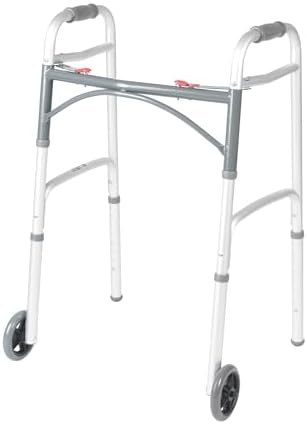
A walker puts a frame in front of the body and asks for both hands. Four points of contact make it far steadier, and the frame gives somewhere to push down when standing up or steadying between steps. It is also wider than most interior doorways were designed for, which is the practical catch nobody mentions in the appointment.
They Are Not Steps on a Ladder
It is tempting to see cane, then walker, then rollator, then wheelchair as a fixed sequence. In practice many people use a cane indoors and a rollator for longer outings, or a walker at home and a transport chair for appointments. Devices are tools for situations, not ranks.
The Difference in One Look
| Factor | Cane | Walker |
|---|---|---|
| Points of contact | One, plus both feet | Four, plus both feet |
| Hands used | One | Both |
| Support offered | Light, balance reference | Substantial, weight bearing frame |
| Space needed | Almost none | Frame width plus turning room |
| Stairs | Usable with instruction and a rail | Generally not, needs a plan |
| Carrying things | One free hand | Needs a bag, tray, or basket |
What Each One Asks of the User
A cane asks for the coordination to place it correctly on the opposite side to the weaker leg, and for enough steadiness that one point of contact is enough. It gives back freedom of movement, easy storage, and the ability to keep a hand free.
A walker asks for both hands, for the space to turn it, and for the patience to move at its pace. It gives back a frame that does not move when weight goes onto it, and a reliable place to push up from when getting out of a chair. Neither trade is obviously better; they answer different needs.
Endurance and Distance
Distance is often the deciding factor rather than steadiness. Someone perfectly comfortable with a cane inside a bungalow may find a supermarket trip exhausting. That is the situation a rollator with a seat is built for, and it is why plenty of households own a cane and a rollator rather than choosing between them. Our rollator walker guide covers that device in detail.
The Home Decides More Than People Expect
Measure before assuming a walker will work. Take the clear width of the narrowest interior door with the door fully open, the tightest hallway, and the free space beside the bed, the toilet, and the sofa where the frame has to be turned. Older houses and apartments frequently have doorways that a standard walker will not clear.
Storage matters too. A cane lives in an umbrella stand; a walker needs a parking place in every room where it is used, or it ends up blocking the hallway. Our guide to indoor mobility aids for small apartments covers turning circles and where devices actually live.
The Options In Between
A quad cane adds a four point base to a single shaft, giving more support than a standard cane while still being used in one hand. It stands up on its own, which some people value more than the extra base width. Our quad cane guide covers the base sizes.
On the walker side, a front wheeled walker is easier to move than a rigid frame while still stopping at every step, and a rollator rolls continuously and adds a seat. Each of those is a meaningfully different device rather than a variation, which is why the conversation is rarely a simple cane or walker choice.

What Families Notice, and What to Do With It
Families usually bring specific observations to an appointment rather than conclusions: holding furniture on the way through a room, taking longer to stand up from a chair, stopping partway along a familiar walk, avoiding outings that used to be routine. Those are useful things to describe because they tell a therapist about function rather than about a device.
What is not useful is buying a device on the strength of those observations and hoping. A walker that gives more support than someone needs can change how they move, and a cane that is not enough is a cane being leaned on in a way it was not built for. This is genuinely a professional judgement.
Who Should Decide
A doctor or an occupational therapist can watch someone walk, check hand strength and balance, look at the home, and recommend a device type and a handle height in one visit. They can also demonstrate how to use it, which matters more than the purchase. If you are unsure what fits your situation, ask for that assessment before ordering anything. Our guides to front wheeled walkers and to measuring for a walker are useful for the conversation afterward.
Frequently Asked Questions
Is a walker better than a cane? Neither is better in general. A walker offers considerably more support and needs both hands and more space; a cane offers light support and leaves a hand free. Which suits a person is a clinical judgement rather than a product comparison.
When do people move from a cane to a walker? There is no universal threshold. Families often raise it after noticing furniture holding, difficulty standing from a chair, or shorter distances before needing to stop, and a therapist assesses from there.
Can you use a cane and a walker at the same time? Not simultaneously, but plenty of households use a cane indoors and a walker or rollator for longer distances. Devices suit situations rather than replacing each other permanently.
Which is better for stairs? A cane, used with a handrail and with instruction on technique. Walkers are generally not used on stairs, and a home with stairs in the daily route needs a plan worked out with a therapist.
Will a walker fit through my doorways? Only if the listed overall width is less than the clear opening of the narrowest door. Measure with the door fully open and leave room for knuckles, since older homes are frequently tight.
What is between a cane and a walker? A quad cane adds a four point base while staying a one handed device, and a front wheeled walker is a lighter step into frames. Both are common intermediate choices.
Does a walker make someone weaker over time? More support than a person needs can change how they move, which is one reason therapists match the device to the assessment rather than defaulting to the most supportive option. Discuss it at the appointment.
Does Medicare cover a cane or a walker? Coverage differs by plan, by situation, and by how equipment is prescribed and supplied. Check the current rules at medicare.gov and with the specific plan.
The Bottom Line
A cane is one point of contact and one free hand; a walker is a four point frame that asks for both hands and real floor space. The gap between them holds quad canes, front wheeled walkers, and rollators, and most households end up with more than one device for different situations. Measure the doorways before deciding, and have the level of support judged by a doctor or an occupational therapist. Our walker versus rollator comparison covers the next step along.