Last updated: August 20, 2026
A rollator walker is one of those purchases families tend to make in a hurry, usually right after a hospital discharge or a physical therapy appointment where someone said the word “walker” and nobody wrote down which kind. The result is a box in the hallway holding a device that is too heavy to lift into a trunk, too wide for the bathroom doorway, or set at a handle height that has the user hunched forward all day.
This guide walks through what actually separates one rollator walker from another: wheel size, frame width, folding style, seat height, and weight capacity. None of it is complicated, but all of it matters more than brand name, and most of it can be checked with a tape measure before anything is ordered.
This article contains affiliate links. If you buy through them, we may earn a commission at no extra cost to you. Learn more.
Quick Answer
What should you look for in a rollator walker?
- Match wheel size to the surface: smaller wheels roll neatly on hard indoor floors, larger wheels handle sidewalk cracks, grass, and gravel far better.
- Measure the narrowest doorway and hallway in the home before ordering, because overall frame width is what decides whether a rollator is usable indoors at all.
- Check handle height range against the user’s wrist height when standing upright, and check the listed weight capacity, which varies widely between standard and heavy duty models.
Bottom line: pick the rollator around where it will be used and who will be lifting it, then confirm handle height and weight capacity from the product listing.
What a Rollator Walker Is, and How It Differs From a Standard Walker
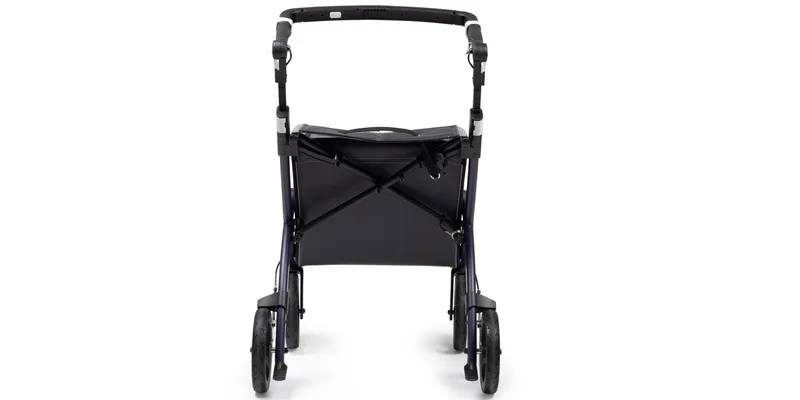
A rollator walker is a wheeled frame with hand brakes, usually three or four wheels, and on most four-wheel models a built-in seat. Unlike a standard walker, it is not lifted and set down with each step. It rolls continuously, which suits someone who can walk steadily but wants something in front of them to hold onto and to rest against.
That rolling motion is exactly why the brakes matter. A standard walker stays put because it is on the floor; a rollator stays put because someone squeezes or locks the brakes. Anyone considering the switch should be comfortable operating brake levers with their hands, which is worth a short conversation with a physical or occupational therapist if hand strength is a question.
Three Wheels or Four
Three-wheel rollators have a narrower turning profile and are easier to steer through tight indoor spaces, but they do not have a seat. Four-wheel rollators are more stable side to side, carry a seat and usually a storage pouch, and are what most people picture when they hear the word rollator. If sitting down partway through a walk is part of the point, a four-wheel model is the starting place.
Wheel Size Decides Where It Works
Wheel diameter is the single most practical spec on a rollator listing. Six-inch wheels are common on indoor-focused models and turn easily on tile, hardwood, and low-pile carpet. Eight-inch wheels are the general-purpose middle ground. Ten-inch and larger wheels are built for outdoor use and roll over sidewalk lips, driveway seams, and packed dirt without stopping short.
The trade is size and weight. Bigger wheels make the whole frame longer and heavier, which shows up when the rollator has to fit in a car trunk or turn around in a bathroom. Households that split use between indoors and daily outdoor walks often end up happiest with an eight-inch model, or with two devices if storage allows it.
Rollator Walkers by Situation
The Broadest Starting Point: A Standard Four-Wheel Rollator With a Seat
For most first-time buyers, a conventional four-wheel rollator with a padded seat, a storage bag, and loop-style hand brakes covers the widest range of daily use. It rolls indoors, handles a paved sidewalk, and gives the user somewhere to sit when a walk turns out longer than expected.

When Someone Else Lifts It Into the Car
If a spouse or adult child is loading the rollator into a trunk several times a week, frame weight becomes the deciding spec rather than an afterthought. Aluminum and carbon-frame models are built specifically around this, and the difference between a heavy steel frame and a light aluminum one is felt on every single lift.

Tight Hallways and Narrow Bathroom Doorways
Older homes and apartments frequently have doorways that a standard rollator simply will not clear. Narrow-frame rollators are built to a reduced overall width for exactly this reason, and they are the difference between a device that lives in the living room and one that can actually follow someone to the bathroom.

Users Who Lean Forward on a Standard Rollator
Upright or stand-up rollators place padded forearm supports at roughly elbow height instead of hand grips at wrist height, which encourages a taller posture and takes load off the wrists and hands. They are noticeably larger and heavier than a standard rollator, so they suit a user who will keep one device in one place.

Higher Weight Capacity
Standard rollators are typically rated somewhere in the 250 to 300 pound range, and heavy duty or bariatric models are built with reinforced frames, wider seats, and higher listed capacities. Always read the capacity from the product listing itself rather than assuming it, since it differs by model even within one brand.

Comparing the Main Rollator Types
| Type | Best suited to | Watch out for |
|---|---|---|
| Three-wheel | Tight indoor turns, apartments | No seat, less side-to-side stability |
| Four-wheel standard | Mixed indoor and paved outdoor use | Overall width in older doorways |
| Lightweight folding | Frequent car transport | Often lower listed weight capacity |
| Narrow indoor | Hallways and bathroom doorways | Small wheels struggle outdoors |
| Upright | Users who hunch over hand grips | Bulk, weight, and storage space |
| Heavy duty | Higher listed capacity, wider seat | Heavier to lift and to fold |
Measuring Before You Order
Three measurements settle most rollator returns. First, handle height: with the user standing upright in their usual shoes, arms relaxed at their sides, measure from the floor to the crease of the wrist. That number should fall inside the model’s adjustable handle height range, not at the very top or very bottom of it.
Second, doorway width: find the narrowest interior door the rollator has to pass through and measure the actual clear opening with the door standing open, not the frame. Compare that to the listed overall width of the rollator, and leave an inch or two of margin for knuckles. Third, seat height, which matters because standing up from a seat that is too low is harder than sitting down onto it.
Weight Capacity and Frame Weight Are Two Different Numbers
Listings show both, and they are easy to mix up. Weight capacity is the maximum user weight the manufacturer states for that model. Frame weight is what someone has to lift. A light frame usually carries a lower capacity, so if both a low lifting weight and a high capacity are needed, read both numbers on the specific model rather than assuming a category rule.
Common Mistakes When Buying a Rollator Walker
Buying on wheel appearance is the most frequent one. Large wheels look sturdier in photos, and they are genuinely better outdoors, but they make a rollator longer and harder to maneuver in a hallway. If the device will spend most of its life inside a house, the smaller wheel is usually the more useful choice.
The second common mistake is skipping the handle height adjustment entirely. Rollators arrive at a factory setting that fits nobody in particular, and leaving it there is why so many users walk hunched forward with their shoulders up around their ears. Adjusting the handles takes a few minutes with the supplied tool or pin clips and changes how the device feels immediately.
Ignoring the Brakes Until Something Goes Wrong
Loop brakes work in two ways: squeeze to slow down while walking, push down to lock the wheels before sitting. Cables stretch over time and brakes need occasional tightening, which is a routine adjustment described in the manufacturer’s manual. Sitting on the seat of an unlocked rollator is a mistake that only needs to happen once, so it is worth building the habit of locking both sides first.
A Note on Getting the Right Device
A rollator is mobility equipment, not medical care, and choosing between a rollator, a standard walker, a cane, or a transport chair depends on things a product page cannot see. If you are unsure what fits your situation, ask your doctor or an occupational therapist, who can look at gait, balance, hand strength, and the home itself before recommending a device type or a handle setting. Our walker versus rollator comparison covers the general differences if you want context before that conversation.
Frequently Asked Questions
What is the difference between a walker and a rollator walker? A standard walker has no wheels or two front wheels and is lifted or pushed forward in short steps, while a rollator rolls on four wheels continuously and is stopped with hand brakes. Rollators usually include a seat; standard walkers do not.
How do I know what height a rollator should be? Stand upright in your usual shoes with arms hanging relaxed, and measure from the floor to the wrist crease. Set the handles to roughly that height, then check that your elbows sit at a slight, comfortable bend when you hold the grips.
Can you sit on a rollator walker safely? On four-wheel models with a seat, yes, provided both brakes are pushed down into the locked position first and the rollator is on level ground. Read the manufacturer’s instructions, since seat use guidance and capacity differ by model.
What weight capacity do rollator walkers have? Standard models commonly list capacities in the 250 to 300 pound range, and heavy duty models list higher. Take the number from the specific product listing rather than a general figure, because it varies by model even within a single brand.
Will a rollator fit through my bathroom door? Only if the listed overall width of the rollator is smaller than the clear opening of the door. Measure the actual opening with the door standing fully open, and consider a narrow-frame model if the gap is tight.
Do rollator walkers work outdoors on grass and gravel? Larger wheels, generally eight inches and up, handle uneven outdoor surfaces much better than the small wheels found on indoor-focused models. Small-wheeled rollators tend to catch on sidewalk lips and stall in grass.
How heavy is a rollator walker to lift into a car? It ranges widely by frame material and wheel size, which is why lightweight aluminum models exist as a separate category. If someone else loads it regularly, make frame weight a primary spec and check it on the listing.
Does Medicare cover a rollator walker? Coverage differs by plan, by situation, and by how the equipment is prescribed and supplied, so no general answer applies to everyone. Check the current rules at medicare.gov and with the specific plan before assuming anything.
The Bottom Line
The best rollator walker is the one sized to the home it lives in and the person lifting it, not the one with the most features on the box. Measure the narrowest doorway, measure wrist height, read the listed weight capacity, and decide honestly whether this device spends its days indoors, outdoors, or in a car trunk. From there, the specific type follows almost automatically. If seating on the go is the main need, our rollator with seat guide goes deeper on seat height and comfort.