Last updated: August 20, 2026
A rollator that cannot get through the bathroom door is not a mobility aid, it is furniture. This is one of the most common and most avoidable disappointments in the whole category: a perfectly good four-wheel rollator arrives, works beautifully in the living room, and then stops dead at the doorway where it is needed most.
Older houses, apartments, mobile homes, and any bathroom built before accessible-width doors became common are all candidates for this problem. The fix is straightforward, but it starts with a tape measure rather than a product page. This guide covers how to measure a doorway properly, what overall width means on a rollator listing, and what a narrow-frame rollator gives up in exchange for fitting.
This article contains affiliate links. If you buy through them, we may earn a commission at no extra cost to you. Learn more.
Quick Answer
How do you choose a narrow rollator for indoor use?
- Measure the clear opening of the narrowest door with the door standing fully open, then subtract an inch or two for knuckles and hardware.
- Compare that number to the rollator’s listed overall width, which is the widest point of the frame, usually across the handles or the rear wheels.
- Expect narrow rollators to have smaller wheels and a narrower seat, which is what makes them excellent indoors and limited outdoors.
Bottom line: the clear door opening minus a margin is your maximum, and the listed overall width of the rollator has to come in under it.
How to Measure a Doorway Correctly
Open the door as far as it goes and measure the horizontal gap between the door slab itself and the opposite jamb. That gap is the clear opening, and it is always smaller than the frame width, because the open door and its hinges eat into it. Measuring the frame instead of the clear opening is the mistake behind most rollator returns.
Do this at the narrowest door the rollator actually needs to pass through, which in most homes is the bathroom. Then repeat it at any hallway pinch point, tight turn between rooms, or gap between furniture, since a rollator that clears the door can still be stuck by a turn immediately after it.
The Margin You Need
A rollator that measures exactly the same as the clear opening will not go through in practice, because hands and knuckles sit outside the handles and nobody steers perfectly straight. Allow at least an inch of margin on each side. Door stops, thick trim, and door handles all take a bite out of the usable gap as well.
What Overall Width Means on a Listing
Overall width is the measurement at the widest point of the rollator, which on most models is either the handles or the rear wheel track. Some listings also give a seat width and a between-the-handles measurement, and those are useful for comfort but are not the number that decides whether the device fits a doorway.
If a listing gives several width figures, use the largest one. If it gives none, that is a reason to look at another model rather than to guess, since width is the entire point of this purchase.
Narrow Rollators by Situation
The General Narrow-Frame Choice
Purpose-built narrow rollators keep the four-wheel layout, the seat, and the loop brakes, and simply build the frame to a reduced overall width. This is the starting point for anyone whose problem is doorways rather than storage or weight.

Apartments and Very Tight Turns
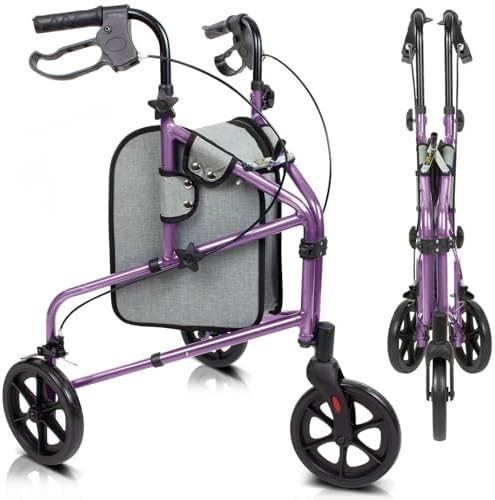
Three-wheel rollators have a narrower front profile and pivot in a smaller arc, which helps in hallways where the issue is turning rather than straight-line width. The trade is that they have no seat and are less stable side to side than a four-wheel frame.
Indoors Only, With a Seat
Compact indoor rollators pair a narrow frame with small wheels and a folding seat, which suits a home where the device never really goes outside. Small wheels are a genuine advantage on hard floors and low-pile carpet, and a genuine limitation on grass and gravel.

When the Frame Also Needs to Be Light
Narrow and light are separate specs, and a narrow frame is not automatically a light one. If the rollator also has to be lifted regularly, look at aluminum narrow models and check both the width and the frame weight on the listing.

Where Doorways Usually Cause Trouble
| Spot | Why it pinches | What helps |
|---|---|---|
| Bathroom door | Often the narrowest door in the house | Narrow frame, or an offset hinge on the door |
| Hallway turn | Turning arc, not straight width | Three-wheel frame or shorter wheelbase |
| Threshold strip | Small wheels catch on the lip | A low threshold ramp |
| Furniture gap | Sofa and table narrow the path | Rearrange rather than buy narrower |
| Door hardware | Handle and stop steal clear width | Measure with the door fully open |
| Rugs and runners | Edges catch small wheels | Remove or secure the rug |
Fixes That Are Not a Different Rollator
Sometimes the doorway is the thing worth changing. Swing-clear offset hinges replace standard hinges and let the door swing entirely out of the opening, recovering an inch or two of clear width without touching the frame. They are a common, reversible change and are widely available at hardware stores.
Removing the door altogether, replacing it with a curtain, or reversing the swing direction are other low-cost options in a bathroom or closet doorway. If the obstacle is a raised threshold strip rather than width, a rubber threshold ramp solves it more cheaply than a new rollator does.
Clearing the Path, Not Just the Door
Once a rollator is in daily indoor use, the route matters as much as the doorway. Loose rugs, extension cords, and furniture that narrows a hallway all turn into daily obstacles. Our guide to trip hazards at home walks through the usual suspects room by room.
Common Mistakes When Buying a Narrow Rollator
Measuring the door frame instead of the clear opening is the top one, and it produces a rollator that misses by exactly the thickness of the open door. The second is measuring only the front door and assuming the interior doors match, when interior doors in older homes are frequently narrower.
The third is buying a narrow model for a household that mainly walks outdoors. Narrow rollators come with small wheels, and small wheels stall on sidewalk lips and sink into grass. If the daily walk is outside, our main rollator guide covers why wheel size usually wins that argument.
A Note on Fit and Professional Input
Doorway width is a measurement anyone can take, but whether a narrow rollator suits the person using it involves balance, gait, and hand strength. If you are unsure what fits your situation, ask your doctor or an occupational therapist. Home assessments are exactly the kind of thing occupational therapists do, and they often spot a doorway or threshold issue before it becomes a returned box.
Frequently Asked Questions
How wide is a standard rollator walker? Overall width varies by model, and it is listed on the product page as the measurement at the widest point of the frame. Compare that figure directly against the clear opening of your narrowest doorway rather than against the door frame.
How do I measure a doorway for a rollator? Open the door fully and measure the horizontal gap between the door slab and the opposite jamb. That is the clear opening. Subtract an inch or two for knuckles and hardware, and take the result as the maximum rollator width.
Will a rollator fit through a 28 inch door? It depends on the clear opening, which is smaller than the nominal door size, and on the rollator’s listed overall width. Measure the actual opening with the door open, then shop only among models listing a width comfortably under it.
Can you make a doorway wider without remodeling? Swing-clear offset hinges move the door out of the opening and recover a small amount of clear width. Removing the door or replacing it with a curtain also works in bathrooms and closets. Both are far cheaper than framing work.
Are narrow rollators less stable? A narrower frame has a smaller footprint, which is a genuine trade for the ability to fit through doors. Well-built narrow four-wheel models are designed to be stable within their listed capacity, but three-wheel models are less stable side to side than four-wheel ones.
Can a narrow rollator be used outdoors? It can, but the small wheels that come with most narrow frames catch on sidewalk lips and sink into grass and gravel. Households that walk outdoors daily are usually better served by a standard-width model with larger wheels.
What is the difference between overall width and seat width? Overall width is the widest point of the frame and decides doorway fit. Seat width is the usable width of the seat and affects comfort. Use overall width for the doorway question and seat width for the comfort question.
Is a three-wheel rollator better for tight spaces? For turning, often yes, since the single front wheel pivots in a smaller arc. For straight-line doorway width the difference is smaller, and three-wheel models give up the seat and some side-to-side stability.
The Bottom Line
Choosing a narrow rollator is mostly a measuring job, and the measurement that matters is the clear opening of the narrowest door with that door standing fully open. Take an inch or two off for margin, compare against the listed overall width, and check the turns after the doorway too. If the gap is close, a pair of swing-clear hinges may fix the house instead of the shopping list. For the wider picture of rollator types and wheel sizes, start with our rollator walker guide.