
Last updated: August 20, 2026
A reacher grabber is one of those items that looks trivial in a catalog and turns out to be the thing someone uses fifteen times a day. It removes the need to bend to the floor, to stretch into the back of a cupboard, or to climb on a chair for something on a high shelf, and those three movements account for a lot of the moments where balance is worst.
The catch is that reachers vary far more than they look. Length, jaw shape, trigger type, and weight all change what the tool is actually good for, and the wrong combination ends up in a drawer. This guide covers what separates them and which version suits which situation.
This article contains affiliate links. If you buy through them, we may earn a commission at no extra cost to you. Learn more.
Quick Answer
How do you choose a reacher grabber?
- Length decides the job: shorter models are easier to control indoors, longer ones reach high shelves and the far side of a bed.
- A rotating jaw lets you pick up items lying flat as well as standing upright, which is the single most useful feature.
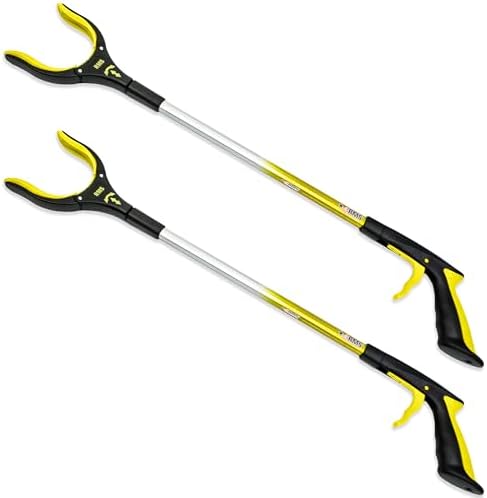
- Trigger style matters more than anything else for a weak or stiff hand: look for a full-hand grip rather than a single-finger trigger.
- Weight matters because the tool is held out at arm’s length, where a few extra ounces feel like far more.
A reacher is a pickup tool, not a support. It should never be leaned on or used to steady yourself.
What Actually Separates One Reacher From Another
Four features do most of the work: length, jaw design, trigger mechanism, and overall weight. Nearly every complaint about a reacher traces back to one of them being wrong for the job rather than to build quality. Read the table, then check the specific listing for the model you are considering, since manufacturers describe these differently.
| Feature | What to look for | Why it matters |
|---|---|---|
| Length | Around 26 inches for close work, 32 inches as an all-rounder, 36 inches and up for high shelves | Longer reach costs control and adds leverage on the wrist |
| Jaw rotation | A jaw that locks at 90 degrees | Lets you grip a flat item on the floor and an upright one on a shelf with the same tool |
| Jaw surface | Rubberized or textured pads, wide opening | Grips a glass or a sock without crushing or dropping it |
| Trigger | Full-hand squeeze grip rather than a single-finger trigger | Spreads the effort across the whole hand for a weak or stiff grip |
| Weight | Aluminum shaft, listed weight in the specifications | Held at arm’s length, weight is felt several times over |
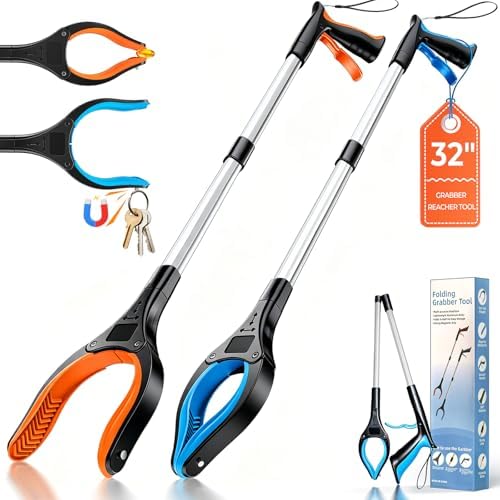
| Magnet | A magnetic tip on the underside of the jaw | Picks up keys, coins, and pins without opening the jaw |
| Folding | A hinge mid-shaft with a locking collar | Fits in a bag or beside a chair; a loose hinge is a downside |
Reachers by Situation
The General Purpose Choice
A 32 inch reacher with a rotating jaw and a full-hand trigger covers the widest range of everyday tasks, from picking laundry off the floor to bringing a box down from a shelf. It is long enough to reach the floor from a seated position without being unwieldy in a hallway.
For Use From a Wheelchair or a Recliner
When most reaching happens from a seated position, weight matters more than length. A lightweight aluminum model is easier to hold out horizontally for several seconds, which is what picking something off the floor from a chair actually requires, and it puts less strain on the wrist.

For a Weak or Stiff Hand
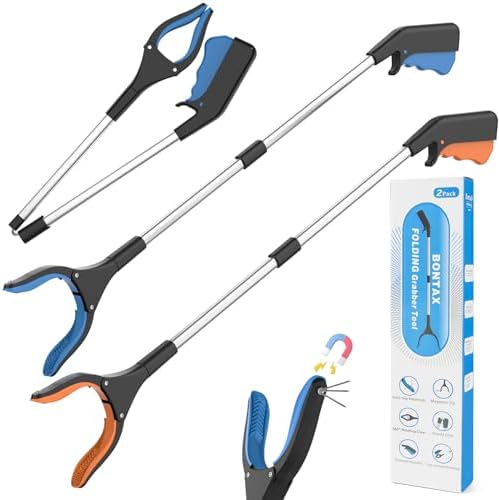
Trigger design is the deciding factor here. A squeeze bar that the whole hand closes over spreads the effort across the palm and fingers, while a small single-finger trigger concentrates it in one place. Some models also include a trigger lock that holds the jaw closed so the grip does not have to be maintained while carrying.
For Heavier Items
Heavy duty models use a stiffer shaft and a stronger jaw mechanism so the tool does not flex under load. Weight capacity varies and is stated in the product listing, which is the figure to work from rather than a general rule. Even so, a reacher is a poor tool for anything genuinely heavy: the load sits at the end of a long lever, and the wrist takes the difference.
For Travel and Small Spaces
Folding models split in the middle and lock back together, which makes them easy to keep in a bag, a car, or beside a chair. The trade is a hinge in the shaft, so check that the locking collar is solid rather than a friction fit that works loose.

Where Reachers Genuinely Help
The value is not really in the reaching. It is in what the reacher replaces: bending all the way to the floor, standing on tiptoe, and climbing onto a stool for a high cupboard. Those are the moments where balance is most tested, and removing several of them from a daily routine is a meaningful change.
The second use is dressing. A reacher is often the tool people use to pull up trousers or to bring a sock within reach, particularly when hip or knee movement is limited. Purpose-made dressing aids handle those jobs more comfortably, but a reacher covers the gap and is usually already in the house.
What a Reacher Is Not
A reacher is a pickup tool. It is not a cane, a walking aid, or something to push up from, and using it that way is how people end up on the floor: the shaft is not built to take body weight and the tip has no grip on a hard surface.
It also does not replace changing where things are kept. If the everyday plates live above shoulder height, moving them down is a better answer than reaching for them with a tool twice a day. Our kitchen safety guide and the aging in place checklist work through what to relocate first.
Buying Notes
Two people in the same house often need two different reachers, and that is normal rather than wasteful. A long one lives in the kitchen for shelves; a short one lives by the bed or the chair for dropped items. Many households end up with a pair, and both get used.
Check the jaw opening if there is a specific item driving the purchase, such as a particular mug or a medication bottle, because jaw width varies and a listing that mentions the opening size saves a return. If you are unsure what fits your situation, ask your doctor or an occupational therapist, who can look at grip strength and shoulder range rather than working from a description.
Frequently Asked Questions
What length reacher grabber should I get? Around 26 inches is easiest to control for close work, 32 inches is the common all-rounder, and 36 inches or more suits high shelves. Longer tools put more leverage on the wrist, so the longest is not automatically the best.
What is the difference between a reacher and a grabber? Nothing consistent. The two words are used interchangeably by manufacturers, and litter pickers sold for garden use are the same tool with a longer shaft and usually a heavier trigger.
Can a reacher help with getting dressed? Yes, particularly for pulling clothing up when bending is difficult. Dedicated dressing sticks, sock aids, and long-handled shoe horns do those jobs more comfortably, but a reacher covers many of them.
How much weight can a reacher grabber hold? It varies by model and is stated in the product listing. Treat that figure as a limit rather than a target, since the load sits at the end of a long lever and the strain lands on the wrist.
Are magnetic tips useful? For keys, coins, hairpins, and small metal items, yes, because you can lift them without lining up the jaw. It is a small convenience rather than a deciding feature.
Can you lean on a reacher for balance? No. A reacher is a pickup tool and is not built to take body weight. Anything used for balance needs to be a cane, a walker, or a fixed grab bar.
What is a trigger lock on a reacher? A catch that holds the jaw closed once you have gripped something, so the hand does not have to keep squeezing while carrying the item. It is worth looking for if grip tires quickly.
The Bottom Line
The reacher worth owning is the one matched to how it will actually be used: a rotating jaw and a full-hand trigger for daily indoor jobs, a light aluminum model for use from a chair, and a longer or heavier duty version only if there is a specific reason. Keeping two, one long and one short, is a reasonable answer for most households. From here, dressing aids and long-handled shoe horns cover the jobs a reacher only half solves.