Last updated: August 20, 2026
The search for the lightest rollator almost never starts with the person using it. It starts with whoever has to lift the thing into a trunk twice a day, get it up three porch steps, or carry it through a narrow apartment entryway. Once that lifting becomes the daily bottleneck, frame weight stops being a spec on a page and becomes the whole decision.
The complication is that weight is the one number manufacturers are most creative about. Listings quote figures with and without the seat bag, with and without the basket, sometimes for a three-wheel version of a four-wheel product family. This guide covers where the weight actually comes from, what you give up to lose it, and how to read the number on a listing so the box that arrives matches the one you thought you ordered.
This article contains affiliate links. If you buy through them, we may earn a commission at no extra cost to you. Learn more.
Quick Answer
What makes a rollator lighter, and what do you give up?
- Frame material does most of the work: steel is heaviest, aluminum is the common lightweight choice, and carbon fiber frames sit lightest of all.
- Smaller wheels, a slimmer seat, and fewer accessories all shave weight, which is why the lightest models are usually indoor-focused rather than all-terrain.
- Lighter frames often carry a lower listed weight capacity, so check that number on the specific model instead of assuming it matches a heavier one.
Bottom line: aluminum covers most households well, carbon fiber goes lighter still, and the number to verify is the listed frame weight together with the listed weight capacity.
Where the Weight Actually Comes From
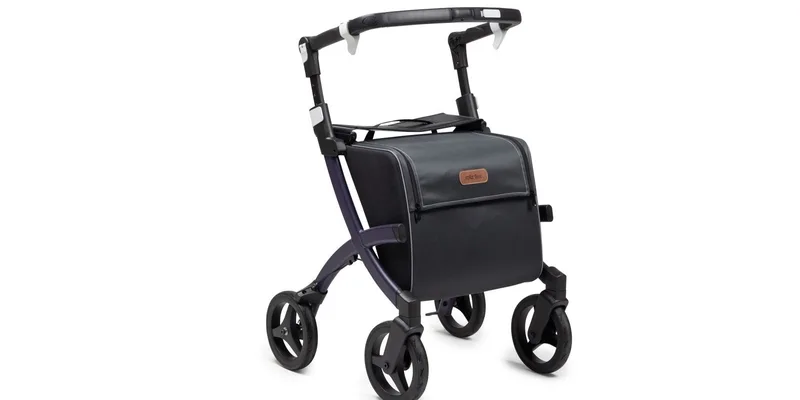
A rollator is a frame, four wheels, a seat, brake hardware, and usually a bag. The frame is where most of the weight lives, and the material choice is what separates the categories. Steel frames are durable and inexpensive to build but noticeably heavy. Aluminum is the standard lightweight material across most of the market. Carbon fiber frames occupy the lightest tier and cost accordingly.
Wheels are the second-largest contributor. Going from six-inch indoor wheels to ten-inch outdoor wheels adds material at four points on the frame, plus the longer frame geometry needed to carry them. That is why the lightest models in any brand’s range are almost always the small-wheeled, indoor-oriented ones.
The Parts That Add Up Quietly
Padded seats, backrests, storage baskets, cane holders, and cup holders each add a modest amount, and together they can account for a meaningful share of a rollator’s total. Some listings quote frame-only weight and then ship the accessories in the box, which is one reason a product can feel heavier in the hallway than it looked on the page.
Aluminum Versus Carbon Fiber
Aluminum is the practical default. It is light enough that most adults can lift it into a car without strain, it holds up to daily use, and it is available across every price tier and body style. For the majority of households looking for a lighter rollator, an aluminum frame with eight-inch wheels solves the problem completely.
Carbon fiber goes lower still and is worth considering when lifting capacity is genuinely limited, for instance when the person loading the rollator has shoulder or back limitations of their own. The trade-offs are cost and repairability, and carbon models are typically built around indoor and paved-surface use rather than rough ground.
Lightweight Rollators by Situation
The Everyday Lightweight Choice
An aluminum four-wheel rollator with a seat and a folding frame is what most people mean when they ask for a lightweight rollator. It keeps the seat, the brakes, and the storage bag, and simply weighs less than the steel-framed equivalent sitting next to it on the shelf.

When Every Pound Counts
Carbon fiber rollators are the lightest option on the market and are built for users or caregivers who need the absolute minimum lifting weight. Check the listed weight capacity carefully on these, since the trade for a light frame is often a lower stated maximum user weight.

Travel, Flights, and Small Trunks
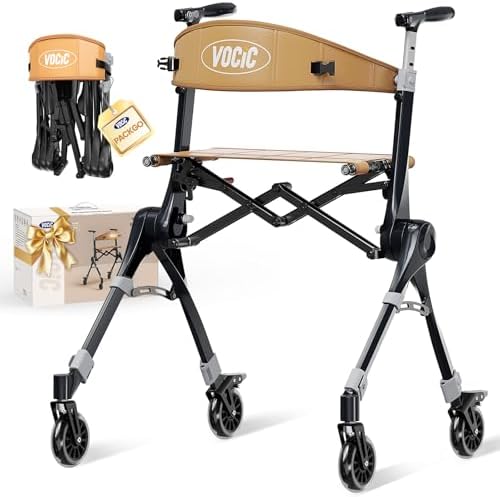
Compact folding rollators fold flat or fold in two directions, which matters as much as weight when the destination is an airline gate check or the trunk of a small sedan. Look at the listed folded dimensions alongside the weight rather than treating the two as the same thing.
Three Wheels for the Lightest Indoor Option
Dropping the fourth wheel and the seat is the simplest way to cut weight further. Three-wheel rollators are light, turn tightly in hallways, and suit someone who does not need to sit down mid-walk. They are less stable side to side than a four-wheel frame, which is a genuine trade rather than a marketing detail.

What You Give Up for a Lighter Frame
| Weight saving | What it costs you |
|---|---|
| Aluminum instead of steel | Very little in daily use; the mainstream choice |
| Carbon fiber frame | Higher cost, often a lower listed weight capacity |
| Smaller wheels | Struggles on grass, gravel, and sidewalk lips |
| Slimmer or no seat | No resting spot partway through a walk |
| Dropping to three wheels | Less side-to-side stability, no seat |
| Fewer accessories | Basket, cane holder, and pouch bought separately |
How to Read a Weight Spec Without Getting Fooled
Start by checking whether the listed weight is for the product as shipped or for the frame alone. Listings that quote a strikingly low figure sometimes exclude the seat bag, the basket, or the backrest strap. If the listing shows a shipping weight alongside the product weight, the gap between them is usually packaging plus accessories.
Next, confirm the number belongs to the exact variant you are buying. Brands frequently sell three-wheel and four-wheel versions, and narrow and standard widths, under one product family with a single set of photos. The weight figure often belongs to the lightest variant in that family, not the one selected in the dropdown.
Lifting Weight Is Not the Only Handling Factor
A rollator that weighs less but folds awkwardly can still be harder to load than a slightly heavier model that folds flat in one motion. Folded dimensions, whether the seat folds with the frame, and whether the device stands up on its own when folded all affect how it feels in practice. Read the folding description as carefully as the weight number.
Common Mistakes When Shopping for a Light Rollator
The first is chasing the lightest listed figure without checking weight capacity. Lighter frames frequently carry lower stated maximums, and a rollator used outside its listed capacity is being used outside what the manufacturer built it for. Both numbers appear on the listing, and both need to fit.
The second is buying a small-wheeled lightweight model for someone whose daily walk happens on a sidewalk with tree roots or on a gravel driveway. The weight saving is real, but a wheel that stops dead at every crack changes the walk into something frustrating. If outdoor use is the main use, our main rollator walker guide covers the wheel size trade in more detail.
A Note on Choosing With Help
Frame weight is a household logistics question, but which mobility device suits a person is not. If you are unsure what fits your situation, ask your doctor or an occupational therapist, who can assess balance, gait, and hand strength before a device type is settled on. That conversation also tends to produce a handle height setting, which is worth writing down before you shop.
Frequently Asked Questions
What is the lightest type of rollator? Carbon fiber frames are the lightest widely available option, followed by aluminum. Within either material, three-wheel models and small-wheeled indoor models weigh less than four-wheel outdoor models with large wheels and full seats.
How much does a lightweight rollator weigh? It varies by material, wheel size, and accessories, so take the figure from the specific product listing. Compare listings within the same wheel size, since a large-wheeled model and a small-wheeled one are not directly comparable on weight alone.
Do lightweight rollators have a lower weight capacity? Often, yes. Lighter frames commonly carry lower listed maximum user weights than heavy duty models. Both the frame weight and the weight capacity appear on the listing, and both should be checked before ordering.
Is aluminum or carbon fiber better for a rollator? Aluminum suits most households and is far more widely available. Carbon fiber makes sense when lifting capacity is genuinely limited and the extra cost is worth it. Neither is better in the abstract; it depends on who lifts it and how often.
Are lightweight rollators stable enough? A well-built lightweight four-wheel rollator is designed to be stable within its listed capacity. Stability concerns usually come from wheel size and frame geometry rather than material, and from using a device outside what the manufacturer specifies.
Can a lightweight rollator go on an airplane? Airlines handle mobility devices under their own policies, so confirm with the carrier before travel. Compact folding models with small folded dimensions are generally the easiest to gate check, but the airline’s rules decide the outcome, not the product listing.
Does a lighter rollator fold more easily? Not automatically. Folding mechanism and folded dimensions are separate from weight, and some heavier models fold flat more cleanly than lighter ones. Read the folding description and the folded dimensions alongside the weight.
Is a three-wheel rollator a good way to save weight? It is the simplest way, since it removes a wheel and usually the seat. The trade is less side-to-side stability and nowhere to rest, so it suits indoor use by someone who does not need to sit down partway through a walk.
The Bottom Line
The lightest rollator that actually works is the lightest one that still matches the surfaces it will roll on and the weight capacity the user needs. Aluminum handles that balance for most families; carbon fiber goes further when lifting capacity is the binding constraint. Verify the weight figure against the exact variant you are ordering, and read the folded dimensions too, because how a rollator folds decides how it feels to load just as much as what it weighs. If space rather than weight is the real problem, our narrow rollator guide is the better starting point.