
Last updated: August 20, 2026
A quad cane is a walking cane with four small feet on a flat base instead of a single rubber tip. That base is the whole point: it gives the cane a footprint rather than a point of contact, which means it stands up on its own and offers a broader area of support than a straight cane.
The catch is that quad canes are not simply better canes. The base that makes them stable also makes them fussier on stairs, on uneven ground, and in tight spaces, and choosing between a small base and a large base changes the device meaningfully. This guide covers the base sizes, the handle types, how to set the height, and where a quad cane genuinely helps compared with the alternatives.
This article contains affiliate links. If you buy through them, we may earn a commission at no extra cost to you. Learn more.
Quick Answer
What should you know before buying a quad cane?
- Small-base and large-base quad canes are different tools: the small base fits stairs and tight spaces, the large base offers a wider footprint on level ground.
- Most quad canes are handed, meaning the base is offset for left-hand or right-hand use, and many are reversible if you swap the shaft.
- Set the handle at wrist-crease height with the user standing upright in their usual shoes, arms relaxed at their sides.
Bottom line: choose base size around the surfaces the cane is used on, check which hand it is set up for, and set the height before first use.
Small Base Versus Large Base
Quad cane bases come in two broad sizes. A small base, sometimes labeled narrow base, has its four feet close together and takes up little floor space. A large base, or wide base, spreads the feet further apart for a broader footprint. Both hold the cane upright on their own when set down.
The choice comes down to where the cane is used. A small base fits on a stair tread, tucks beside a chair, and moves through a doorway without catching. A large base needs level, open ground to get all four feet down evenly, which it does not reliably find on stairs or uneven pavement.
When All Four Feet Are Not on the Ground
A quad cane only does its job when the whole base contacts the surface. On a slope, a curb, or a stair edge, part of the base hangs in the air and the cane behaves like an unstable single-point stick. This is the main practical limitation of the wide-base design and the main reason small-base models exist.
Handles, Grips, and Handedness
Most quad canes are set up for one hand, with the base offset so the wide side sits away from the user’s foot. Many models can be reversed by removing the shaft and turning it, and the product listing or manual will say whether that applies. Using a left-handed setup in the right hand puts the base where the foot wants to go.
Handle shape is the other variable. Offset handles put the user’s weight over the center of the shaft, which many people find steadier than a curved crook handle. Foam and gel grips are more comfortable for hands that tire, and larger-diameter grips are easier to hold for someone with limited grip strength.
Quad Canes by Situation
The General-Purpose Choice
An adjustable-height aluminum quad cane with a small base and an offset foam handle covers the widest range of daily use. It stands on its own, fits on a stair tread, and adjusts to the user rather than the other way around.

When a Broader Footprint Is Wanted
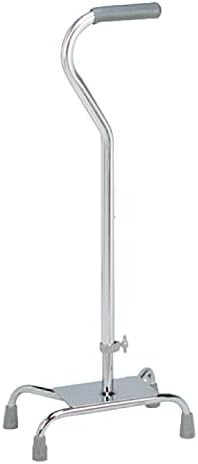
Large-base quad canes spread the four feet wider and suit users walking mainly on level indoor floors and paved outdoor surfaces. They are less convenient on stairs and in tight rooms, which is the trade for the wider base.
Higher Weight Capacity
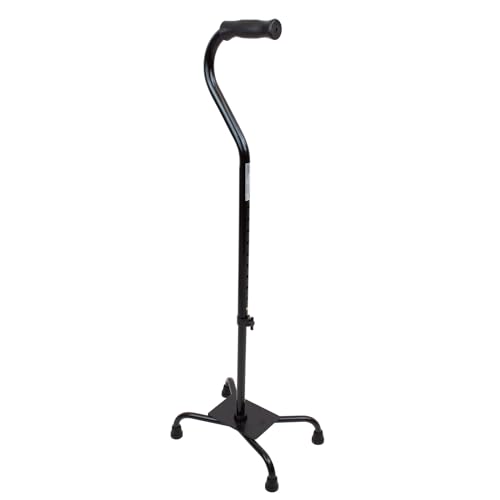
Bariatric and heavy duty quad canes use thicker shafts and reinforced bases with higher listed weight capacities. Read the capacity from the specific product listing, since it differs by model and is the number that matters most on a weight-bearing device.
Comfort for Tired or Weaker Hands
Padded, contoured, and larger-diameter grips reduce the pressure a plain plastic handle puts on the palm over a long walk. Some quad canes ship with a gel grip; others accept an aftermarket grip that slides onto a standard shaft.

Quad Cane Compared With the Alternatives
| Device | Footprint | Best suited to |
|---|---|---|
| Standard cane | Single tip | Light support, stairs, tight spaces |
| Quad cane, small base | Compact four-foot base | Stands alone, works on stair treads |
| Quad cane, large base | Wide four-foot base | Level ground, broader support area |
| Cane with seat | Tripod or four legs | Walking plus a place to rest |
| Standard walker | Four legs, both hands | Two-handed support, lifted per step |
| Rollator | Four wheels | Continuous rolling support with a seat |
Setting the Height and Checking the Tips
With the user standing upright in the shoes they normally wear, arms hanging relaxed, measure from the floor to the crease of the wrist. Set the cane so the top of the handle sits at that height. Elbows should end up with a slight bend when holding the grip, not locked straight and not sharply bent.
The four rubber tips wear down, and worn tips are the most common maintenance issue on any cane. Check them every few months for flattening, cracking, or a smoothed-over tread, and replace the set when they no longer grip. Replacement tips are sold by size, so measure the shaft or tip diameter before ordering.
Storage and Everyday Handling
The fact that a quad cane stands up by itself is genuinely useful: it does not slide down the wall or clatter to the floor when set aside at a table or a counter. That single practical benefit is a large part of why people who try one keep it, even setting the support question aside.
Common Mistakes With Quad Canes
Using the wrong hand setup is the first. If the base is offset for the left hand and the cane is carried in the right, the wide edge of the base sits where the user’s foot lands. Check the listing for handedness and whether the shaft reverses.
The second is treating a large base like a small one. On stairs, a wide base rarely gets all four feet on a tread, and the cane loses the stability that made it appealing. Households with stairs should look at small-base models or read our stair safety guide for the wider picture.
A Note on Choosing a Walking Aid
Which walking aid suits a person depends on balance, strength, and how much weight they need to put through their arms, none of which a product page can assess. If you are unsure what fits your situation, ask your doctor or an occupational therapist. Physical therapists routinely fit canes and set handle heights, and it is a short appointment that prevents a lot of guesswork.
Frequently Asked Questions
What is a quad cane used for? It is a walking cane with a four-footed base that stands on its own and offers a wider area of contact with the floor than a single-tip cane. It is designed to provide support for users who want more than a standard cane offers.
Small base or large base quad cane, which is better? Neither is better overall. A small base fits on stair treads and in tight spaces; a large base offers a broader footprint on level ground. Choose around the surfaces the cane will actually be used on.
Which hand do you hold a quad cane in? Most quad canes are set up with the base offset for one specific hand, and many can be reversed by swapping the shaft. Check the product listing, and ask a physical therapist which side is appropriate for the user’s situation.
How do you set the height of a quad cane? Stand upright in usual shoes with arms hanging relaxed, and measure from the floor to the wrist crease. Set the handle to that height. The elbow should have a slight bend when holding the grip.
Can you use a quad cane on stairs? A small-base quad cane fits on most stair treads; a large base usually does not get all four feet down. Stair technique with any cane is worth reviewing with a physical therapist rather than working out by trial and error.
How often should quad cane tips be replaced? Check them every few months and replace the set when the tread is flattened, cracked, or slick. Replacement tips are sold by diameter, so measure before ordering rather than assuming one size fits every cane.
Is a quad cane better than a regular cane? It is different rather than better. A quad cane stands alone and offers a wider base of contact, while a standard cane is lighter, simpler, and easier on stairs and in tight spaces. The right choice depends on the user.
What weight can a quad cane support? Take the listed weight capacity from the specific product page. Standard models and heavy duty models list different maximums, and on a weight-bearing device that number should be checked before ordering rather than after.
The Bottom Line
A quad cane is worth considering when a standard cane feels like too little and a walker feels like too much. Decide base size around stairs and floor space rather than around which looks sturdier, confirm the cane is set up for the correct hand, and set the handle at wrist height before the first walk. Check the four tips a few times a year, because worn tips undo everything else. If a place to sit down matters too, our cane with seat guide covers that option.