Last updated: August 20, 2026
Some links on this page are affiliate links. If you buy through them we may earn a commission at no extra cost to you. See our affiliate disclosure.
The shower is where a grab bar earns its place. Wet tile, a raised threshold to step over, soap underfoot, and a movement that asks someone to balance on one leg while turning: no other spot in the house combines those things.
Choosing a shower grab bar comes down to three questions that are easier to answer than the product listings suggest. Where does the hand need to be during each part of the movement, what is actually behind the shower wall, and does the bar need to survive constant water. This guide answers those in order.
Quick Answer
Which grab bars do you need in a shower?
- Most showers need two: a vertical bar at the entry for stepping in and out, and a horizontal or angled bar on the long wall for steadying and turning.
- Screw mounted stainless bars anchored into studs or solid blocking are the standard, because they are the type manufacturers write their weight ratings around.
- Choose a textured or knurled gripping surface rather than polished chrome, since wet, soapy hands slide on smooth finishes.
- If the shower is a one piece fiberglass or acrylic surround, the mounting method changes and needs its own approach.
Bottom line: think of shower grab bars as a pair covering entry and movement, not as a single bar to tick a box.
The Two Movements a Shower Bar Supports
Every shower involves two distinct movements, and they want different bars. The first is crossing the threshold, which is a step over an edge with weight shifting onto one foot. That movement wants something to pull up and forward on, which is why a vertical bar near the opening works better than a horizontal one.
The second is everything that happens inside: turning under the water, reaching for soap, bending, and standing back up. That movement wants a bar the hand can slide along rather than a single fixed point, which is what a longer horizontal or gently angled bar on the back or long wall provides.
Why One Bar Is Usually Not Enough
A single bar forces the person to let go somewhere in the sequence, and letting go is the moment balance is most likely to be lost. Two bars keep a hand in contact from stepping in to stepping out, and most bathrooms have room for both.
Choosing Shower Grab Bars by Position
Buying by position rather than by product name keeps the shortlist short. Below are the positions that come up in almost every shower, with the bar type that suits each.
At the Entry: A Vertical Bar
A vertical bar mounted just inside or just outside the opening gives the hand a fixed hold at chest height while the foot crosses the threshold. Shorter bars in the 16 to 24 inch range are typical here, since the hand does not need to travel far. This is the single most useful bar in most showers.

On the Long Wall: A Horizontal Bar
A horizontal bar on the back or long wall lets the hand move with the body while turning or reaching. Longer bars span more framing, which usually makes it easier to land screws in two studs. Stainless steel with a satin or brushed finish is the default because it handles constant water without pitting.

Where the Movement Is Diagonal
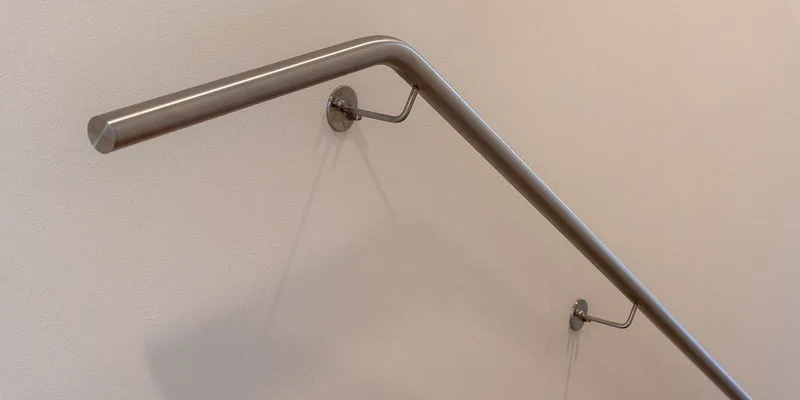
Angled and wave shaped bars follow the natural arc of a hand rising while the body stands up or steps up onto a threshold. Families often prefer them where a strictly horizontal bar would force the wrist into an uncomfortable angle at the end of the movement.

In a Corner Shower
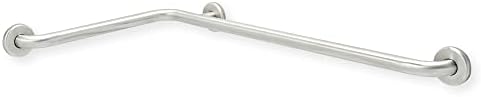
Corner and neo angle showers rarely offer a clean run of wall, and a corner or L shaped bar covers two planes from a single installation. Check the projection dimensions against the door swing before ordering, since a bar that fouls a pivot door is a return you can avoid.
If Drilling Is Not an Option Right Now
Renters and short term situations sometimes rule out screws entirely. There are real options there, though they come with real limits, and it is worth reading our guide to no drill grab bars before assuming a suction cup will do the same job as a mounted bar.
What Is Behind Your Shower Wall
The wall decides the installation more than the bar does. A tiled wall over cement board with studs behind it is the straightforward case: drill through the tile with a carbide or diamond bit at low speed, land the screws in framing, and seal around the flange with silicone so no water gets behind the surface.
A one piece fiberglass or acrylic surround is different, because the shell flexes and there is often an air gap between the shell and the framing. That case needs its own method, which our guide to grab bars for fiberglass showers covers step by step.
When the Studs Are in the Wrong Place
Framing is typically spaced 16 inches on center, and it will not always line up with where the bar needs to go. That is a solvable problem rather than a reason to compromise on placement, and the two accepted routes are purpose built heavy duty hollow wall anchors or blocking added behind the wall during a remodel. Our walkthrough of installing grab bars without studs goes through both.
Finish, Texture, and Water
Shower bars live in steam and soap, so material matters more here than anywhere else. Stainless steel with a satin or peened finish is the workhorse: it resists corrosion, keeps its grip when wet, and hides water spots better than polished chrome.
| Feature | What to look for in a shower |
|---|---|
| Material | Stainless steel or a corrosion resistant coated core; check the listing for wet area suitability |
| Surface | Knurled, peened, or textured center section for wet hands |
| Diameter | Comfortable to wrap; the ADA standard specifies 1 and 1/4 to 2 inches for public facilities |
| Wall clearance | Enough room for a full hand; the ADA standard specifies 1 and 1/2 inches |
| Mounting | Concealed flange screws into studs, blocking, or rated hollow wall anchors |
| Sealing | Silicone around each flange so water cannot travel behind the tile |
What the ADA Standard Says About Shower Bars
The ADA Standards for Accessible Design govern public and commercial facilities rather than private homes, but they are a useful published reference and most manufacturers design to them. For transfer type showers the standard specifies grab bars on the control wall and back wall, with the top of the gripping surface 33 to 36 inches above the floor.
At home you are free to adapt those numbers to the actual person. Someone noticeably shorter or taller, or someone who sits on a shower chair, may be better served by a different height. If you are unsure what fits your situation, ask your doctor or an occupational therapist, who can watch the movement before anything is drilled.
Common Mistakes With Shower Grab Bars
The most common mistake is mounting the bar where there happens to be a stud rather than where the hand needs it. A bar in a convenient spot that nobody reaches for has done nothing, and anchors exist precisely so placement can lead the installation instead of following it.
The second is treating a towel bar, a soap shelf, or a shower door handle as a support. None of them are built to take body weight, and a shower door handle in particular can pull the door off its track. If a fixture sits where someone might grab it, replace it with a real bar.
Forgetting the Seat
Grab bars and seating work together. If standing for a full shower is difficult, a bar alone is treating half the problem, and pairing it with a shower chair often makes more difference than adding a third bar. Placement then shifts, because the hand starts and ends at seated height.
Frequently Asked Questions
Where should grab bars go in a shower? One vertical bar at the entry for stepping over the threshold, and one horizontal or angled bar on the long or back wall for steadying and turning. If a shower seat is used, add a bar within easy reach of the seated position.
What height should a shower grab bar be? The ADA standard for public facilities specifies the top of the gripping surface 33 to 36 inches above the floor. At home that range is a sensible starting point, adjusted for the height of the person actually using it.
Can you install a grab bar on shower tile? Yes. Drill the tile with a carbide or diamond tipped bit at low speed without hammer action, land the screws in studs or rated anchors behind the tile, and seal around the flange with silicone.
Do shower grab bars need to go into studs? Studs are the standard method. Where framing does not line up, heavy duty hollow wall anchors designed for grab bars or added blocking behind the wall are the accepted alternatives, following the manufacturer’s instructions for the rating.
Are suction cup grab bars okay for a shower? Their manufacturers describe them as balance aids rather than weight bearing supports, so they should not be the only thing available in a shower used daily. They suit travel and short stays where drilling is impossible.
How long should a shower grab bar be? Long enough to cover the movement. Around 16 to 24 inches is typical for a vertical entry bar, while 32 to 42 inches suits a long wall where the hand travels as the body turns.
What is the best finish for a shower grab bar? Satin or brushed stainless with a textured gripping section, because polished chrome becomes slick under soapy water and shows every water spot.
Can a grab bar be mounted horizontally and vertically in the same shower? Yes, and that combination is common. The orientations do different jobs, so mixing them is usually better than matching them for appearance.
The Bottom Line
Shower grab bars work best as a pair: a vertical bar at the entry and a longer horizontal or angled bar inside, both in textured stainless and both anchored into framing or rated anchors. Let placement drive the installation rather than letting the studs decide, and seal every flange. For the wider picture, see our grab bar buying guide and our walkthrough of making a shower safer.