
Last updated: August 20, 2026
Trip hazards are the part of home safety that costs almost nothing and gets skipped anyway, usually because they hide in plain sight. A rug that has been in the same spot for fifteen years stops registering as an object. A phone charger cable running along the edge of a hallway is invisible until a toe finds it. The lip between the kitchen and the garage was always there.
This guide is a walkthrough rather than a shopping list. It goes room by room, names what to look for, and gives the practical fix for each, with a handful of inexpensive products where a fix genuinely needs one. Most of the list can be worked through in a single afternoon with nothing more than a screwdriver and a rubbish bag.
This article contains affiliate links. If you buy through them, we may earn a commission at no extra cost to you. Learn more.
Quick Answer
What are the most common trip hazards at home?
- Loose rugs and runners, especially small ones that slide or curl at the corner.
- Cords and cables crossing a walking route, including charger leads and lamp flexes.
- Raised thresholds, sliding door tracks, and the single step between rooms or into a garage.
- Clutter that has migrated onto the floor: boxes, shoes, laundry baskets, pet bowls, and anything stored on the stairs.
Bottom line: walk each route at the speed the person actually walks it, and fix what your own foot catches on.
Walk the House the Way It Gets Used
The most useful survey takes fifteen minutes. Start at the bed, walk to the bathroom, then to the kitchen, then to the front door, then to wherever the laundry lives. Do it once in daylight and once with the lights off, because the hazards are not always the same set.
Look down rather than ahead, and note anything that changes the surface: a rug edge, a cable, a threshold, a transition from carpet to tile. Those transitions are where feet catch, and writing them down as you go beats trying to remember them afterwards.
Rugs Are the Biggest Single Category
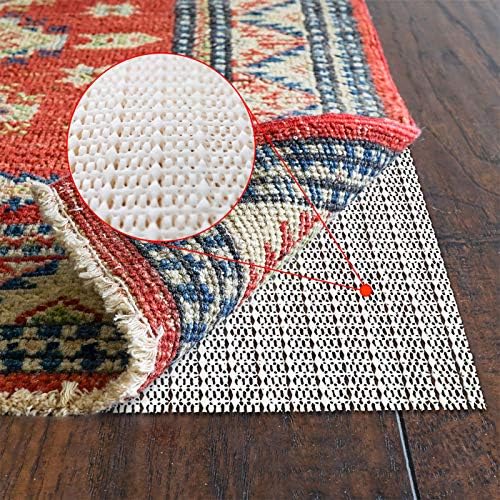
A rug becomes a hazard in three ways: it slides on the floor beneath it, it curls or bunches at an edge, or it has a thick border that a foot catches on. Small runners and bath mats are the worst offenders because they are light enough to move and short enough that both edges sit in the walking path.
The honest answer for many small rugs is to remove them. Where a rug stays, a full sheet of non slip underlay cut to size holds far better than corner grippers alone, and it also stops the rug from developing ripples over time.
Bathroom Mats Are a Separate Problem
Bath mats get wet, which is precisely when a mat needs to grip most and grips least. A mat with a rubberised backing that keeps its suction on tile, replaced when the backing hardens, is a different product from a decorative bathroom rug. Our guide to non slip bath mats covers the inside and outside of the shower separately.
Cords and Cables Along the Route
Charger cables, lamp flexes, extension leads, and the cord of a vacuum left plugged in are all easy to remove from a walking path and easy to forget about. The first move is not a product but a rearrangement: plug things into an outlet on the same side of the room as the appliance, so nothing has to cross.
Where a cable genuinely has to run along a wall, a low profile cord cover fixed along the baseboard keeps it flat and out of the path. Under a rug is the one place a cable should never go, because it creates an invisible ridge that also wears the insulation.

Thresholds, Steps, and Level Changes
The single step between a kitchen and a family room, the raised strip in a doorway, and the track of a sliding patio door all catch toes and stop walker wheels. A rubber threshold ramp bridges the height difference so the surface stays continuous, and the low ones simply sit in place without fixing.
Where a doorway threshold is only a few millimeters proud, a transition strip screwed down flat solves it outright. For anything larger, or for a household using a walker or a wheelchair, the sizing logic in our threshold ramp guide and the rubber threshold ramp guide applies.

Room by Room, What to Look For
| Room | Usual culprits |
|---|---|
| Hallway | Runners that slide, shoes by the door, charger cables, dark stretches |
| Bedroom | Bedside rug, lamp cord, laundry basket, low furniture near the bed |
| Bathroom | Bath mat with a hardened backing, tub lip, wet tile, scale in the bathtub |
| Kitchen | Mat in front of the sink, appliance cords, items stored on the floor, spills |
| Living room | Coffee table corners in the path, footstools, pet beds and bowls, cable to a lamp |
| Stairs | Anything stored on a tread, loose runner, rug at the bottom step |
| Entry and garage | Doormat edges, hose reels, the step down into the garage, doorstep lip |
The Hazards Nobody Lists
Pets are a real one and an awkward one to raise. A cat that weaves between ankles and a dog bed left in a doorway both belong on the survey, as do bowls placed in a walking route rather than tucked against a wall.
Footwear is another. Backless slippers, socks on hard floors, and shoes with worn smooth soles undo a good deal of what the rest of the list achieves. Slippers with a back and a grip sole are one of the cheapest changes in the house.
Furniture That Has Drifted
Rooms rearrange themselves slowly. A chair pushed out a little further each time it is used, a side table moved for a visitor and never moved back, or a new piece of furniture that narrows the route past the sofa. Walking the route yourself finds these because your own foot notices what habit has stopped noticing.
Keep It From Creeping Back
The list undoes itself over months unless someone repeats it. A quick walkthrough every few months, and a specific look after any change in the house such as a new appliance, a delivery of boxes, or a visitor who rearranged the furniture, keeps the routes clear.
Clearing the floor is designed to make the house easier to move through, and it works alongside rather than instead of medical advice. If someone is catching their feet more than they used to, or is unsteady on flat ground, that is worth raising with a doctor or an occupational therapist rather than treating as a housekeeping matter.
Frequently Asked Questions
Should all the rugs come out of the house? Not necessarily. Rugs that lie flat, have thin edges, and sit on a full underlay behave very differently from a small loose runner that slides or curls. Remove the ones that move; anchor the ones that stay.
Are rug grippers or a full underlay better? A full sheet of non slip underlay cut to the rug size holds more reliably than corner grippers, and it keeps the middle of the rug flat as well as the corners. Grippers suit a light rug on carpet more than a heavy one on tile.
Can I run a cable under a rug just for now? No. It creates a ridge that cannot be seen, and it wears the cable insulation at the same time. Move the appliance, use a different outlet, or fix a cord cover along the baseboard.
What can be done about a single step between rooms? A rubber threshold ramp on one or both sides keeps the surface continuous, and for anything more than a small lip it is also what makes the doorway usable with a walker.
What footwear is best indoors? Slippers or shoes with a back and a grip sole. Backless slippers and socks on hard floors are two of the more common contributors to a slip, and they cost nothing to change.
How often should the walkthrough be repeated? Every few months, and always after something changes in the house: new furniture, a delivery, a visitor who rearranged a room, or a new appliance with a cable.
Does clearing trip hazards fix the problem? It makes the house easier to move through, which is worth doing on its own. It does not change balance, strength, eyesight, or the effects of medication, so it belongs alongside a conversation with a doctor rather than in place of one.
The Bottom Line
Trip hazards are the cheapest part of a home safety plan and the part most often left undone. Walk each route at normal speed, in daylight and in the dark, and deal with what your foot catches on: rugs that move, cables crossing a path, raised thresholds, and floor clutter. A rug underlay, a cord cover, and a rubber threshold ramp handle nearly everything that needs buying. From there, move on to lighting and the bathroom in our home fall prevention plan.