Last updated: August 21, 2026
Once a household has read about wearable exoskeletons, the obvious question follows: is this better than the walker or rollator sitting in the hallway? It is a fair question, and the honest answer is that the two are not competing for the same job, even though they get compared constantly.
This page puts them side by side on the things that decide daily use: what each one physically provides, what it demands from the user, what happens when something goes wrong, and which household situations point clearly at one rather than the other.
This article contains affiliate links. If you buy through them, we may earn a commission at no extra cost to you. Learn more.
Quick Answer
Exoskeleton or walker and rollator: which fits?
- A walker or rollator gives something solid to lean on, plus a seat and storage on a rollator. A wearable exoskeleton gives none of those things.
- A consumer exoskeleton assists a leg that is already swinging, which is useful on distance and inclines, and is sold as outdoor gear rather than as a mobility aid.
- Fastening, charging, and what happens when the battery is flat are the practical differences that decide whether a wearable device stays in use.
Which one suits a particular person is a judgment for their doctor or an occupational therapist, made by watching them move.
What Each One Physically Is
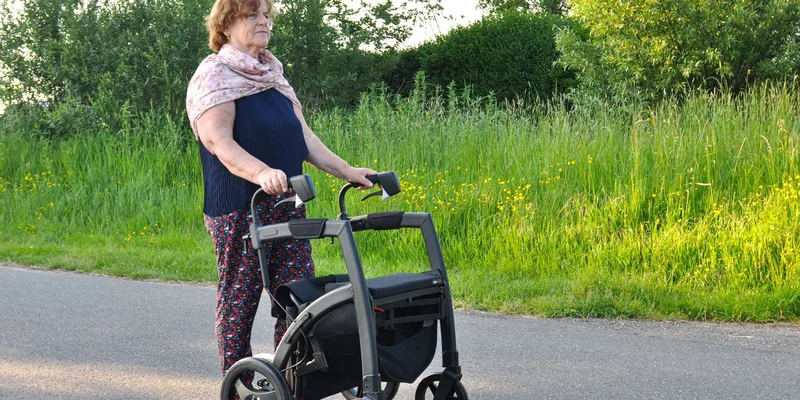
A walker is a rigid frame held in front of the body, taking weight through the arms. A rollator is a wheeled version with hand brakes, a seat, and usually a bag or basket. A consumer exoskeleton is a belt worn around the waist with thigh cuffs, with a motor at each hip adding torque as the leg swings.
Those descriptions already contain the answer to most comparisons. One category puts a structure between the person and the floor. The other puts a motor alongside the hip. They address different failures in the same activity.
Support Versus Assistance
Support means something to hold that does not move when leaned on. Assistance means help with the movement itself. Someone who feels wobbly needs support, and no amount of hip torque provides it. Someone whose legs work but who runs out of energy on a slope is describing an assistance problem.
The Differences That Show Up Daily
Three practical differences decide which device is still being used a month later: how long it takes to get going, what it does with your hands, and what happens when the power or the terrain fails. None of them appears in a specification table.
A rollator is ready the moment it is unfolded. A hip exoskeleton needs a waist buckle and two thigh cuffs positioned consistently, which takes grip, shoulder movement, and steady standing. If a helper is needed each time, the device is only available when the helper is.
Hands, Seats and Carrying
A rollator occupies both hands and gives back a seat and a basket. An exoskeleton leaves both hands free and gives back nothing to sit on. For a walk around the block that includes a rest, that difference is the whole decision.
Side by Side
| Factor | Walker or rollator | Hip assist exoskeleton |
|---|---|---|
| Support to lean on | Yes, that is the point | None |
| Seat to rest | On a rollator, yes | No |
| Carrying things | Basket or bag | Nothing |
| Hands | Both occupied | Both free |
| Setup each time | Unfold and go | Belt and two thigh cuffs |
| Power needed | None | Charged battery |
| Indoors in tight rooms | Depends on doorway width | No extra width at all |
| Sold as | Mobility equipment | Outdoor and hiking gear |
Where the Exoskeleton Has the Advantage
There is one clear scenario where a wearable device wins: somebody who walks steadily and unaided, whose limit is stamina on longer walks or on hills, and who wants both hands free. That is exactly the user these products are designed and marketed for, which is why they are sold alongside hiking equipment.
It also takes up no width. A rollator has to fit through the doorway and turn in the hallway, and in an older home that can be the deciding constraint. A belt worn on the body adds nothing to the person’s footprint.
Travel Is a Mixed Picture
Hypershell states that its batteries are rated at 72 watt hours, below the level most airlines set for carry on lithium batteries, which makes air travel plausible in principle. Every airline sets its own rules, though, so confirm before booking rather than at the gate.
Where the Rollator Wins Comfortably
For the majority of households, the rollator is the better answer and it is not close. It provides support, a seat, and storage, it needs no charging, it folds into a car, and it works the same on the worst day as on the best. Decades of product development sit behind it, and it can be fitted to the person in minutes.
It is also fixable. A brake cable can be adjusted, a wheel can be replaced, and nothing depends on a battery or a proprietary charger. Our guide to choosing a rollator walker covers the sizing and the features worth paying for, and walker against rollator covers the step before that.
Posture Deserves a Mention
One common complaint about conventional rollators is that people end up hunched over the handles. Upright models place forearm supports higher so the user stands taller, which is a real alternative worth knowing about before writing the category off. Our page on upright rollators explains the difference.
Which Description Fits the Person
Answering three questions usually settles it. Does the person need something to lean on while standing still? Do they need to sit down partway through a walk? Can they fasten a belt and two cuffs unaided? A yes to either of the first two, or a no to the third, points at the rollator.
If the answers are no, no and yes, and the limit is genuinely stamina over distance, the wearable category becomes worth investigating. Our guide to exoskeletons for older adults covers what is available and how to read the claims.
Ask a Doctor or an Occupational Therapist
Both options change how a person walks, and that is a judgment made by watching rather than by reading. An occupational therapist assesses the movement, the home, and the daily route, and will often find that an existing walker set to the wrong height is the actual problem. If you are unsure what fits your situation, ask your doctor or an occupational therapist before buying either one.
Frequently Asked Questions
Is an exoskeleton better than a rollator? They do different jobs. A rollator provides support, a seat and storage. An exoskeleton assists leg movement and provides none of those. Most households needing daily help are describing a rollator problem.
Can an exoskeleton replace a walker indoors? No. Indoor use is usually about steadiness and something to hold, and a wearable device offers nothing to lean on.
Which is easier to start using? A rollator. It unfolds and is ready. A hip exoskeleton needs a belt and two thigh cuffs positioned the same way each time, which not everyone can manage alone.
What happens when the exoskeleton battery runs out? It becomes an unpowered frame that still has to be worn or carried home. That scenario is worth planning for before the first long walk.
Does an exoskeleton fit through narrow doorways? It adds no width beyond the person, which is one genuine advantage in older homes where a rollator is tight through doors.
Can both be used together? Some households use a rollator for daily indoor life and something else for specific outings. There is no rule against combining approaches.
Which one travels better? Rollators fold into car trunks and are familiar to airline staff. Exoskeleton batteries are governed by airline rules, so check with the carrier before flying.
How do I choose? Ask whether the person needs support, a seat, or assistance. Support and seat point to a rollator, assistance over distance points to a wearable device, and a therapist can settle it.
The Bottom Line
A walker or rollator provides support, a seat, and storage with no battery involved, and for most households that is what the daily problem calls for. A hip assist exoskeleton assists a leg that already swings, suits somebody whose limit is stamina rather than steadiness, and depends on being fastened and charged every time. Answer the support question first, then let a therapist confirm. Our rollator walker guide and upright rollator page cover the mainstream route.