Last updated: August 20, 2026
Watch someone use a standard rollator for a few minutes and you often see the same thing: shoulders creeping up, head down, eyes on the floor a few feet ahead instead of on the room. The hand grips sit at wrist height, the user leans onto them, and the whole posture folds forward. Upright rollators exist to change that geometry.
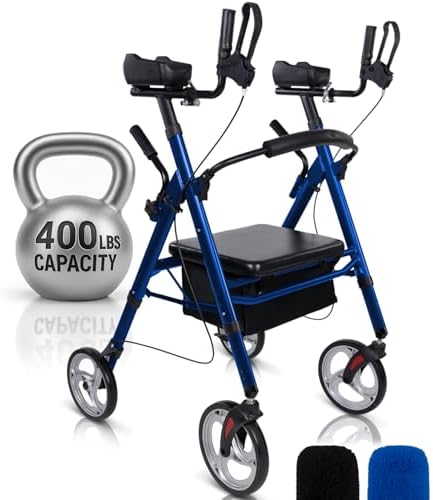
Instead of grips at wrist height, an upright rollator puts padded forearm supports at roughly elbow height, with hand grips in front of them. The user stands taller, leans on their forearms rather than their wrists, and looks ahead rather than down. It is a real difference, and it comes with real trade-offs in size, weight, and price tier that are worth understanding before ordering one.
This article contains affiliate links. If you buy through them, we may earn a commission at no extra cost to you. Learn more.
Quick Answer
What is an upright rollator, and who is it for?
- It is a four-wheel rollator with padded forearm supports at elbow height instead of hand grips at wrist height, which encourages a taller stance.
- It suits users who lean heavily forward on a standard rollator or who find wrist and hand loading uncomfortable over a full walk.
- The trade is size and weight: upright rollators are bulkier, heavier to lift, and take up more space in a car and a hallway.
Bottom line: an upright rollator is a posture and forearm-support device rather than a lighter or smaller one, and armrest height is the fitting measurement that decides whether it works.
How an Upright Rollator Is Built Differently
The visible difference is the pair of padded armrests, sometimes called forearm supports, mounted where a standard rollator has hand grips. The user rests their forearms on the pads and holds vertical or angled grips in front, which keeps the trunk upright and shifts load from wrists onto forearms and elbows.
The rest of the machine is familiar: four wheels, loop or lever brakes, a seat between the rear uprights, and usually a storage bag. Frames are taller and longer to carry the arm platforms, which is where the extra bulk and weight come from.
Why the Posture Change Matters Day to Day
Standing taller means looking forward instead of down, which makes it easier to see the room and the people in it. Many users also report that leaning on forearms is more comfortable over a long walk than bearing weight through the wrists and palms. Whether that applies to a specific person is a question for the person and their therapist, not a product claim.
Fitting an Upright Rollator
The critical measurement is armrest height. Have the user stand upright in their usual shoes with elbows bent at roughly a right angle, forearms level. Measure from the floor to the underside of the forearm. That figure should land comfortably within the model’s adjustable armrest range, ideally near the middle rather than at either end.
Armrest width and pad spacing matter too. Pads set too far apart push the shoulders out; set too close, they crowd the trunk. Many models allow the pads to be angled or shifted, and it is worth adjusting them on day one rather than living with the factory setting.
Upright Rollators by Situation
The Standard Upright Setup
A four-wheel upright rollator with adjustable padded forearm supports, a seat, and loop brakes is the mainstream configuration. It suits a user who will keep the device in one home and walk indoors and on paved surfaces outside.

Taller Users
Armrest height range is the limiting spec, and standard uprights often top out below what a tall user needs. Tall-frame upright models list a higher armrest range specifically for this. Check the stated range against the measured forearm height rather than assuming adjustability will cover it.

Higher Weight Capacity
Heavy duty upright rollators use reinforced frames, wider seats, and higher listed weight capacities. As with any rollator, read the capacity from the specific product listing rather than assuming it carries over from a related model.
Where Storage and Transport Are Tight
Folding upright rollators exist and are worth seeking out if the device travels by car, since a non-folding upright is genuinely awkward to load. Check both the folded dimensions and the frame weight, because uprights are heavier than standard rollators to begin with.

Upright Versus Standard Rollator
| Aspect | Upright rollator | Standard rollator |
|---|---|---|
| Support point | Forearms at elbow height | Hands at wrist height |
| Posture | Encourages a taller stance | User often leans forward |
| Frame size | Taller and longer | More compact |
| Weight | Heavier to lift and fold | Lighter across the range |
| Indoor turning | Needs more room | Easier in tight hallways |
| Storage | Bulky even when folded | Folds smaller for a car trunk |
What You Give Up
Size is the honest headline. An upright rollator has a larger footprint than a standard model and needs more room to turn, which can be a problem in the same narrow hallways and bathroom doorways that already cause trouble. If doorway width is a known issue in the home, measure before ordering, and read our narrow rollator guide first.
Weight is the second. Uprights carry more frame material, so they are heavier to lift into a trunk and heavier to fold. Households where a caregiver loads the device several times a week should weigh that against the posture benefit, and look specifically at folding models rather than assuming any upright folds well.
Using the Armrests as Intended
Forearm supports are designed for resting forearms while walking, not for taking full body weight in a lean or for pulling oneself up from a seated position. Manufacturer manuals set out how their supports are meant to be used and what the device is rated for, and those instructions are the reference, not general habit.
Common Mistakes When Buying an Upright Rollator
The first is ordering without measuring forearm height and finding that the armrests do not adjust far enough in either direction. The listed adjustment range is on the product page, and the measurement takes two minutes.
The second is buying an upright for someone whose issue is endurance rather than posture. If the main need is somewhere to sit down partway through a walk, a lighter standard model with a good seat may serve better; our rollator with seat guide covers that case directly.
A Note on Whether Upright Is the Right Choice
Switching from hand grips to forearm supports changes how a person carries their weight while walking, and that is a bigger change than it looks. If you are unsure what fits your situation, ask your doctor or an occupational therapist before buying. Physical and occupational therapists work with these devices regularly and can set the armrest height correctly during a fitting.
Frequently Asked Questions
What is an upright rollator? It is a four-wheel rolling walker with padded forearm supports at roughly elbow height instead of hand grips at wrist height. The user rests their forearms on the pads and holds grips in front, which encourages a taller standing posture.
Who is an upright rollator designed for? It is designed for users who lean forward heavily on a standard rollator or who find sustained weight through the wrists and hands uncomfortable. Whether it suits a particular person is best confirmed with a physical or occupational therapist.
How do you set the armrest height on an upright rollator? Stand upright in usual shoes with elbows bent at roughly a right angle and forearms level, then measure from the floor to the underside of the forearm. Set the armrests near that height, within the model’s stated adjustment range.
Are upright rollators heavier than standard ones? Generally yes. The taller, longer frame and the arm platforms add material. If the device will be lifted into a car regularly, look specifically at folding upright models and compare listed frame weights.
Do upright rollators fit through standard doorways? Overall width is what decides that, and it is listed on the product page. Uprights are usually longer rather than dramatically wider, but they need more room to turn, so measure hallway turns as well as door openings.
Can you sit on an upright rollator? Most models include a seat between the rear uprights. As with any rollator, lock both brakes and use the seat on level ground, and follow the manufacturer’s instructions for that specific model.
What is the difference between an upright rollator and a stand-up walker? The terms are used interchangeably by most manufacturers for the same forearm-support design. Read the product description rather than the name, since naming is not standardized across brands.
Does an upright rollator work outdoors? That depends on wheel size, exactly as with a standard rollator. Larger wheels handle sidewalk lips and packed dirt; smaller ones do not. Check the listed wheel diameter if outdoor walking is the main use.
The Bottom Line
An upright rollator solves a specific problem, which is a user hunched over hand grips with load running through the wrists. It does that well, and it pays for it in bulk, weight, and turning room. Measure forearm height against the model’s stated armrest range before ordering, check overall width against your tightest doorway, and look for a folding model if the device travels by car. For a side-by-side view of every rollator type, start with our rollator walker guide.