Last updated: August 20, 2026
Some links on this page are affiliate links. See our affiliate disclosure.
A standard American toilet bowl sits low enough that getting back up asks a lot from the knees and hips. For someone recovering from hip or knee surgery, or simply dealing with less strength than a few years ago, those last few inches are where the effort concentrates. A raised toilet seat closes that gap by lifting the seating surface, so the movement becomes a shorter, more controlled push rather than a deep squat in reverse.
The category looks simple until you start shopping and find clamp-on risers, hinged seats, locking models, and frames with arms built in, all in two bowl shapes and several heights. This guide covers what separates those types, how to measure before you order, and which style suits which situation.
Quick Answer
Which raised toilet seat should you choose?
- Match the bowl shape first. Round and elongated bowls are not interchangeable, and a mismatch is the most common reason a seat gets returned.
- Pick the lift height from how far the user actually needs, not the maximum available. Common options add roughly two, four, or five inches.
- Add arms only if the user pushes up with their hands. If they use a walker or hold a nearby grab bar instead, a plain riser keeps the space clearer.
- Check the weight capacity printed in the product listing, and confirm the mounting style works with your toilet before ordering.
Bottom line: bowl shape and mounting style decide whether the seat fits at all, and height plus arms decide whether it helps.
What a Raised Toilet Seat Actually Does
A raised toilet seat lifts the seating surface several inches above the standard bowl rim, which shortens the distance the user has to lower into and push up from. That shorter range of motion is the whole point of the product, and it is why occupational therapists commonly bring these up when someone is working through a period of limited hip or knee flexion.
It is worth being clear about what the product is and is not. A raised seat is a positioning aid, designed to provide support during a sit-to-stand movement. It does not stabilize someone unsteady on their feet, a separate question that points toward a frame with arms, a grab bar, or both.
The Main Types, and How They Mount
There are four common designs, and the differences are mostly about how the seat attaches and whether it stays on the toilet permanently. Getting this right matters more than brand, because a seat that does not lock onto your bowl will shift under load, which is exactly what nobody wants.
Clamp-On Risers
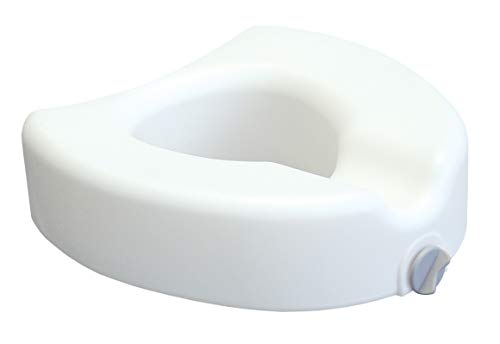
These sit on the bowl rim under the existing seat, or replace it, held by a bracket or wing nuts that tighten against the inside of the bowl. They are the most common style, install without tools in most cases, and lift off again when a guest visits. The trade-off is that the clamp needs a reasonably standard bowl profile to grip well.
Hinged and Locking Models
A hinged raised seat bolts on where the original seat was, using the same two mounting holes, and flips up like a normal lid. That gives a much more permanent, furniture-like result and keeps the original seat usable underneath on some models. Locking versions add a clamp that tightens down so the riser cannot slide sideways when someone leans on one edge.
Risers With Arms Built In
These combine the lift with padded or contoured armrests on both sides, giving the user something to push against. They suit people who rely on their arms for the last part of the stand. The arms usually detach, which is useful if the bathroom is narrow.
Over-the-Toilet Frames With a Seat
Rather than clamping to the bowl, these stand on four legs around the toilet and carry a raised seat on the frame. They put the load on the floor instead of the porcelain, which is why they are often chosen when a higher weight capacity is needed. We cover the frame-only version in detail in our guide to toilet safety rails.
Raised Toilet Seats by Situation
The Most Common Starting Point
A basic clamp-on riser adding around five inches covers the majority of situations, including the post-surgery period when a surgeon has asked someone to avoid bending the hip past a certain angle. It installs in minutes, costs the least of the four types, and comes off just as easily when it is no longer needed.

When the User Pushes Up With Their Hands
If standing up involves leaning forward and pressing down on something, a model with armrests puts that support exactly where the hands land. This is the version most families end up with when the plain riser turns out to help with height but not with balance. Our dedicated guide to a raised toilet seat with handles compares the arm designs in more detail.

For a Tidier, Permanent Setup
A hinged model that bolts to the existing seat holes looks far less like medical equipment in a shared or guest bathroom, and it lifts out of the way for cleaning. Elongated bowls are the most common shape in newer American homes, so check yours before ordering this style.

When Stability Matters More Than a Quick Install
A locking riser clamps against the inside of the bowl so it cannot shift or rock when weight lands off-center. Families often move to this style after a plain riser proved to slide, particularly on bowls with a shallower rim.
When a Higher Weight Capacity Is Needed
Bariatric and heavy-duty models are built with wider seating surfaces and higher stated weight ratings, and many use a floor-standing frame rather than clamping onto the bowl. Read the capacity figure in the listing itself rather than assuming, since it varies considerably between models.

Comparing the Types
| Type | How it mounts | Suits |
|---|---|---|
| Clamp-on riser | Brackets grip inside the bowl rim, no tools on most models | Short-term needs, quick removal, guests still using the bathroom |
| Hinged riser | Bolts to the existing seat holes, flips up like a lid | Long-term use, shared bathrooms, easier cleaning |
| Riser with arms | Clamps on, with armrests attached to the unit | Users who push up with their hands |
| Frame with seat | Four legs stand on the floor around the toilet | Higher weight capacity, adjustable overall height |
Measuring Before You Order
Two measurements decide whether a seat fits. First, bowl shape: measure from the center of the seat mounting bolts to the front edge of the rim. Roughly sixteen and a half inches is a round bowl, roughly eighteen and a half is elongated. Second, the lift you need, which is the gap between the current seat height and a comfortable height for the user.
Finding that second number is easier than it sounds, and it is worth doing rather than guessing at the maximum. Our walkthrough on choosing the right raised toilet seat height covers how to measure it from a chair the user already stands up from comfortably.
Bowl Shape Is Not Optional
An elongated seat on a round bowl overhangs the front and rocks. A round seat on an elongated bowl leaves the front of the rim exposed and does not clamp evenly. Neither is a small annoyance, both make the seat unsafe to lean on, so confirm the shape before adding anything to a cart.
Common Mistakes When Buying a Raised Toilet Seat
The most frequent mistake is buying purely on the biggest lift number. Too much height leaves the user’s feet dangling, which makes the sit-to-stand movement less stable rather than more. The right height leaves the feet flat on the floor with the knees at roughly a right angle.
The second is skipping the weight capacity line in the listing, and the third is assuming a riser fixes an unsteady transfer on its own. If the difficulty is balance rather than height, the answer is more likely a frame with arms or a properly anchored grab bar beside the toilet, which our grab bars for toilets guide walks through.
A Note on Getting Advice
Height, arm support, and whether a frame or a clamp-on suits better all depend on how a specific person moves. If you are unsure what fits your situation, ask your doctor or an occupational therapist. After hip or knee surgery in particular, the surgical team often has a specific height in mind, and asking is quicker than reordering.
Frequently Asked Questions
How high should a raised toilet seat be? High enough that the user’s feet stay flat on the floor with knees at roughly ninety degrees. Common lifts add about two, four, or five inches, and the right one depends on the user’s leg length and the height of the existing bowl.
Do raised toilet seats fit all toilets? No. They come in round and elongated versions to match the two standard bowl shapes, and clamp-on models need a fairly standard rim profile to grip. Measure from the seat bolts to the front of the rim before ordering.
Will a raised toilet seat move when someone sits on it? A properly fitted clamp-on or locking model should not. If a riser shifts, the usual causes are a bowl shape mismatch or a clamp that was never fully tightened. A locking model or a floor-standing frame is the more stable option.
Do I need one with arms? Only if the user pushes up with their hands. If they hold a walker or a wall-mounted grab bar instead, a plain riser keeps more room around the toilet, which matters in a narrow bathroom.
Is a raised toilet seat the same as a commode? No. A raised seat sits on an existing toilet, while a bedside commode is a freestanding chair with a removable bucket, used where reaching the bathroom is the problem rather than the height of the seat.
Is a riser or a toilet frame better? They solve different problems, and many people use both together. Our riser versus frame comparison lays out which situations point to which.
The Bottom Line
Choosing a raised toilet seat comes down to three checks in order: bowl shape, the lift height the user actually needs, and whether arm support belongs in the picture. Get those right and the mounting style largely follows, with clamp-on models suiting temporary needs and hinged or frame-based ones suiting long-term setups. If the difficulty is balance rather than height, look at toilet safety rails instead.